Rabindranath Tagore · Naivedya 72A freedom to which we still have to awaken
What makes freedom real within a human being and within shared life?
Tagore prays for an awakening for India—where thought does not live in fear, knowledge is free, and courtyard walls do not shatter the world into fragments. That freedom is threatened by inner barriers as well: dead habit and petty custom can swallow the clear stream of reason and deprive a person of the courage to think and act.
Freedom appears here both as a desired state for a country and as the inner labor of the human spirit. Today new instruments expand what I am able to create. In conversation with Tagore a different question remains: what do I choose myself, and what do I repeat out of fear or habit? The capacity to act still demands the capacity to answer for one's own action.
Chitto Jetha Bhoyshunyo (Naivedya 72 / Gitanjali 35)
Rabindranath Tagore’s poem “Chitto Jetha Bhoyshunyo” (first published in Bengali as Naivedya 72 in 1901, then rendered into English by the author as Gitanjali 35 in 1912) confronts both outer fragmentation and inner servitude to dead habit. This edition preserves the 14-line Bengali original alongside the 1912 English text without conflating them, restoring the full force of Tagore’s plea.
Where the mind is without fear and the head is held high;
Where knowledge is free;
Where the world has not been broken up into fragments by narrow domestic walls;
Where words come out from the depth of truth;
Where tireless striving stretches its arms towards perfection;
Where the clear stream of reason has not lost its way into the dreary desert sand of dead habit;
Where the mind is led forward by thee into ever-widening thought and action—
Into that heaven of freedom, my Father, let my country awake.
চিত্ত যেথা ভয়শূন্য, উচ্চ যেথা শির,
জ্ঞান যেথা মুক্ত, যেথা গৃহের প্রাচীর
আপন প্রাঙ্গণতলে দিবসশর্বরী
বসুধারে রাখে নাই খণ্ড ক্ষুদ্র করি’,
যেথা বাক্য হৃদয়ের উৎসমুখ হ’তে
উচ্ছ্বসিয়া উঠে, যেথা নির্বারিত স্রোতে
দেশে দেশে দিশে দিশে কর্মধারা ধায়
অজস্র সহস্রবিধ চরিতার্থতায়;
যেথা তুচ্ছ আচারের মরুবালুরাশি
বিচারের স্রোতঃপথ ফেলে নাই গ্রাসি’,
পৌরুষেরে করেনি শতধা; নিত্য যেথা
তুমি সর্ব কর্ম চিন্তা আনন্দের নেতা,—
নিজ হস্তে নির্দয় আঘাত করি’ পিতঃ
ভারতেরে সেই স্বর্গে কর জাগরিত ।
Staying Beside the Question
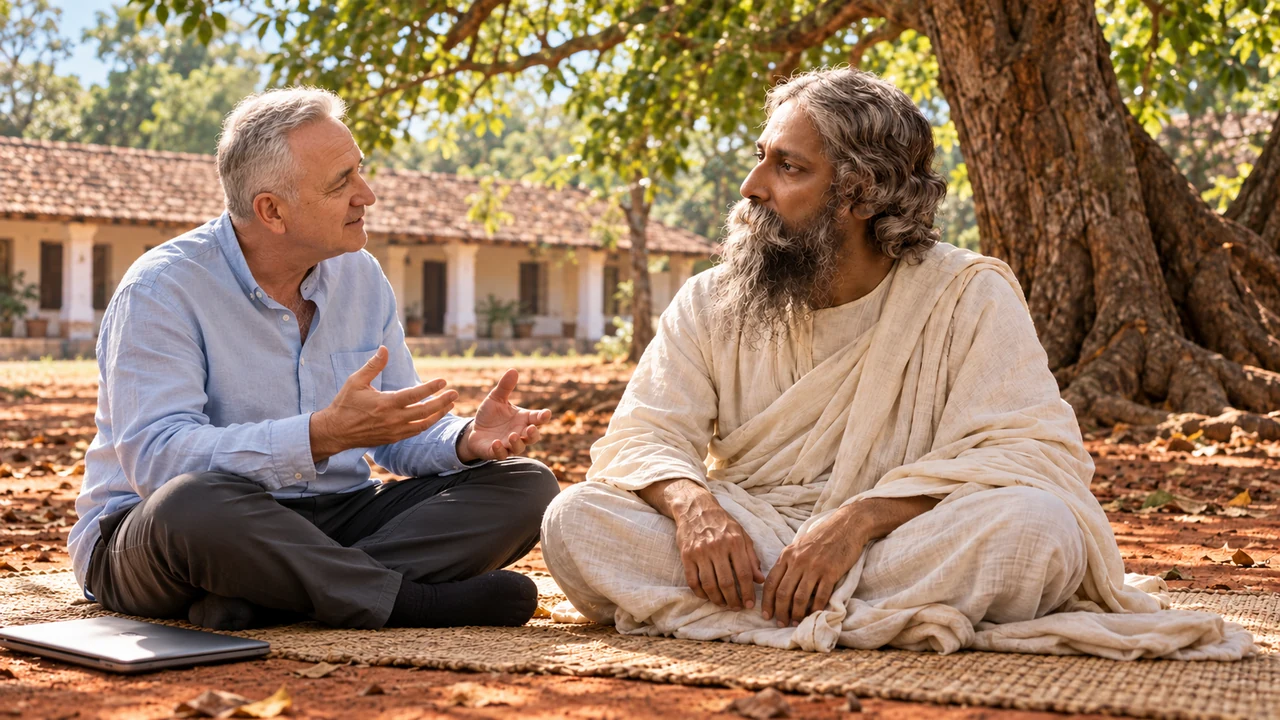
In this image, the contemporary author stands beside his interlocutor (Rabindranath Tagore · Naivedya 72). This encounter is created for a conversation through the poem; the contemporary participant's likeness is grounded in photographs of Oleksandr Bochkala.
The image does not claim a literal historical meeting—it opens a shared space where the poet’s question is addressed to us today and asks for a personal answer.
Historical Context & Keys to the Text
Critical Tagore variorum edition: Prof. Sukanta Chaudhuri (Jadavpur University, Kolkata, Bichitra Online Tagore Variorum & Oxford Tagore Translations), Prof. Sisir Kumar Das (University of Delhi), and Rabindra Bhavana Archives (Visva-Bharati University, Santiniketan).