Rigveda X.135 (Kumāra Yāmāyana) · Manoratha: Chariot of Sorrow and LoveChariot of mind and heart in the boat of the Sāman
What happens to us after death—and how do we live knowing that we and everyone we love will die?
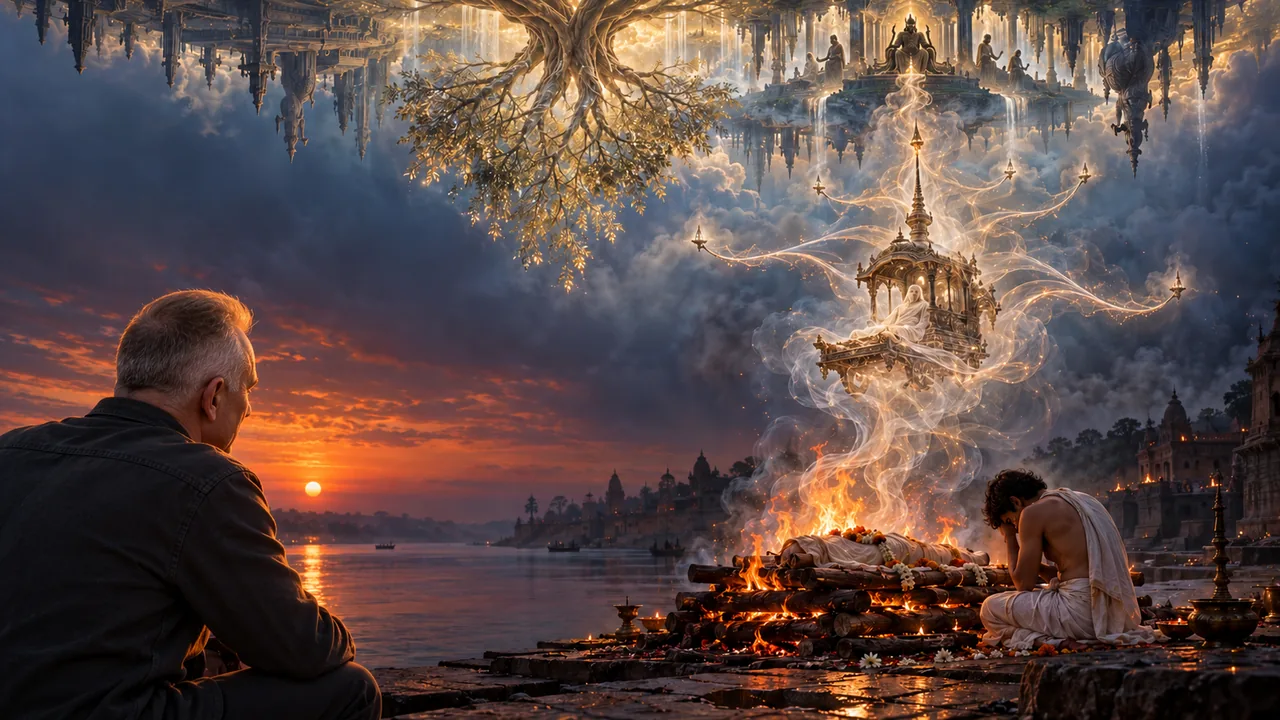
“What happens to us after death — and how do we live knowing that we and everyone we love will die?” That is the question the author seeks to answer in Hymn 10.135 of the Rigveda. Both the ancient text and my song are about this search.
Beside the funeral pyre, a son bids farewell to his father. The first feeling of the one left behind is bitter resentment at his father’s departure (asūyan). Yet in the very next instant it gives way to sharp longing and love (aspṛhayam punaḥ).
The son closes his eyes (apaśyan). By the power of thought he builds a new chariot without wheels or horses (ratham acakram manasākṛṇoḥ), facing all directions at once and forward toward the House of the Gods. Out of this Vedic image Indian culture later formed the Sanskrit concept manoratha — “chariot of the mind,” and later “heart’s desire, dream.”
Manoratha is caught up by the Sāman — a drawn-out Vedic ritual chant. Like a boat (nāvy āhitam), it carries him aloft.
The world of the gods is a mirror — a parallel universe where the World Tree turns its crown downward toward the earth. In the bright home of Yama, the house of the gods beneath the branches of the World Tree, death is transformed into music. Here the breath (prāṇa) that has left the body becomes the eternal melody of a reed flute (dhamyate nāḷīr).
In the project, this hymn unfolds in three distinct forms.
The first is a modern translation of the source into contemporary Russian and English, moving away from archaisms and grounded in academic sources.
The second is an original song in Russian and English in a contemporary sound. It is not a translation of the hymn: I take its core idea and key images as a foundation to live through this encounter in the language of contemporary poetry and music.
The third is an audio reconstruction of the actual sound of the ancient original language.
Manoratha: Chariot of Sorrow and Love (Rigveda X.135 — Yama and the Boy)
Three audio formats for Rigveda 10.135: a contemporary sound reconstruction of the ancient text in Vedic Sanskrit (ORIG · 3:08 · 68 BPM · F Major) and two independent vocal versions of an original song in Russian and English (RU · 4:10 · 66 BPM · A Minor and EN · 4:00 · 66 BPM · A Minor). Rather than translating the hymn, the song interprets its core idea and images in the language of contemporary poetry and music: the son’s passage beside the funeral pyre from bitter resentment at his father’s departure to love, building a wheelless chariot in his mind, and rising on the boat of the Sāman chant into the mirrored world of the gods where breath (prāṇa) becomes the eternal melody of a reed flute.
«Beside the funeral pyre, a son builds in his mind a chariot without wheels or horses, and the drawn-out Sāman chant carries it into the mirrored world of the gods—where departed breath becomes the eternal melody of a reed flute.»
Note on the ancient text sound reconstruction (ORIG): this is not an archival recording of native speakers nor a claim to complete historical fidelity, but a contemporary technology-assisted reconstruction grounded in academic transliteration, offering a way to hear how the dead language might have sounded.
Погребальный костёр — дым уносится ввысь,
Боль и слёзы смешались с обидой —
Рядом быть обещал он со мною всю жизнь,
Клятва, данная сыну, забыта.
От любви и тоски закрываю глаза,
Я узна́ю, что было в начале —
Без коней и колёс колесницу создам —
Маноратху любви и печали.
Вознесёт колесницу мою к небесам
Древний Са́ман на лодке напева —
Дом богов среди света увижу я сам,
Мир зеркальный без смерти и гнева.
У начала начал завершится полёт,
Где мгновенья текут как столетья, —
Я услышу, как вечную песню поёт
Тростниковая флейта бессмертья.
From the funeral pyre, dark smoke climbs to the sky;
Pain and tears and resentment are burning as one —
All my life, Father promised to stand by my side —
He's forgotten the vow that he made to his son.
Out of love and deep longing, I close my eyes;
I will learn what awaits at the source up above —
With no horses or wheels, in my mind it will rise —
Manoratha, a chariot of sorrow and love.
Ancient Saman will carry my chariot in flight
On the boat of its chant, on the melody's breath —
I will see for myself where the gods dwell in light,
A bright mirrored world without anger or death.
Now the flight comes to rest at the source of all things,
Where a moment can last while the ages go by —
I will hear how the song of eternity rings
From the reed flute whose voice cannot die.
Yama and the Boy: Manoratha — Chariot of the Mind (Rigveda X.135)
The Vedic hymn of Yama and the Boy (Rigveda 10.135, Kumāra Yāmāyana, stanzas 1–7, c. 1200–900 BCE) answers the question: “What happens to us after death—and how do we live knowing that we and everyone we love will die?” At his father’s funeral pyre, a son moves from resentment at his father’s departure to love, building a wheelless chariot in his mind. Presented here are a modern translation, a Vedic Sanskrit sound reconstruction (ORIG), and an original song (RU & EN).
India at the close of the second millennium BCE. The funeral pyre is lit: the farewell rite is underway for the boy’s deceased father, head of the clan (viśpatiḥ pitā). Smoke and ritual chant carry the father along the irreversible path of the ancestors toward the mirrored world of the gods, where Yama feasts beneath the branches of the World Tree.
The hymn unfolds simultaneously across two spaces. Below, beside the funeral pyre, the bereaved boy experiences a sudden turn from bitter resentment at his father’s departure to sharp longing and love—closes his eyes, and builds with his mind a wheelless chariot, which the Sāman—a drawn-out Vedic ritual chant—takes aboard like a boat and carries aloft.
Beneath that cosmic world tree with fair foliage where Yama drinks together with the gods,
there our father, the head of the clan, seeks out the ancient ancestors.
At him, seeking out the ancient ancestors and walking away on that grim road of death,
I stared with bitter resentment, and then I longed for him again.
Upon Manoratha, that new wheelless chariot, boy, which you built with your mind,
with a single pole, facing forward in every direction, you stand without seeing with your eyes.
That chariot, boy, which you set in motion forward away from the inspired poets —
taking it aboard like a boat, the drawn-out Sāman chant caught it up from here and carried it aloft.
Who gave life to the boy? Who rolled the chariot out into the open?
Who today could tell us this — how the accompanying funeral gift came to be?
Just as the accompanying funeral gift came to be, so right after that the summit was born:
in front the foundation was stretched out, and behind the way out was made.
This here is the home of Yama, which is called the house of the gods;
here his reed flute is blown with breath, here he himself is surrounded by songs of praise.
yásmin vṛkṣé supalāśé deváiḥ sampíbate yámaḥ |
átrā no viśpátiḥ pitā́ purāṇā́m̐ ánu venati || 1 ||
purāṇā́m̐ ánu vénantaṃ cárantam pāpáyāmuyā́ |
asūyánn abhy àcākaśaṃ tásmā aspṛhayam púnaḥ || 2 ||
yáṃ kumāra návaṃ rátham acakráṃ mánasā́kṛṇoḥ |
ékeṣaṃ viśvátaḥ prā́ñcam ápaśyann ádhi tiṣṭhasi || 3 ||
yáṃ kumāra prā́vartayo ráthaṃ víprebhyas pári |
táṃ sā́mā́nu prā́vartata sám itó nāvy ā́hitam || 4 ||
káḥ kumā́ram ajanayad ráthaṃ kó nír avartayat |
káḥ svit tád adyá no brūyād anudeyī́ yáthā́bhavat || 5 ||
yáthā́bhavad anudeyī́ táto ágram ajāyata |
purástād budhná ā́tataḥ paścā́n niráyaṇaṃ kṛtám || 6 ||
idáṃ yamásya sā́danaṃ devamā́naṃ yád ucyáte |
iyám asya dhamyate nāḷī́r ayáṃ gīrbhíḥ páriṣkṛtaḥ || 7 ||
Staying Beside the Question
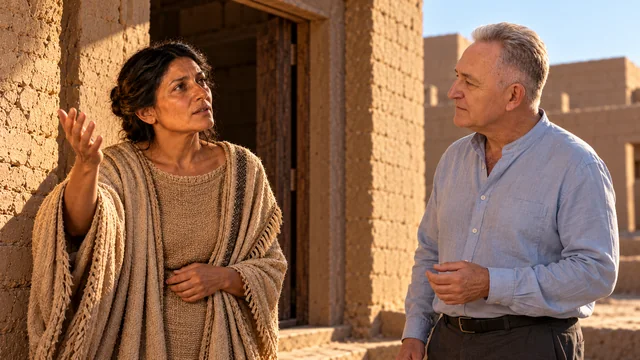
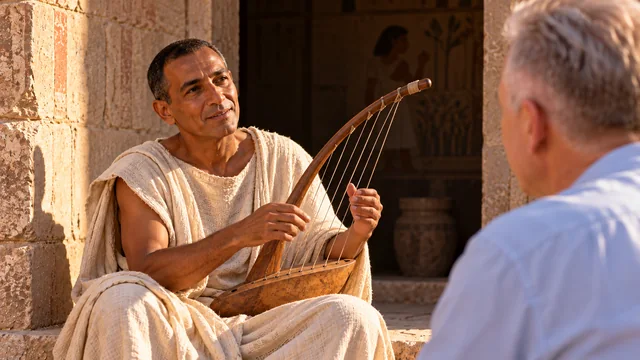
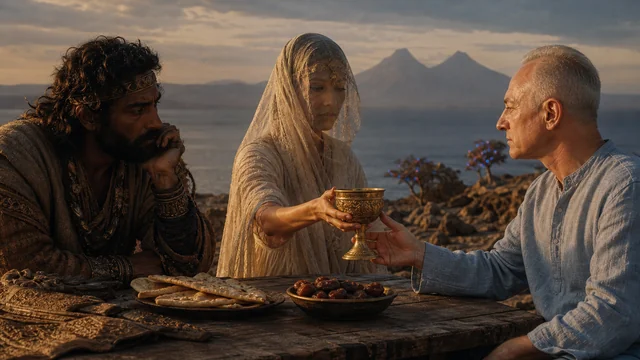
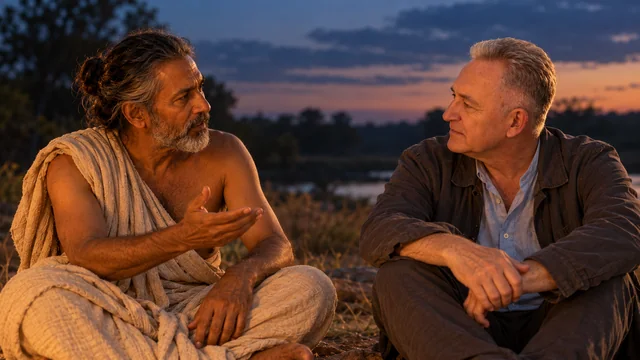
In this image, the contemporary author stands beside his interlocutor (Rigveda X.135 (Kumāra Yāmāyana) · Manoratha: Chariot of Sorrow and Love). This encounter is created for a conversation through the poem; the contemporary participant's likeness is grounded in photographs of Oleksandr Bochkala.
The image does not claim a literal historical meeting—it opens a shared space where the poet’s question is addressed to us today and asks for a personal answer.
Historical Context & Keys to the Text
Bitter resentment at the father's departure and the return of love (asūyann abhy acākaśaṃ ... aspṛhayam punaḥ)
The psychological turn of the hymn: the boy first stares after his deceased father with bitter resentment at his departure (asūyan)—like a child left behind—and in the very next instant reaches out for him again with sharp longing and love (aspṛhayam punaḥ).
The wheelless chariot built with the mind (navaṃ ratham acakram manasākṛṇoḥ) and the later birth of manoratha
Out of this Vedic image of a wheelless chariot built by thought (manas 'mind/heart' + ratha 'chariot'), Indian culture later formed the Sanskrit concept manoratha—'chariot of the mind,' and subsequently 'heart’s desire, dream.'
The Sāman chant as a celestial boat (taṃ sāmānu prāvartata sam ito nāvy āhitam)
The Sāman (sāman) is a drawn-out Vedic ritual chant. In the original grammar, masculine taṃ ('it') refers to the chariot (ratham): the Sāman chant itself acts as the celestial boat (svargyā nāvaḥ) that cradles the boy's mind-chariot aboard and carries it aloft.
Our father, head of the clan (viśpatiḥ pitā) & the World Tree (vṛkṣe supalāśe)
Beneath the branches of the sacred World Tree (the fig tree aśvattha) in the world of the gods Yama feasts, while the boy's recently deceased earthly father (viśpatiḥ pitā) already turns his gaze toward the ancient ancestors.
The mirrored world of the gods & the open way out behind (purastād budhna ātataḥ paścān nirayaṇaṃ kṛtam)
The world of the gods is a mirror of the earthly world—a parallel universe where the World Tree turns its crown downward toward the earth, while behind the boy's living consciousness (paścāt) an open exit back to life (nirayaṇam) is preserved.
The reed flute and breath of life in Yama's bright house (dhamyate nāḷīr ... devamānam)
In the bright home of Yama, the house of the gods (devamānam) beneath the branches of the World Tree, death is transformed from silent decay into music: here the breath (prāṇa) that left the body becomes the eternal melody of a hollow reed flute (nāḷī).
Critical edition and Vedic philology: Prof. Stephanie W. Jamison (UCLA) & Prof. Joel P. Brereton (University of Texas at Austin, Oxford University Press 2014), Prof. Barend A. van Nooten & Prof. Gary B. Holland (UC Berkeley, Harvard Oriental Series 1994), Prof. Theodor Aufrecht (Universität Bonn, 1877), and Prof. T. Ya. Elizarenkova (Institute of Oriental Studies RAS, 1999).