CATHARSIS GROOVE — Solar Vinyl Mandala emblem
CATHARSIS GROOVEWorld Poetry · Translations · Songs · 3D
RU
SCALE OF MEANING × 6 EPOCHS · INVITATIONS TO CONTACT · ORIGINALS & MODERN TRANSLATIONS

Poetry Across Time: Invitations to Contact, Translations & Songs

In the project’s poetic library, works are already selected for all 12 Eternal Questions across all six historical epochs. Here the author’s personal encounters with poets of the past are open: filter by human question, historical epoch layer, or format (with song / with 3D world).

2D FILTER · ETERNAL QUESTIONS × HISTORICAL EPOCHSShowing all 25 works
Scale of Meaning · Eternal Human Questions:
Horizontal Layers · 6 Historical Epochs:
Format:
c. 3000–800 BCE

Epoch I · Voices of the Ancient World

Epoch I (c. 3000–800 BCE) brings together five foundational written works of the Ancient Near East and Vedic India: Enheduanna’s Sumerian temple hymn from Ur, the Egyptian “Harper’s Song” on Papyrus Harris 500, Siduri’s Old Babylonian counsel from the Epic of Gilgamesh, the Vedic cosmogony “Nāsadīya Sūkta” (Rigveda 10.129), and the hymn of Yama and the Boy “Manoratha: Chariot of the Mind” (Rigveda 10.135) in modern translations and songs.

Source geography & cultures in the epoch library: Mesopotamia (Sumer, Akkad, Babylon) · Ancient Egypt (Thebes, Memphis) · Vedic India · Hittite Anatolia · Ugarit & Canaan
5 works
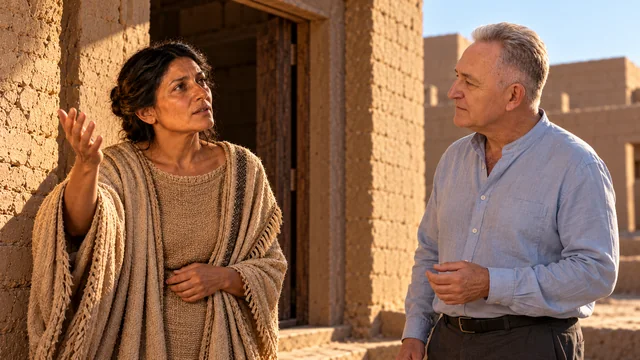
High priestess Enheduanna at a mudbrick temple threshold beside Oleksandr Bochkala (Sumerian cuneiform hymn Nin-me-šara, ETCSL t.4.07.2, 2285 BCE).
Ancient MesopotamiaQuestion 12◈ 3D WebGL
Enheduanna · Exile in 'The Exaltation of Inanna'

A prayer from the place where faith is wounded

Whom do you address when the sacred order you served failed to protect you?

Enheduanna speaks to the goddess from a world where her devotion did not save her from exile. Her place in the temple was stripped away; her plea received no judgment from Nanna. Yet she continues to seek justice from the gods: her tears become an offering to Inanna, and a humiliated voice demands an answer.

Relation to a larger, sacred, trans-individual order
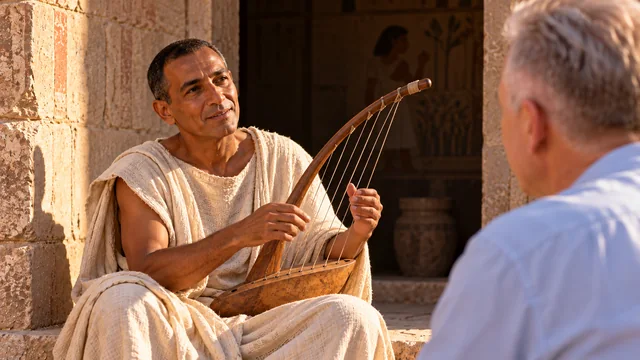
Blind Egyptian harper with arched harp at King Intef’s tomb beside Oleksandr Bochkala (Papyrus Harris 500, EA 10060, 2050 BCE).
Ancient Egypt♫ Song Premiere (ORIG · RU · EN)Question 04◈ 3D WebGL
Song of the Harper · Tradition of King Intef

Rejoicing while knowing you will leave

What makes life worthwhile if everything we possess must be left behind?

The Harper's Song does not promise that death will explain everything. Dwellings have crumbled, generations have vanished; no one has returned to calm the living with an account of what awaits them. And in the very same song sounds an invitation to put on festive linen, anoint oneself with myrrh, and follow the desire of the heart.

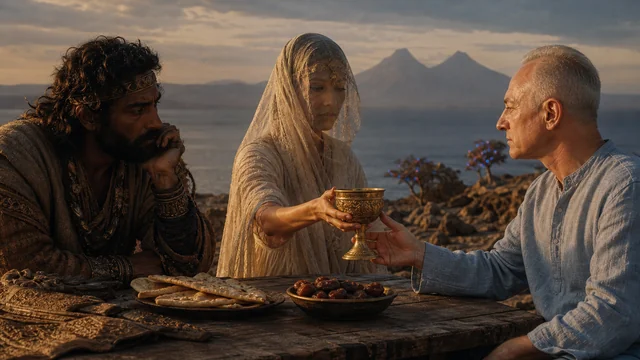
Veiled goddess Siduri offers a golden cup to Oleksandr Bochkala beside King Gilgamesh (Sippar cuneiform tablet VAT 4105, K.3375, 1800 BCE).
Mesopotamia♫ Song Premiere (ORIG · RU · EN)Question 04◈ 3D WebGL
The Goddess Siduri (ᵈSiduri) · Epic of Gilgamesh

A life you cannot keep forever

Can a mortal life be enough for someone who refuses to die?

Searching for immortality, Gilgamesh passes through the darkness of Mount Mashu and the Garden of the Gods, with its trees of carnelian and lapis lazuli, and comes to the shore where the Waters of Death begin. Here he meets not a roadside tavern-keeper—as nineteenth- and twentieth-century translations often portrayed her—but Siduri, the veiled goddess of wisdom and the sacred cup, whose name in cuneiform bears the divine determinative DINGIR (ᵈSiduri).

The value and meaning of a worthwhile life
Vedic rishi poet and Oleksandr Bochkala converse beside a sacrificial night fire (cosmogonic hymn Nāsadīya Sūkta, Rigveda 10.129, 1200–900 BCE).
Vedic IndiaQuestion 01
Rigveda X.129, Nasadiya Sukta

At the beginning of the world, a question remains

Whence did the world arise if its beginning may have had no witness?

The Nasadiya Sukta carries thought back to a point where day and night, death and immortality, even being and non-being cannot yet be told apart. We try to picture a beginning through everything we know of the world, and one by one the hymn strips those familiar distinctions away. Even the gods came later. Who then could tell how all this came to be?

World, order, origin, and causality
Oleksandr Bochkala on stone river ghats watches a bereaved boy and the wheelless chariot Manoratha (Rigveda 10.135, 1200–900 BCE).
Vedic India♫ Song Premiere (ORIG · RU · EN)Question 11
Rigveda X.135 (Kumāra Yāmāyana) · Manoratha: Chariot of Sorrow and Love

Chariot of mind and heart in the boat of the Sāman

What happens to us after death—and how do we live knowing that we and everyone we love will die?

“What happens to us after death — and how do we live knowing that we and everyone we love will die?” That is the question the author seeks to answer in Hymn 10.135 of the Rigveda. Both the ancient text and my song are about this search.

Mortality, finitude, and what lies beyond the threshold
800 BCE – 300 CE

Epoch II · Birth of the Personal Voice

Epoch II (800 BCE – 300 CE) traces the emergence of the personal “I” across four classical civilizations: Sappho’s Papyrus Fragment 16 from Lesbos, Chapter 8 of Laozi’s Tao Te Ching on the nature of water, Qoheleth’s poem of the twenty-eight seasons (Ecclesiastes 3:1–15), and Catullus’s Latin distich Carmen 85 (“Ōdī et amō”).

Source geography & cultures in the epoch library: Hellas & Aegean Islands · Rome · Ancient Israel (Jerusalem) · Zhou & Han China · India of the Upanishads & Early Buddhism · Ancient Iran
4 works
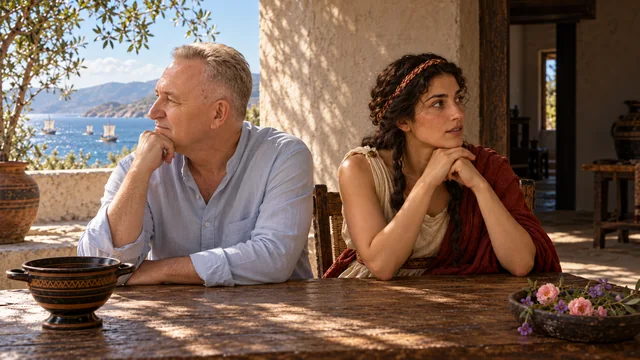
Sappho on Lesbos turns from harbor warships toward Anaktoria’s doorway beside Oleksandr Bochkala (Oxyrhynchus Papyrus P.Oxy. 1231, Fragment 16).
Archaic GreeceQuestion 04
Sappho · Fragment 16

Love changes the measure of beauty

What defines the worth of the world for me: its grandeur or my love?

Sappho places horsemen, infantry, and warships beside the walk of absent Anactoria. What everyone can admire together yields to the one a single person loves. Yet love in this poem is not harmless: before remembering Anactoria, Sappho speaks of Helen, who left behind her husband, her child, and her parents.

The value and meaning of a worthwhile life
A sage of Laozi’s tradition beside a mountain stream invites Oleksandr Bochkala toward the water (Tao Te Ching 8, Mawangdui silk).
Ancient ChinaQuestion 04
Laozi Tradition · Dao De Jing, Chapter 8

The highest good flows downward

How can one live worthily without turning life into a contest for supremacy?

Water in the Dao De Jing settles in the places people avoid and brings benefit to all living things. The highest good turns out to be bound to the lowest position. To be indispensable, it does not need to triumph over anyone.

The value and meaning of a worthwhile life
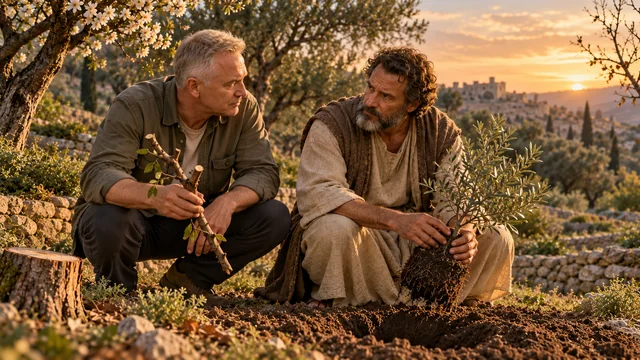
Qoheleth holding a sapling and Oleksandr Bochkala holding pruned branches in Jerusalem (Ecclesiastes 3:1–15, Leningrad Codex B19A, scroll 4QQohᵃ).
Ancient JudeaQuestion 10◈ 3D WebGL
Qohelet · Ecclesiastes 3:1–15

There is a time to embrace. And a time to let go.

How do we live in time when the meaning of the whole remains beyond our grasp?

Ecclesiastes gives a place in life to opposite actions: keeping and casting away, silence and speech, loving and hating. What was right at one moment receives no promise of remaining right forever. And a human being is not given to fathom God's work from beginning to end.

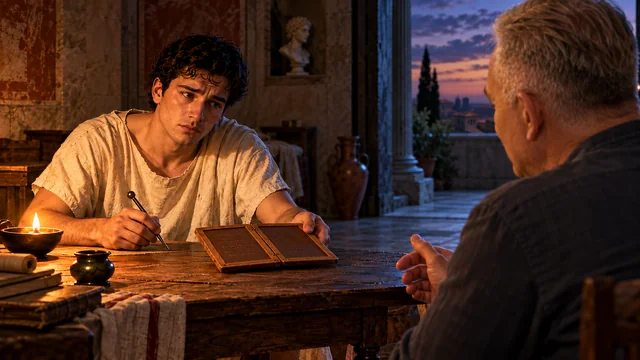
Roman poet Catullus turns a wax tablet inscribed with Latin Carmen 85 (Odi et amo, 55 BCE) toward Oleksandr Bochkala.
Ancient RomeQuestion 03◈ 3D WebGL
Catullus, Carmen 85

I do not know why. Yet it is happening to me.

Who am I when opposite feelings within me are equally real?

Catullus loves and hates at the same time. When asked why, he answers with non-knowing, and then testifies to what he feels: it is happening, and it tears him apart. A human being cannot explain himself and yet knows his own pain.

300–1100 CE

Epoch III · Inner World & Tradition

Epoch III (300–1100 CE) connects four classical Asian and Near Eastern traditions: Su Shi’s philosophical dialogue on river and moon in the “First Ode on the Red Cliff” (1082 CE), Kalidasa’s Sanskrit lyric “The Cloud Messenger,” Ono no Komachi’s Heian waka (Kokin Wakashū 113), and Ferdowsi’s thirty-year concluding coda to the Persian Shahnameh.

Source geography & cultures in the epoch library: Tang & Song China · Nara & Heian Japan · Classical India · Persia & the Arab East · Andalusia · Latin Europe, Celtic Ireland, Britain & Scandinavia
4 works
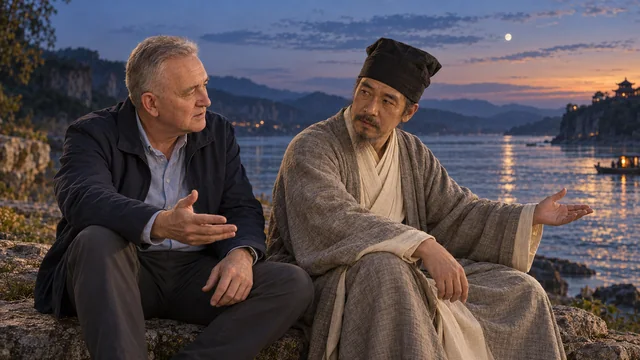
Northern Song poet Su Shi and Oleksandr Bochkala converse beside the moonlit Yangtze (“First Ode on the Red Cliff,” Huangzhou, 1082).
Song Dynasty ChinaQuestion 02
Su Shi, First Ode on the Red Cliff

The water has flowed past. The river is still before us.

Which world is real: the one where everything passes, or the one where everything continues?

Su Shi's guest looks at the river and feels the brevity of human life before its endless current. Su Shi answers with the very same river and the very same moon: the water passes away yet is never gone; the moon wanes only to grow full again. Seen from the side of change, nothing stands still for an instant. Seen from the side of permanence, we too participate in the continuity of the world.

Reality, truth, and knowability
Exiled yaksha on Mount Ramagiri lifts kutaja blossoms toward a monsoon cloud beside Oleksandr Bochkala (Kalidasa, Sanskrit Meghadūta, 4th–5th c.).
Classical IndiaQuestion 07
Kalidasa · 'The Cloud Messenger' (Meghaduta), Opening

Addressing the one who cannot hear you

What preserves closeness when the other person is out of reach?

At the opening of 'The Cloud Messenger,' an exiled yaksha begs a monsoon cloud to carry news to his beloved. We notice what the lover himself overlooks: how can smoke, fire, water, and wind serve as a messenger? Yet for one who longs, the entire world is already drawn into his address to her.

Attachment, intimacy, trust, and mutual recognition
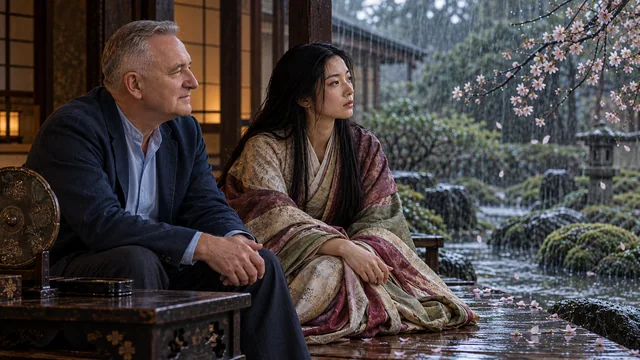
Heian poet Ono no Komachi and Oleksandr Bochkala on a wooden veranda watching rain-faded sakura (Kokin Wakashū #113, c. 905 CE).
Heian JapanQuestion 10
Ono no Komachi · 'The Color of the Flowers...'

In the blossoms, my own youth is fading

What does time do to us while we think we are merely watching it?

In Ono no Komachi's poem the cherry blossoms fade, and in their washed-out color she recognizes her own fading. Long rains, quiet gazing, and passing days converge inside a few short lines. Between what she looks at and what has happened to her, no calm boundary can be drawn anymore.

Time, change, and irreversibility
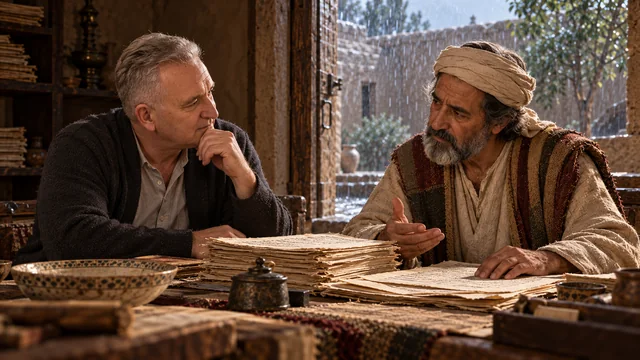
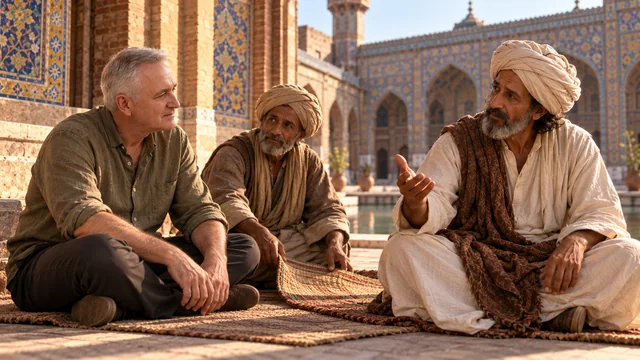
Persian poet Abu’l-Qasim Ferdowsi and Oleksandr Bochkala at a table with completed Shahnameh manuscript folios in Tus (c. 1010 CE).
Persian TraditionQuestion 09
Ferdowsi · 'Shahnameh', Concluding Coda

A mortal human being builds out of words

Why give one's finite life to creating something meant to live without you?

Ferdowsi speaks of thirty years of toil, and then of a lofty palace of verse that neither wind nor rain can harm. Beside the building appears another image: the word has been sown as seed, and life continues through it. A human being pours a finite span of years into what can outlast his own mortality.

Action, making, and lasting contribution
1100–1600 CE

Epoch IV · At the Threshold of a New Age

Epoch IV (1100–1600 CE) explores human consciousness at the threshold of modernity: Francesco Petrarch’s Sonnet 134 (“Pace non trovo”) from his Vatican autograph, Jalal al-Din Rumi’s Masnavi prologue on the singing reed flute, Nahua Song XXIV (“Flowers and Songs”) from Tenochtitlan, and Wang Mian’s Yuan Dynasty quatrain “Ink Plum.”

Source geography & cultures in the epoch library: Italy, France, England, Spain & Portugal · Bhakti India (Kabir, Nanak, Mirabai) · Sufi East (Rumi, Hafez, Fuzuli) · Mesoamerica (Tenochtitlan) · China & Korea
4 works
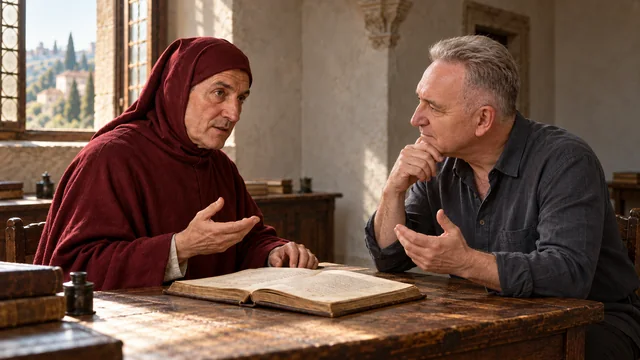
Francesco Petrarch and Oleksandr Bochkala converse over the open parchment Canzoniere autograph codex (Vatican MS Vat. lat. 3195, Sonnet 134).
Italian RenaissanceQuestion 03
Petrarch · Sonnet 134, Pace non trovo

Living inside what cannot be reconciled

Can I remain myself when no single description can contain me?

Petrarch knows neither peace nor war; he fears and hopes, burns and is ice. Opposites multiply as though every confession were incomplete without another that contradicts it. Love holds him between release and captivity, between life and death.

Human being, selfhood, and continuity of self
Jalal al-Din Rumi holding a reed flute ney in Konya beside listening Oleksandr Bochkala (Masnavi Book I prologue, 1278 manuscript).
Persian PoetryQuestion 12
Rumi · Opening of the 'Masnavi', Song of the Reed

A voice that remembers separation from the whole

How can one be a separate self and still feel belonging to what one was torn from?

Rumi's reed flute sings because it has become an instrument, and laments because it was torn from its reed bed. Its voice carries separation from its source. To hear that speech requires a heart that knows rupture of its own.

Relation to a larger, sacred, trans-individual order
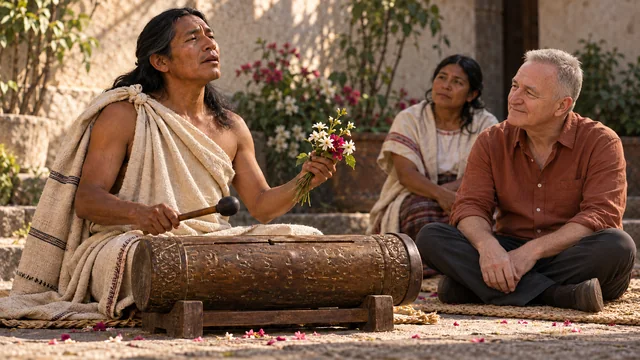
Nahua singer beside a carved teponaztli drum in the Cuicacalli with Oleksandr Bochkala (Nahuatl manuscript Cantares Mexicanos, fols. 28v–29r, Song XXIV).
MesoamericaQuestion 09◈ 3D WebGL
Nahua Song Tradition · Cantares Mexicanos, Song XXIV

I will depart. To whom will the song remain?

What can a mortal voice leave behind in a world where even flowers wither?

To the two-toned beat of the wooden teponaztli slit-drum and the thunder of the deerskin huehuetl, the dance circle turns in the courtyard of the Cuicacalli amid falling poyoma blossoms. Deep within the singer’s heart the flower of song blooms open, yet at the height of the feast comes a sudden turn: he will wrap himself in song like a parting shroud as he departs.

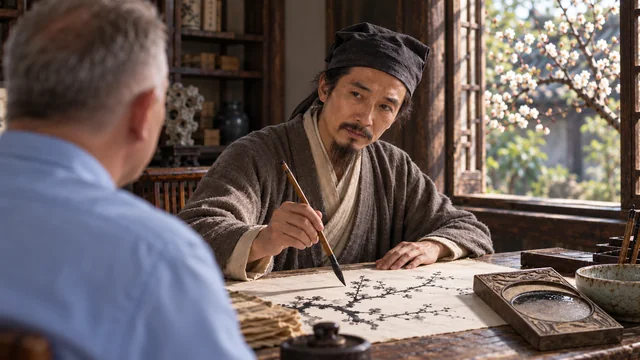
Yuan painter-poet Wang Mian pauses with his ink brush over the monochrome scroll “Mo Mei” beside Oleksandr Bochkala (14th century).
Yuan Dynasty ChinaQuestion 09
Wang Mian, '墨梅' / 'Ink Plum'

What remains of a blossom painted in pale ink?

What do we create for when other people's praise is no longer the measure of our work?

In Wang Mian's poem the plum tree blossoms in pale traces of ink beside the pond where inkstones are washed. It asks for no praise for bright colors; it wishes only to leave qingqi—clear, pure spirit—filling heaven and earth. A modest ink painting addresses something far larger than its outward visibility.

Action, making, and lasting contribution
1600–1850 CE

Epoch V · Reason, Feeling, and Revolt

Epoch V (1600–1850 CE) confronts Enlightenment reason with moral revolt and creative dread across four voices: William Blake’s illuminated poem “The Tyger” (1794), Sor Juana Inés de la Cruz’s philosophical redondillas (1689), Nalan Xingde’s ci lyric at a ruined frontier pass, and Bulleh Shah’s Punjabi Sufi kafi.

Source geography & cultures in the epoch library: England (Metaphysicals & Romanticism) · Spanish & Mexican Baroque · German Classicism & Romanticism · Italy & Poland · Russia · Punjab & Qing China · North America
4 works
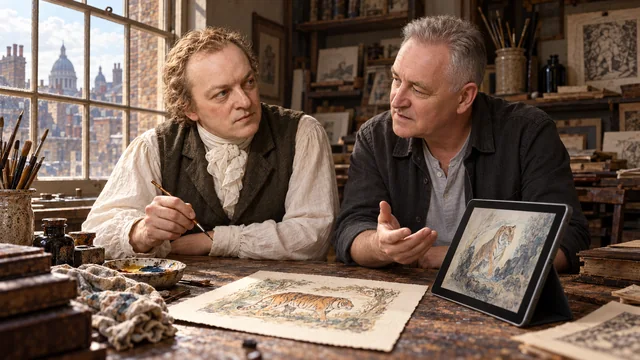
William Blake and Oleksandr Bochkala at a London engraving bench compare illuminated plate 42 of “The Tyger” (1794) and tablet.
EnglandQuestion 01
William Blake, The Tyger

Standing in awe of what you fear

What kind of world is this, in which beauty and terror may share a single creator?

Blake looks at the tiger and cannot separate its beauty from terror. Images of fire and the forge compel us to picture the labor of shaping a creature whose heart is about to beat. Did the same creator make the gentle Lamb? Could he smile upon seeing the tiger?

World, order, origin, and causality
Sor Juana Inés de la Cruz poses a question to Oleksandr Bochkala in her Mexico City library (Inundación castálida, 1689).
New Spain (Mexico)Question 08
Sor Juana Inés de la Cruz · Hombres necios que acusáis

Who created the fault he now sits in judgment on?

Is just judgment possible when the judge excludes his own part from the verdict?

Sor Juana turns the accusation back upon those accustomed to accusing. Men press a woman to yield and then condemn as vice the very thing they urged her toward. Their own desire vanishes from the verdict, as though it had played no part in what happened.

Justice, obligation, reciprocity, and belonging
Qing lyric poet Nalan Xingde and Oleksandr Bochkala gaze from stone gates toward a ruined frontier garrison (Yinshui ci, 1678).
Qing Dynasty ChinaQuestion 11
Nalan Xingde · 'Nangezi', Ruins of the Frontier Pass

The heroes are gone. The earth is not empty.

What remains of human life when even the world of its deeds has vanished?

In Nalan Xingde's poem life continues beside the site of human ruin: hungry crows gather, wild pheasants fly across the deserted city. The commanders' tents stand empty, the war-horns have fallen silent, and blood and ash remain in the landscape. The word 'heroes' stands next to what failed to save them from vanishing.

Mortality, death, and what remains
Punjabi Sufi poet Bulleh Shah converses with Oleksandr Bochkala in a Kasur courtyard beside a woven mat (18th-century kafi).
Punjabi Sufi TraditionQuestion 12
Bulleh Shah · 'What Kind of Lineage Does Love Have?'

Seeking the Beloved until separateness gives way

Where do you look for what you belong to when it is already closer than your own 'I'?

In Bulleh Shah's kafi, public scolding of Ranjha stands beside a secret prayer for him in the heart. Then the lover names himself and Ranjha a single being. Speech is still addressed to another, yet the familiar boundary between them no longer holds.

Relation to a larger, sacred, trans-individual order

1850–1930 CE

Epoch VI · The Fracture of Modernity

Epoch VI (1850–1930 CE) examines consciousness, vulnerability, and human dignity in modernity through four witnesses: Emily Dickinson’s manuscript poem “The Brain—is wider than the Sky—” (1862), Rabindranath Tagore’s Bengali and English prayer (“Naivedya 72 / Gitanjali 35”), Delmira Agustini’s sonnet “El intruso,” and Paul Laurence Dunbar’s “We Wear the Mask.”

Source geography & cultures in the epoch library: North America (Amherst, New York) · Symbolist & Modernist France · Germany & Austria · Britain & Ireland · Russian Silver Age · India (Bengal) · Latin America
4 works
Emily Dickinson at her Amherst bedroom window beside Manuscript Fascicle 26 (Fr598 / J632, 1862) and Oleksandr Bochkala’s hand.
New England (USA)Question 02
Emily Dickinson · The brain is wider than the sky

The sky that contains me fits inside me

How do we know the world when everything known of it passes through our consciousness?

Dickinson proposes placing the brain and the sky side by side: the first will contain the second with ease—and you beside. Then the brain absorbs the sea. What is bodily and finite turns out to be capable of representing what is immeasurably larger than itself.

Reality, truth, and knowability
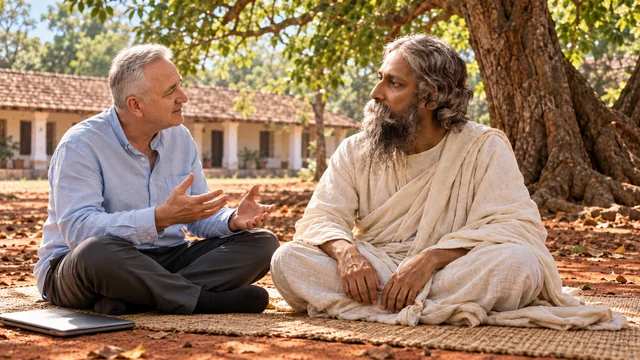
Oleksandr Bochkala converses with Rabindranath Tagore beneath a tree in Santiniketan (Bengali Naivedya 72 and English Gitanjali 35, 1901–1912).
BengalQuestion 05
Rabindranath Tagore · Naivedya 72

A freedom to which we still have to awaken

What makes freedom real within a human being and within shared life?

Tagore prays for an awakening for India—where thought does not live in fear, knowledge is free, and courtyard walls do not shatter the world into fragments. That freedom is threatened by inner barriers as well: dead habit and petty custom can swallow the clear stream of reason and deprive a person of the courage to think and act.

Agency, choice, constraint, and responsibility
The speaker of Delmira Agustini’s sonnet “El intruso” unlocks a door into a sunlit Montevideo room (El libro blanco, 1907).
Latin America (Uruguay)Question 07
Delmira Agustini · El intruso

A light you begin to depend on

How do you become close to another person and endure how vulnerable that closeness makes you?

In Agustini's sonnet the shadow of the entering beloved illuminates the tragic night. Afterwards the speaker laughs when he laughs, sings after him, and sleeps at his feet. Intimacy enters her movements, her sleep, even her own shadow, which carries his scent of spring.

Attachment, intimacy, trust, and mutual recognition
American poet Paul Laurence Dunbar greets Oleksandr Bochkala at the doorway over the shoulder (rondeau “We Wear the Mask,” 1896).
United StatesQuestion 03
Paul Laurence Dunbar, We Wear the Mask

Hiding the face in order to preserve the person

How do you preserve yourself when showing yourself openly to the world is dangerous?

In Dunbar's poem a collective 'we' smiles with torn and bleeding hearts and sings while pain sounds in an appeal to Christ. In African American history, behind that mask stands a world of racism: showing that world everything you endure does not mean being heard or protected.

Human being, selfhood, and continuity of self
◈ SPATIAL HERMENEUTICS · 5 LIVE 3D WORLDS

Step Inside the Ancient Cities & Sanctuaries of the Poets

Open Interactive Hub →
Catharsis Groove Audio Player Disc
Audio
Catharsis Groove · Audio Player
0:004:00