
Sor Juana Inés de la Cruz · Hombres necios que acusáisWho created the fault he now sits in judgment on?
Is just judgment possible when the judge excludes his own part from the verdict?
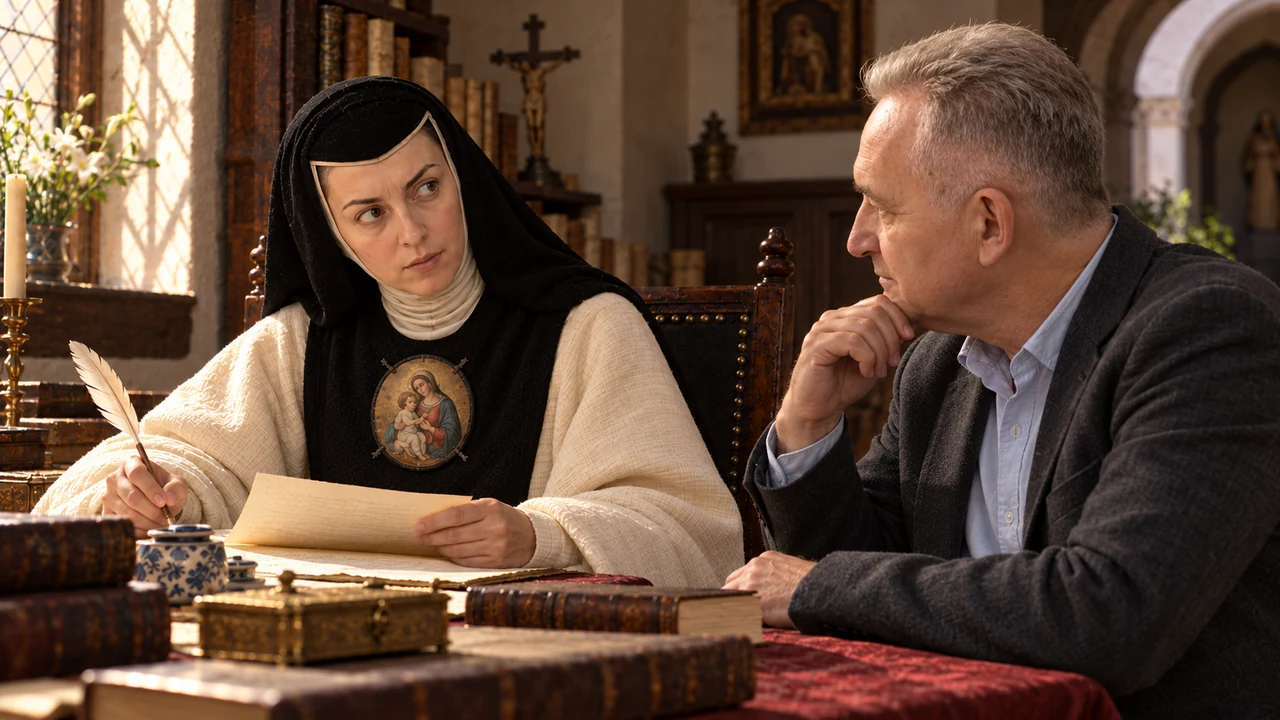
Sor Juana turns the accusation back upon those accustomed to accusing. Men press a woman to yield and then condemn as vice the very thing they urged her toward. Their own desire vanishes from the verdict, as though it had played no part in what happened.
The poem restores that participation to its place. The demand for virtue collides with the conduct of the one making the demand. Reading Sor Juana, I too stand before an uncomfortable possibility: judging another person's choice is easier than admitting what conditions I helped create for it myself. Justice requires including that part in the account.
Hombres necios que acusáis (Redondillas, excerpt)
The philosophical redondillas “Hombres necios que acusáis” by Mexican hieronymite scholar-poet Sor Juana Inés de la Cruz (published in Inundación castálida, Madrid, 1689) dismantle the causal logic of a double standard: the judge actively engineers the very fault (ocasión) he subsequently condemns. Baroque rhetorical symmetry turns the mirror of moral responsibility back upon the accuser.
Foolish men who unjustly accuse
Women without rhyme or reason,
Failing to see that ye yourselves are the cause
Of the very fault that ye blame:
If with unexampled eagerness
Ye solicit their disdain,
Why do ye wish them to act well
When ye incite them to evil?
Ye batter down their resistance,
And then, with pompous gravity,
Ye declare it was lightness of mind
Which your own striving accomplished!
Who has committed the greater guilt
In an erring, sinful passion:
She who falls when besought,
Or he who beseeches for her fall?
Hombres necios que acusáis
a la mujer sin razón,
sin ver que sois la ocasión
de lo mismo que culpáis:
si con ansia sin igual
solicitáis su desdén,
¿por qué queréis que obren bien
si las incitáis al mal?
Combatís su resistencia
y luego, con gravedad,
decís que fue liviandad
lo que hizo la diligencia.
¿Cuál mayor culpa ha tenido
en una pasión errada:
la que cae de rogada,
o el que ruega de caído?
Staying Beside the Question
In this image, the contemporary author stands beside his interlocutor (Sor Juana Inés de la Cruz · Hombres necios que acusáis). This encounter is created for a conversation through the poem; the contemporary participant's likeness is grounded in photographs of Oleksandr Bochkala.
The image does not claim a literal historical meeting—it opens a shared space where the poet’s question is addressed to us today and asks for a personal answer.
Historical Context & Keys to the Text
Critical edition of Sor Juana’s complete works: Prof. Alfonso Méndez Plancarte (Universidad Nacional Autónoma de México — UNAM, Fondo de Cultura Económica), Prof. Electa Arenal (CUNY Graduate Center), Prof. Amanda Powell (University of Oregon), and Prof. Edith Grossman (Yale University Press).