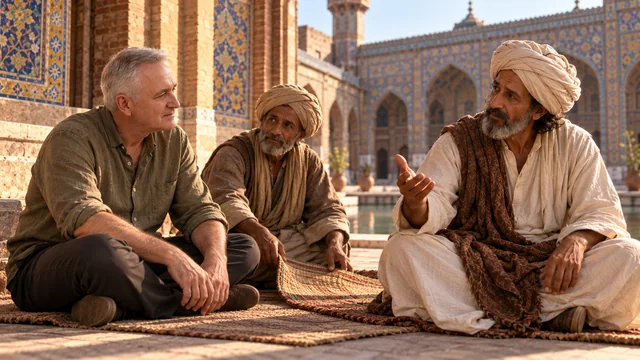
Nalan Xingde · 'Nangezi', Ruins of the Frontier PassThe heroes are gone. The earth is not empty.
What remains of human life when even the world of its deeds has vanished?
In Nalan Xingde's poem life continues beside the site of human ruin: hungry crows gather, wild pheasants fly across the deserted city. The commanders' tents stand empty, the war-horns have fallen silent, and blood and ash remain in the landscape. The word 'heroes' stands next to what failed to save them from vanishing.
Nature lives on, yet its continuation does not bring back the fallen. The poem holds their absence inside a living world. What does it mean to remember a human being when only traces remain, and the causes of ruin still provoke questions? My encounter with the poet begins with refusing to treat ruins as mere picturesque scenery.
Nangezi · At the Old Frontier Garrison (南歌子)
The ci lyric “Nangezi: At the Old Frontier Garrison” (Yinshui ci, 1678 CE) by Qing Dynasty poet Nalan Xingde (1655–1685) addresses the question: what remains after a person when everything they lived and fought for is gone? Beside the ruined fortress, ordinary life goes on: hungry crows gather and wild pheasants take flight. Only empty tents, silent horns, ash, and an open question remain: is ruin fate, or the work of human hands?
Hungry crows gather at the old garrison; wild pheasants cross the abandoned city.
From what forgotten year of calamity does this lingering ash remain?
Behold the crimson blood of fallen heroes scattered across the White Dragon mounds!
The commanders' jade tents stand empty in the divided camp; the golden war-horns have ceased to blow.
Turning back into the east wind, everything that was has turned to nothingness.
Do they not say that the rise and fall of dynasties is only fate—
Or was it wrought by human hands?
古戍饑烏集,荒城野雉飛。
何年劫火剩殘灰。
試看英雄碧血,滿龍堆。
玉帳空分壘,金笳已罷吹。
東風回首盡成非。
不道興亡命也,豈人為?
*Транслитерация (Pinyin):*
Gǔ shù jī wū jí, huāng chéng yě zhì fēi.
Hé nián jié huǒ shèng cán huī.
Shì kàn yīngxióng bì xiě, mǎn lóng duī.
Yù zhàng kōng fēn lěi, jīn jiā yǐ bà chuī.
Dōng fēng huí shǒu jìn chéng fēi.
Bù dào xīng wáng mìng yě, qǐ rén wéi?
Staying Beside the Question
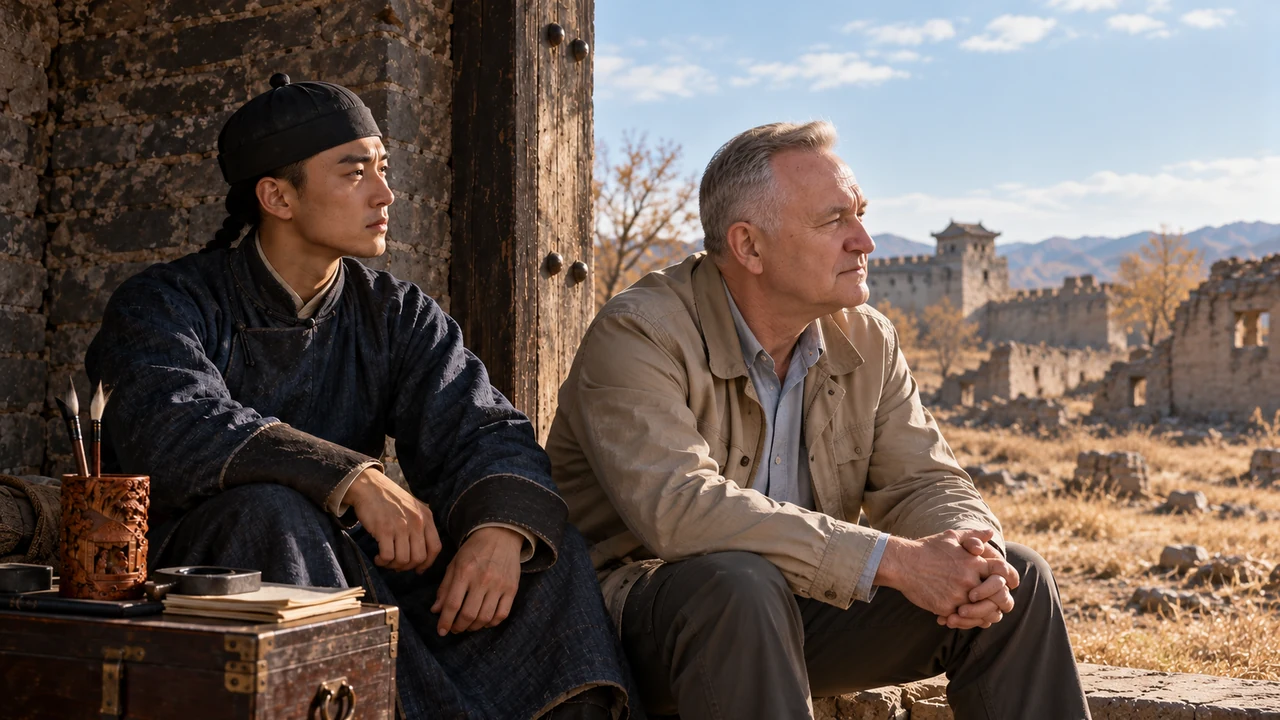
In this image, the contemporary author stands beside his interlocutor (Nalan Xingde · 'Nangezi', Ruins of the Frontier Pass). This encounter is created for a conversation through the poem; the contemporary participant's likeness is grounded in photographs of Oleksandr Bochkala.
The image does not claim a literal historical meeting—it opens a shared space where the poet’s question is addressed to us today and asks for a personal answer.
Historical Context & Keys to the Text
Qing Dynasty ci lyric scholarship and Yinshui ci textual studies: Prof. Kang-i Sun Chang (Yale University), Prof. Chia-ying Yeh (University of British Columbia / Nankai University), and the Siku Quanshu critical corpus.