William Blake, The TygerStanding in awe of what you fear
What kind of world is this, in which beauty and terror may share a single creator?
Blake looks at the tiger and cannot separate its beauty from terror. Images of fire and the forge compel us to picture the labor of shaping a creature whose heart is about to beat. Did the same creator make the gentle Lamb? Could he smile upon seeing the tiger?
The poem does not reconcile these creations by explaining a higher design. At the end, the capacity to frame turns into the daring to frame—could becomes dare. I enter this conversation with admiration for form and unease over what it carries. In my own workshop the question returns in another register: the ability to bring an image into being still leaves me with the decision whether I want to give it life, and what statement I am willing to answer for.
The Tyger
William Blake’s “The Tyger” from his illuminated book Songs of Experience (London, 1794, plate 42) confronts the reader with an ontological shock: did the same Creator who made the gentle Lamb forge the predator’s fearful symmetry in a midnight furnace? In the final stanza Blake alters a single verb—could to dare—turning cosmology into a question of creative daring.
Tiger, tiger, burning bright
In the forests of the night,
What immortal hand or eye
Could frame thy fearful symmetry?
In what distant deeps or skies
Burnt the fire of thine eyes?
On what wings dare he aspire?
What the hand dare seize the fire?
And what shoulder and what art
Could twist the sinews of thy heart?
And, when thy heart began to beat,
What dread hand and what dread feet?
What the hammer? what the chain?
In what furnace was thy brain?
What the anvil? what dread grasp
Dare its deadly terrors clasp?
When the stars threw down their spears,
And watered heaven with their tears,
Did He smile His work to see?
Did He who made the lamb make thee?
Tiger, tiger, burning bright
In the forests of the night,
What immortal hand or eye
Dare frame thy fearful symmetry?
Staying Beside the Question
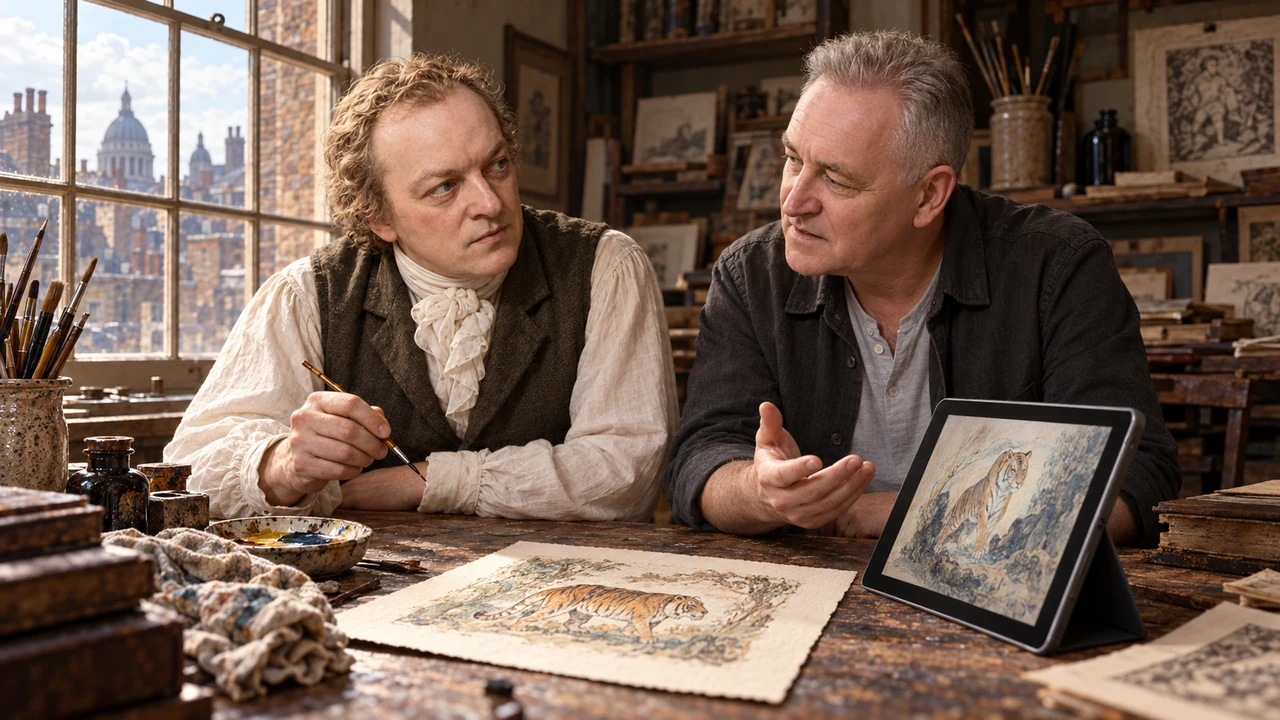
In this image, the contemporary author stands beside his interlocutor (William Blake, The Tyger). This encounter is created for a conversation through the poem; the contemporary participant's likeness is grounded in photographs of Oleksandr Bochkala.
The image does not claim a literal historical meeting—it opens a shared space where the poet’s question is addressed to us today and asks for a personal answer.
Historical Context & Keys to the Text
Textual scholarship and illuminated plate archive: Prof. David V. Erdman (Stony Brook University, Complete Poetry and Prose), Prof. Morris Eaves (University of Rochester), Prof. Robert N. Essick (UC Riverside), and Prof. Joseph Viscomi (UNC Chapel Hill, The William Blake Archive).