Laozi Tradition · Dao De Jing, Chapter 8The highest good flows downward
How can one live worthily without turning life into a contest for supremacy?
Water in the Dao De Jing settles in the places people avoid and brings benefit to all living things. The highest good turns out to be bound to the lowest position. To be indispensable, it does not need to triumph over anyone.
I hear a demanding answer here to the question of a worthy life. We can measure ourselves by height achieved, recognition, victories. The eighth chapter asks us to look instead at how a person lives among others: whether there is sincerity in relationship, truth in words, skill in action, and a sense for the right time. Refusing rivalry leaves a person with all of that real work.
Dao De Jing · Chapter 8 (Shang Shan Ruo Shui)
Chapter 8 of the Tao Te Ching (Laozi, 5th–4th century BCE, Mawangdui silk manuscripts and Wang Bi’s recension) defines highest good through the physics of water: it benefits all things without contending and settles in low places people disdain. The modern translation restores concrete bodily and social terms across all seven lines.
Warring States China, 4th–3rd centuries BCE. A world of relentless struggle for primacy, where rulers, generals, and ministers climb over one another for rank, territory, and a loud name.
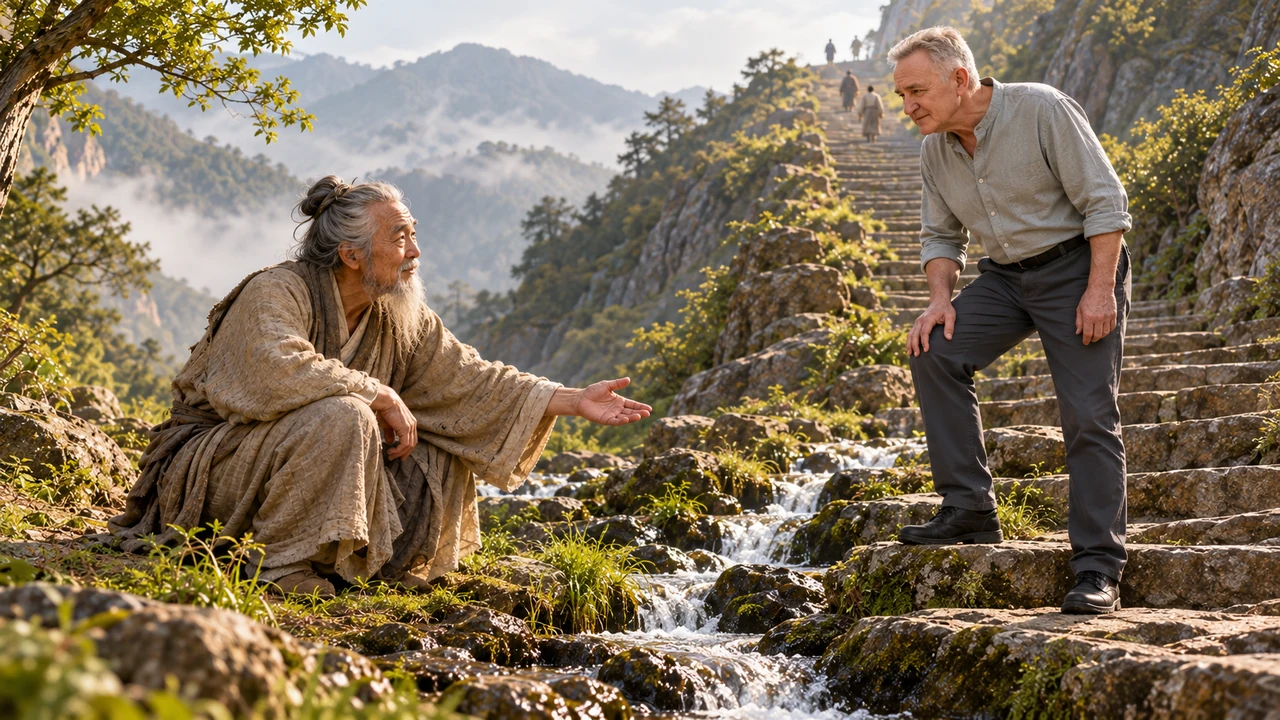
An unnamed sage of the Laozi tradition turns his gaze away from royal courts toward a mountain stream. Water descends from rocky peaks into a shaded hollow—the very place no ambitious climber wants to stand. It argues with no one for height, yet without it every living thing withers. Out of that observation comes the formula of the seven goods of a person who chooses depth over the scramble for the top.
The highest good is like water.
Water benefits all ten thousand living things without competing for primacy,
and settles in the low places that people shun,
so it comes closest to the Way.
The good in choosing a place is staying close to the ground,
the good in the heart is silent, fathomless depth,
the good in relations with others is living kindness,
the good in words is solid reliability,
the good in governing is harmonious order,
the good in work is true skill,
the good in action is the right moment.
Only where there is no struggle for primacy
is there neither fault nor blame.
上善若水。 (Shàng shàn ruò shuǐ.)
水善利萬物而不爭, (Shuǐ shàn lì wànwù ér bù zhēng,)
處眾人之所惡, (chǔ zhòngrén zhī suǒ wù,)
故幾於道。 (gù jī yú dào.)
居善地, (Jū shàn dì,)
心善淵, (xīn shàn yuān,)
與善仁, (yǔ shàn rén,)
言善信, (yán shàn xìn,)
正善治, (zhèng shàn zhì,)
事善能, (shì shàn néng,)
動善時。 (dòng shàn shí.)
夫唯不爭, (Fú wéi bù zhēng,)
故無尤。 (gù wú yóu.)
Staying Beside the Question
In this image, the contemporary author stands beside his interlocutor (Laozi Tradition · Dao De Jing, Chapter 8). This encounter is created for a conversation through the poem; the contemporary participant's likeness is grounded in photographs of Oleksandr Bochkala.
The image does not claim a literal historical meeting—it opens a shared space where the poet’s question is addressed to us today and asks for a personal answer.
Historical Context & Keys to the Text
The highest good is like water (shàng shàn ruò shuǐ)
Classical Chinese shàn (善) is not an abstract moral rule, but the highest good and organic fitness of being. Water is the softest thing in the world, possessing no rigid shape of its own, yet it nourishes all ten thousand living things and wears through the hardest stone.
The low places that people shun (zhòngrén zhī suǒ wù)
By gravity, water seeks the lowest ground—ravines, hollows, river valleys. Ordinary people (zhòngrén), obsessed with status and climbing upward, shun the low place as humiliating. Yet it is in the hollow that water gathers its full depth and sustains life.
Silent, fathomless depth in the heart (xīn shàn yuān)
In Chinese thought, xīn (心) is the undivided center of heart and mind. Its model is yuān (淵)—a deep river pool. A shallow brook chatters loudly over stones, while deep water at the bottom of a pool remains utterly still and clear.
The Seven Goods (qī shàn) & the restored line on words (yán shàn xìn)
Across lines 5–11, the word shàn ('the good') repeats seven times, binding every dimension of human life: staying close to the ground (dì), depth of heart (yuān), living kindness toward others (rén), solid reliability in words (xìn), harmonious order in governing (zhì), true skill in work (néng), and the right moment in action (shí).
No struggle for primacy, neither fault nor blame (bù zhēng / wú yóu)
The character zhēng (爭) depicts two hands pulling a prize in opposite directions. Refusing the struggle for primacy (bù zhēng) in Laozi is neither weakness nor apathy—it is the precision of a current that flows around boulders and therefore suffers neither fault nor fracture (yóu).
Textual criticism and manuscript collation: Prof. Robert G. Henricks (Dartmouth College, Columbia University Press), Prof. Rudolf G. Wagner (Universität Heidelberg, study of Wang Bi’s recension), and Prof. D. C. Lau (SOAS University of London / Chinese University of Hong Kong).