Song of the Harper · Tradition of King IntefRejoicing while knowing you will leave
What makes life worthwhile if everything we possess must be left behind?
The Harper's Song does not promise that death will explain everything. Dwellings have crumbled, generations have vanished; no one has returned to calm the living with an account of what awaits them. And in the very same song sounds an invitation to put on festive linen, anoint oneself with myrrh, and follow the desire of the heart.
Joy stands here side by side with the knowledge that nothing can be carried across. Is it worth less because it ends? The harper answers with a call to live. What matters to me is hearing both notes at once: sorrow over vanishing and consent to a happiness that has been promised no eternity. Remove either one, and it becomes a completely different song.
Make Holiday: Song of the Harper (Papyrus Harris 500 — Tomb of King Intef)
Three audio versions of the “Song of the Harper” from the Tomb of King Intef (Papyrus Harris 500, Track #2 of the album “While We Live”): an Ancient Egyptian sound reconstruction (ORIG · 84 BPM · G Dorian) and two independent vocal versions of the original song in Russian and English (RU “Song of the Harper” and EN “Make Holiday”). Moving from the crumbled pyramids and the silence of Imhotep and Hordedef, the song arrives at the central discovery of the Theban banquet: while your heart still beats, wear pure fine linen, anoint your brow with myrrh, and celebrate the living day.
«The tomb walls of Imhotep and Hordedef have crumbled into dust, and no witness has ever returned from the other shore. That is why the blind Theban harper sings not of death, but of pure linen, fragrant myrrh, and the joy of the living hour.»
Note on the Ancient Egyptian sound reconstruction (ORIG): this is a contemporary acoustic reconstruction grounded in Egyptological transliteration of Papyrus Harris 500, offering a way to hear the rhythm and cadence of the Theban banquet ode accompanied by a cedar arched harp.
Уходит век за веком в прах,
В глубоком чреве пирамид
Цари былого спят впотьмах,
И время камни не щадит.
Где ХардедЕф и ИмхотЕп?
Их поглотил безмолвный склеп.
Никто оттуда не придёт,
И сердцу мира не вернёт.
Забудь печаль, как страшный сон,
Оденься в праздничный виссон!
Лей мирру щедро на себя,
Живи, пируя и любя!
Умножь же радости земли,
Печаль от сердца удали!
С собой богатств не унести,
И нет обратного пути!
Забудь печаль, как страшный сон,
Оденься в праздничный виссон!
Лей мирру щедро на себя,
Живи, пируя и любя!
The generations pass like sand;
Inside the pyramids of stone,
The kings who ruled the ancient land
Now rest, their fallen walls unknown.
Wise Imhotep has lost his place,
And Hordedef has left no trace;
No witness leaves the silent tomb
To tell their state or calm our gloom.
Make holiday, let gladness shine,
Wear festive linen, pure and fine!
Pour fragrant myrrh, anoint your brow,
And while we live, be joyful now!
My cedar harp rings warm and clear,
Increase your earthly pleasures here!
We take no treasures when we go,
And none returns from down below!
Make holiday, let gladness shine,
Wear festive linen, pure and fine!
Pour fragrant myrrh, anoint your brow,
And while we live, be joyful now!
Song from the Tomb of King Intef
The “Song from the Tomb of King Intef” (Papyrus Harris 500, British Museum EA 10060, c. 2050–1400 BCE) is a Theban Egyptian poem uniting clear-eyed skepticism toward crumbled pyramids with an urgent call to celebrate earthly life. The modern translation strips away Victorian archaisms across all twenty-two papyrus lines, restoring the direct material speech of the blind harper.
The west bank of the Nile, Thebes. A stone offering hall of a royal tomb on the border between the living valley and the burning sands of the necropolis. Once a year, during the Beautiful Festival of the Valley, the living gathered here to feast beside the dead. Carved into the chapel wall sits a blind harper before an arched cedar harp.
Around him stands a civilization that spent millennia building stone machines of resurrection—pyramids and houses of eternity. And right inside the tomb, the harper sings words that shatter that stone dogma from within: the pyramids have cracked, the walls of the sages have crumbled, and no one has ever returned from the other side. All we truly possess is the living day.
Generations of people pass away and disappear,
while others take their place since the time of the ancestors.
The god-kings who lived before lie in their pyramids,
and the great and the honored dead are likewise buried in their tombs.
Those who built houses — their places no longer exist;
see what has become of them!
I have heard the words of Imhotep and Hordedef,
whose words are repeated everywhere in full:
what has become of their places? Their walls have crumbled,
their places are no more, as if they had never existed.
No one comes back from there to tell how they are,
to tell what they need and calm our hearts,
until we ourselves reach the place where they have gone.
Let your heart rejoice and forget the rewards after death,
follow your heart while you live!
Put fragrant myrrh on your head, dress in pure fine linen,
rub your body with genuine precious oils from the god's offerings!
Fill your life with even more joy, and do not lose heart!
Follow your heart and your happiness, do your work upon the earth!
Celebrate the joyful day without tiring!
See: no one is allowed to take his possessions with him;
see: no one who has gone has ever come back!
ẖꜣ.wt ḥr sbj.t ḥr swꜣ
ky.w ḥr mn m s.t=sn ḏr rk tpj.w-ꜥ
nṯr.w ḫpr.w m-bꜣḥ ḥtp.w m mr.w=sn
sꜥḥ.w ꜣḫ.w m-mjtt qrs.w m mr.w=sn
qd.w pr.w nn wn s.t=sn
ptr jr.t jm=sn
sḏm.n=j mdw.w n j-m-ḥtp ḥnꜥ ḥr-ḏd=f
sḏd.t m mdw.t=sn r-ḏr=w
jḫ s.wt=sn jnb.w=sn fḫ.w
nn wn s.wt=sn mj nty nn ḫpr.n=sn
nn jw jm sḏd=f qd=sn
sḏd=f ẖr.t=sn sgrḥ=f jb=n
r pḥ=n bw šm.n=sn r=f
wḏꜣ jb=k r mh.t jb=k ḥr sꜣḫ=k
šms jb=k wnn=k
jmj ꜥntyw ḥr tp=k wꜥb.tw m pꜣq.t
wrḥ.tw m bjꜣ.wt mꜥꜣ.wt n.t jḫ.t-nṯr
jmj ḥꜣw ḥr nfr.w=k m rdj.t bꜣg jb=k
šms jb=k ḥnꜥ nfr.w=k jrj jḫ.wt=k tp tꜣ
jrj hrw nfr m wrḏ jm=f
ptr nn rdj.t jṯj s jḫ.t=f ḥnꜥ=f
ptr nn jw šm.w ꜥn.n=f
Western Thebes (2050 BCE): Saff-Tomb of King Intef & Sanctuary of the Harper’s Song in 3D
Enter a real-time 3D reconstruction of the 11th Dynasty Theban necropolis between the Nile canal and the limestone cliffs of Deir el-Bahari: inspect the 24-pillared saff-tomb of King Intef, the offering pavilion where the blind harper sings of Imhotep and Hardjedef, the crumbling ancestor pyramids, and the shrine of Hathor.
Ready to Enter 3D Western Thebes (2050 BCE)?
The 3D scene launches on click so it never traps page scrolling while you read the poem. Inside you can orbit and zoom the camera, run the 8-act historical auto-tour, trigger a Khamsin sandstorm, hear the Egyptian arched harp (benet), and explore the Egyptological glossary.
✦ Archaeological Dossier of this 3D Scene: Saff-Tomb of King Intef, Harper’s Stele & Tombs of Imhotep and Hardjedef (Read)▼
Saff-Tomb Colonnade of King Intef
The 11th Dynasty kings Intef I, Intef II Wahankh, and Intef III pioneered the monumental saff-tomb architecture at El-Tarif (from Arabic “saff”, meaning “row”). A vast sunken courtyard was excavated deep into the desert gravel and bedrock, terminating at a western cliff façade pierced by double rows of square rock-cut piers, royal stelae, and the king’s burial shaft.
- Excavations by the German Archaeological Institute (DAI Cairo) under Dieter Arnold (1970–1974) documented the courtyard of Intef II (Saff el-Kisas) at nearly 300 meters long and 75 meters wide.
- The famous “Hound Stela” of King Intef II Wahankh discovered by Auguste Mariette is preserved in the Egyptian Museum, Cairo (CG 20512).
Chapel of the Harper’s Stele & Banquet Court
Inside the open-pillared offering pavilion before the royal false door, family members, lector priests, and musicians gathered for the mortuary banquet. Seated cross-legged on a woven reed mat, the blind harper plucked the gut strings of his arched harp (benet) before the carved stela. Rather than reciting standard assurances of tomb immortality, his song urged the living to cherish sunlight, lotus fragrance, and earthly joy.
- The celebrated relief of the blind harper from the Tomb of Paatenemheb (Rijksmuseum van Oudheden, Leiden, AM 105) preserves the Harper’s Song inscribed directly in front of the musician.
- Authentic Middle Kingdom wooden arched harps with falcon-headed soundboxes excavated at Thebes are housed in the Metropolitan Museum of Art (Acc. 25.3.306).
Ruined Tombs of the Ancestors: Imhotep & Hardjedef
The central philosophical argument of the Harper’s Song draws directly from the visual landscape of the necropolis: beside the newly carved royal tombs stood weathered mudbrick pyramids and mastabas of earlier eras, half-swallowed by windblown Khamsin dunes. Even the greatest sages of antiquity—the architect Imhotep and Prince Hardjedef—found endurance through their spoken wisdom rather than crumbling brick and stone.
- Small mudbrick pyramids in Dra Abu el-Naga and Deir el-Bahari featured steep angles (60–65°) crowned by carved limestone pyramidia.
- The Instructions of Imhotep and Hardjedef were revered in Theban scribal schools as the pinnacle of Old Kingdom classical literature.
Purification Tent & Embalmers’ Court
Beside the quiet waters of the canal stood the columned purification pavilion (ibu), where ritual ablutions were performed and fragrant myrrh resin (antiu) from the Land of Punt, frankincense, cedar oil, and bleached royal linen were prepared. In the Harper’s Song, these sacred substances are reimagined: fine linen and fragrant myrrh belong on the brow of the living during the feast of life.
- The largest cache of fine Middle Kingdom linen bearing Theban workshop marks was excavated by Herbert Winlock in the Tomb of Wah (Metropolitan Museum of Art, 20.3.203).
Staying Beside the Question
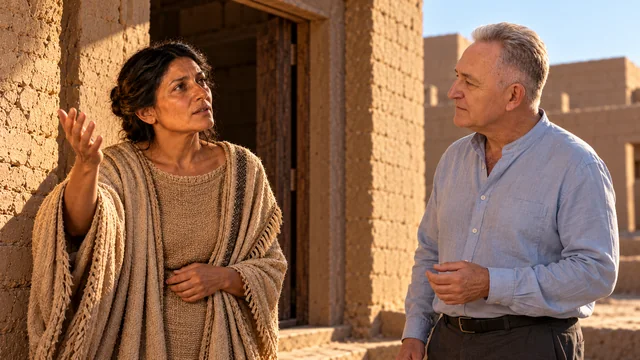
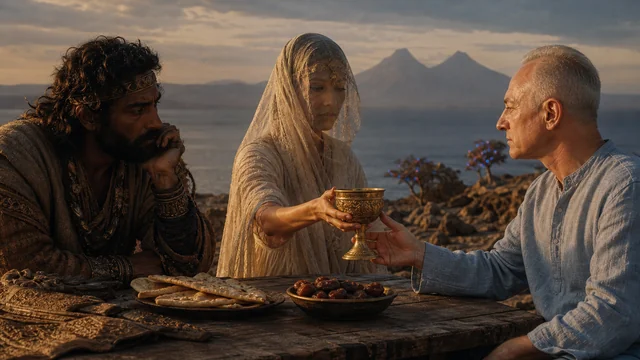
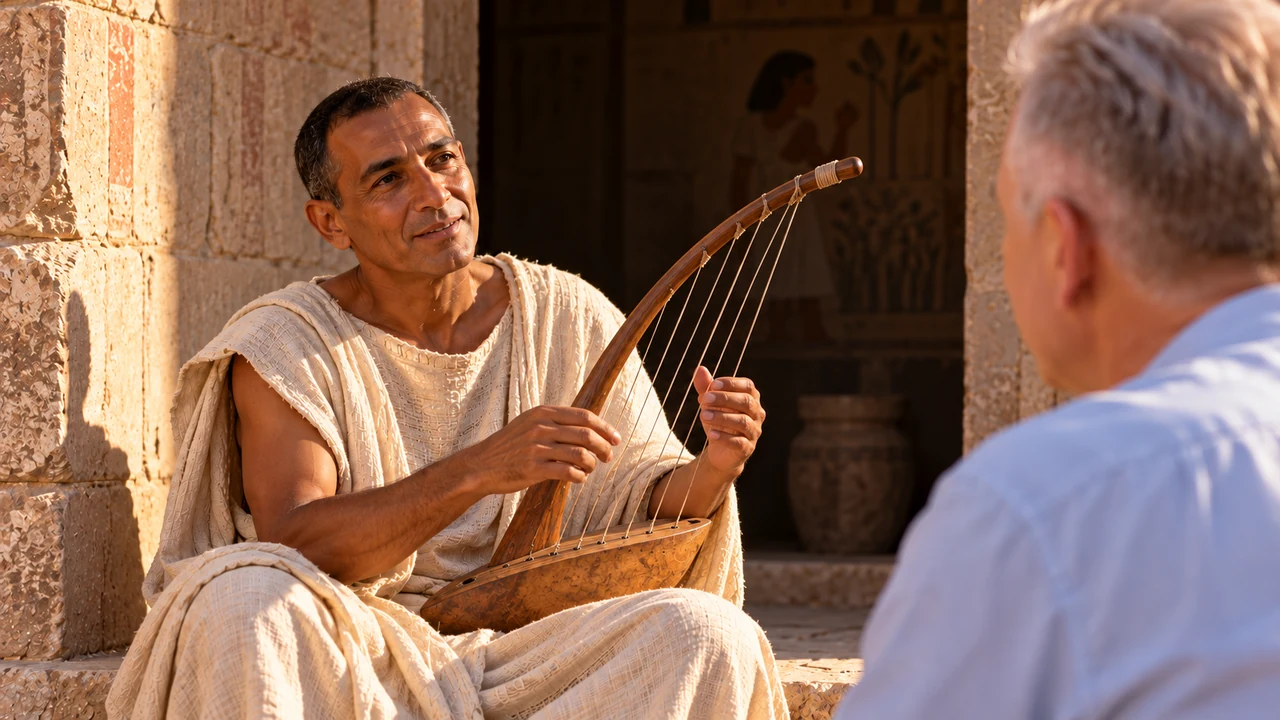
In this image, the contemporary author stands beside his interlocutor (Song of the Harper · Tradition of King Intef). This encounter is created for a conversation through the poem; the contemporary participant's likeness is grounded in photographs of Oleksandr Bochkala.
The image does not claim a literal historical meeting—it opens a shared space where the poet’s question is addressed to us today and asks for a personal answer.
Historical Context & Keys to the Text
God-kings in their pyramids (nṯr.w ... m mr.w=sn)
The Egyptian text literally says 'gods' (nṯr.w)—the title of deceased pharaohs of the Old and Middle Kingdoms. The sharp irony is that even earthly gods lie dead inside stone monuments that failed to save them from oblivion.
Imhotep and Hordedef
The two supreme intellectual authorities of Egypt. Imhotep built the first Step Pyramid at Saqqara; Prince Hordedef was the son of Khufu (builder of the Great Pyramid) and a famed sage. Their words are still recited everywhere, yet their own stone tombs have crumbled to dust.
Rewards after death (sꜣḫ)
The term sꜣḫ referred to the funerary rites meant to transform the deceased into a blessed spirit in the hereafter. The harper proposes something radical for Egypt: stop living for promised posthumous rewards and return to the living hour.
Fragrant myrrh on the head (ꜥntyw) & fine linen (pꜣq.t)
At Egyptian banquets, guests wore a cone of scented fat infused with myrrh resin atop their heads. Warmed by the living body, it slowly melted, cooling and perfuming the skin, while sheer white royal linen (pꜣq.t) clothed the body in light.
Following the heart (šms jb) & celebrating the joyful day (jrj hrw nfr)
For an Egyptian, the heart (jb) was the seat of mind, conscience, desire, and memory. 'Following your heart' and 'celebrating the joyful day' is not shallow hedonism, but courageous consent to the fullness of life in the face of finitude.
Edition and papyrus paleography: Prof. Miriam Lichtheim (University of California, Los Angeles — UCLA), Prof. Michael V. Fox (University of Wisconsin–Madison), Prof. Richard B. Parkinson (University of Oxford / British Museum EA 10060), and the TLA Corpus (Berlin-Brandenburgische Akademie der Wissenschaften).