Catullus, Carmen 85I do not know why. Yet it is happening to me.
Who am I when opposite feelings within me are equally real?
Catullus loves and hates at the same time. When asked why, he answers with non-knowing, and then testifies to what he feels: it is happening, and it tears him apart. A human being cannot explain himself and yet knows his own pain.
Which of the two is real: the one who loves, or the one who hates? The distich refuses to separate them. For my conversation with Catullus, this is the core: can I recognize as myself what I do not know how to reconcile? Any attempt to make the confession consistent would leave part of a living human being outside speech.
Carmen 85 (Ōdī et amō)
Gaius Valerius Catullus’s elegiac distich Carmen 85 (“Ōdī et amō,” Rome, c. 58–54 BCE) uses fourteen Latin words and eight verbs without a single noun to expose the fracture of the personal “I”: hatred and love tear the speaker apart simultaneously. The modern translation preserves passive fierī (“it is happening to me”) and the physical rack-cross inside excrucior.
Late Republican Rome, mid-1st century BCE. The sacred bond of mutual fidelity that the young poet from Verona, Gaius Valerius Catullus, tried to bring into his love for Clodia Metelli (Lesbia) has been shattered by her betrayals. In neighboring poems he notices something terrifying: his respect and trust for her are dead, yet his blind desire has only grown fiercer from the wound.
Here there are no gods, no Roman street scenes, not even the woman's name. Fourteen Latin words and eight verbs without a single noun. Left alone with an imagined sober interlocutor demanding a rational explanation, the poet discovers for the first time in European lyric that the human 'I' can be split in two and no longer master of itself.
I hate and I love. Why do I do this, perhaps you ask?
I do not know, but it is happening, and I feel crucified.
Ōdī et amō. Quārē id faciam, fortasse requīris?
Nesciō, sed fierī sentiō et excrucior.
Rome of Catullus (55 BCE): Late Republican Forum, Via Sacra & Clodia’s Palatine Domus in 3D
Explore Late Republican Rome a century before Imperial marble and the Colosseum: step inside the Palatine peristyle domus of Clodia Metelli (Catullus’s Lesbia) with an architectural cutaway of the atrium and impluvium, walk the basalt Via Sacra past papyrus bookstalls, inspect the Rostra, Temple of Vesta, and Tabularium, and play the 7-string Roman cithara.
Ready to Enter 3D Rome of Catullus (55 BCE)?
The 3D scene launches on click so it never traps page scrolling while you read Carmen 85. Inside you can orbit and zoom the camera, toggle the Palatine Domus roof cutaway, run the 8-act biography of Catullus (62–54 BCE), switch weather to a summer thunderstorm over the Forum, and pluck the 7-string cithara.
✦ Archaeological Dossier of this 3D Scene: Clodia’s Palatine Domus, Via Sacra Bookstalls, Rostra & Temple of Vesta (Read)▼
Palatine Peristyle Domus of Clodia (Lesbia)
The aristocratic townhouse of Clodia Metelli—immortalized by Catullus under the Sapphic pseudonym Lesbia—perched on the northern brow of the Palatine Hill near Cicero’s residence. Rainwater and twilight fall through the open roof compluvium into the marble-lined impluvium basin. Beyond lies the colonnaded peristyle garden lit by bronze oil lamps, where wax writing tablets (pugillares) and a bronze stylus rest beside the triclinium couches.
- Tuscan-style atrium featuring a sloped terracotta compluvium roof and central impluvium water basin
- Colonnaded peristyle garden with travertine columns, fountain, cypress trees, and bronze oil lucernae
Via Sacra & Librarii Bookstalls
Paved with tightly fitted polygonal blocks of dark volcanic basalt (silex), the Via Sacra winds across the Forum valley from the Palatine ramp toward the Capitoline. Beneath the flanking Republican porticoes stand the bookstalls (tabernae librariae) referenced in Carmen 14, where scribes copied and sold fresh papyrus rolls of the Neoteric poets, their edges smoothed with dry pumice stone and stored in cylindrical leather book-buckets (scrinia).
- Polygonal volcanic silex flagstones worn smooth by triumphal processions and daily footsteps
- Shaded Republican porticoes housing wooden bookstalls (tabernae librariae) and scroll racks
Circular Temple of Vesta & Atrium Vestae
The circular tholos sanctuary at the foot of the Palatine slope where the Vestal Virgins tended the undying sacred hearth of the Roman Republic (Focus Publicus). Live smoke and glowing embers rise through the central vent of its conical bronze-tiled roof. Within the reconstruction, the state’s eternal flame stands in poignant contrast to Catullus’s meditation on mortal fragility—our "brief light" (brevis lux) against perpetual night.
- Circular tholos peripteros of 20 fluted columns crowned by a conical Corinthian bronze roof
- Animated eternal flame (Focus Publicus) casting warm flickering light with rising smoke particles
Republican Rostra, Comitium & Curia Cornelia
The Republican Rostra Vetera on the rim of the circular Comitium assembly area—a curved tufa speaker’s platform bristling with the bronze naval rams (rostra) captured at Antium in 338 BCE. Behind it rises the Curia Cornelia, the Sullan Senate house (still standing in 55 BCE prior to its burning in 52 BCE). Here Cicero delivered his forensic orations (mocked or praised in Carmen 49), and here Catullus aimed his fearless epigrams against Julius Caesar and Mamurra (Carmina 29 and 93).
- Curved Republican Rostra platform mounted with six three-pronged bronze warship rams
- Stepped circular Comitium assembly tiers and commemorative honorific columns
Staying Beside the Question
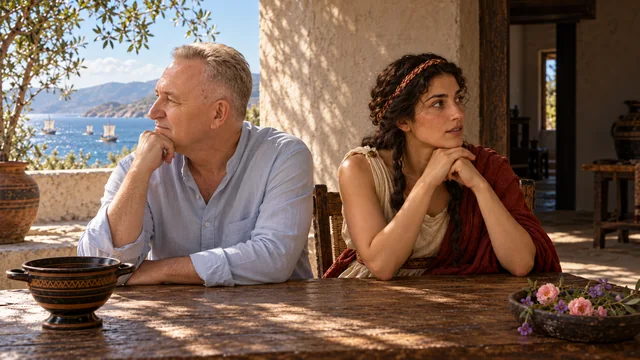
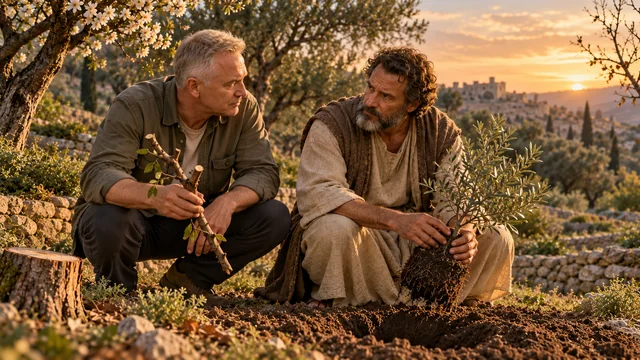
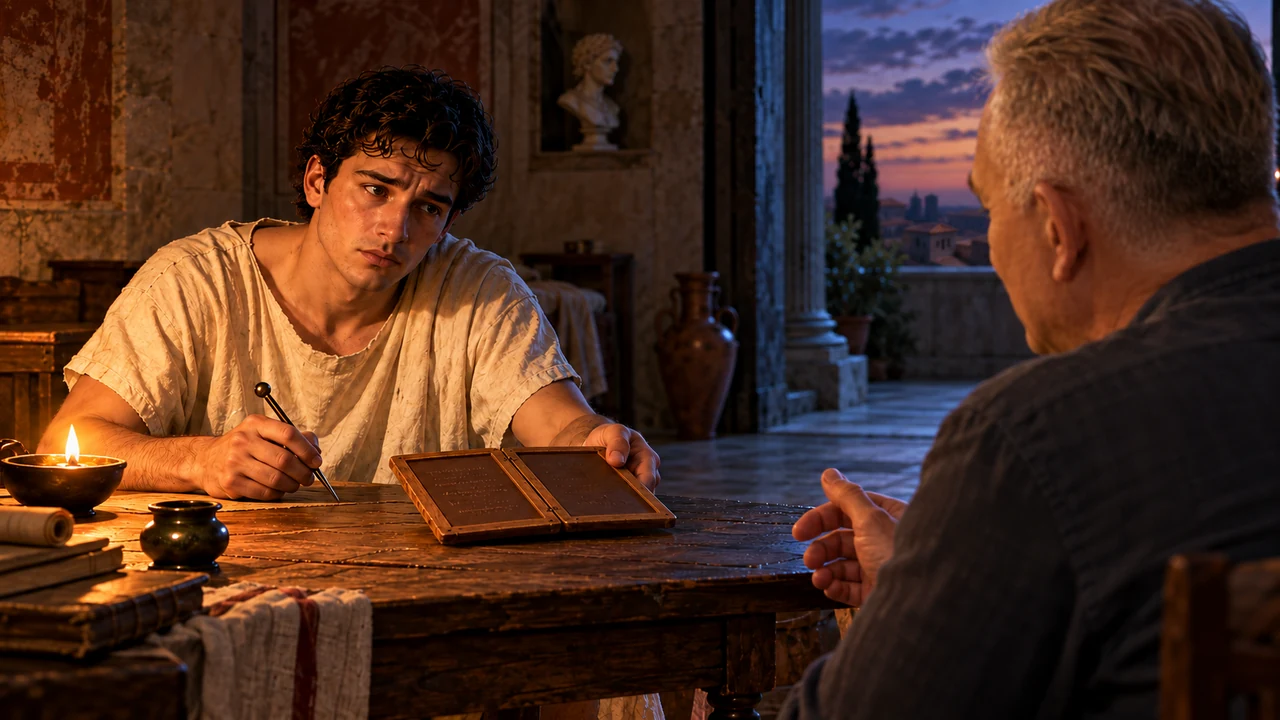
In this image, the contemporary author stands beside his interlocutor (Catullus, Carmen 85). This encounter is created for a conversation through the poem; the contemporary participant's likeness is grounded in photographs of Oleksandr Bochkala.
The image does not claim a literal historical meeting—it opens a shared space where the poet’s question is addressed to us today and asks for a personal answer.
Historical Context & Keys to the Text
I hate and I love (Ōdī et amō)
Two poles are bound by the stark conjunction et ('and at the same time'), with no alternation across time. In Roman ethics, ōdī marks a conscious rupture of trust after betrayal, while amō is an irresistible sensual pull that refuses to obey the will.
'I do this' (id faciam) vs. 'it is happening' (fierī)
The pivot of the distich lies in the grammar of two verbs. The interlocutor questions the poet as a rational agent in charge of his actions: why do you do this (faciam)? Catullus answers with the passive infinitive fierī: I am not doing it—it is happening to me.
I feel crucified (sentiō et excrucior)
The final verb excrucior is built from crux—the wooden cross or rack on which Rome stretched a body in opposite directions. Hatred and love pull the speaker two ways at once, and he experiences that crucifixion from inside his own feeling.
Critical edition of the Latin text: Prof. Sir Roger A. B. Mynors (Corpus Christi College, University of Oxford, Oxford Classical Texts 1958), Prof. Kenneth Quinn (University of Toronto), and Prof. D. F. S. Thomson (University of Toronto, 1997).