The Goddess Siduri (ᵈSiduri) · Epic of GilgameshA life you cannot keep forever
Can a mortal life be enough for someone who refuses to die?
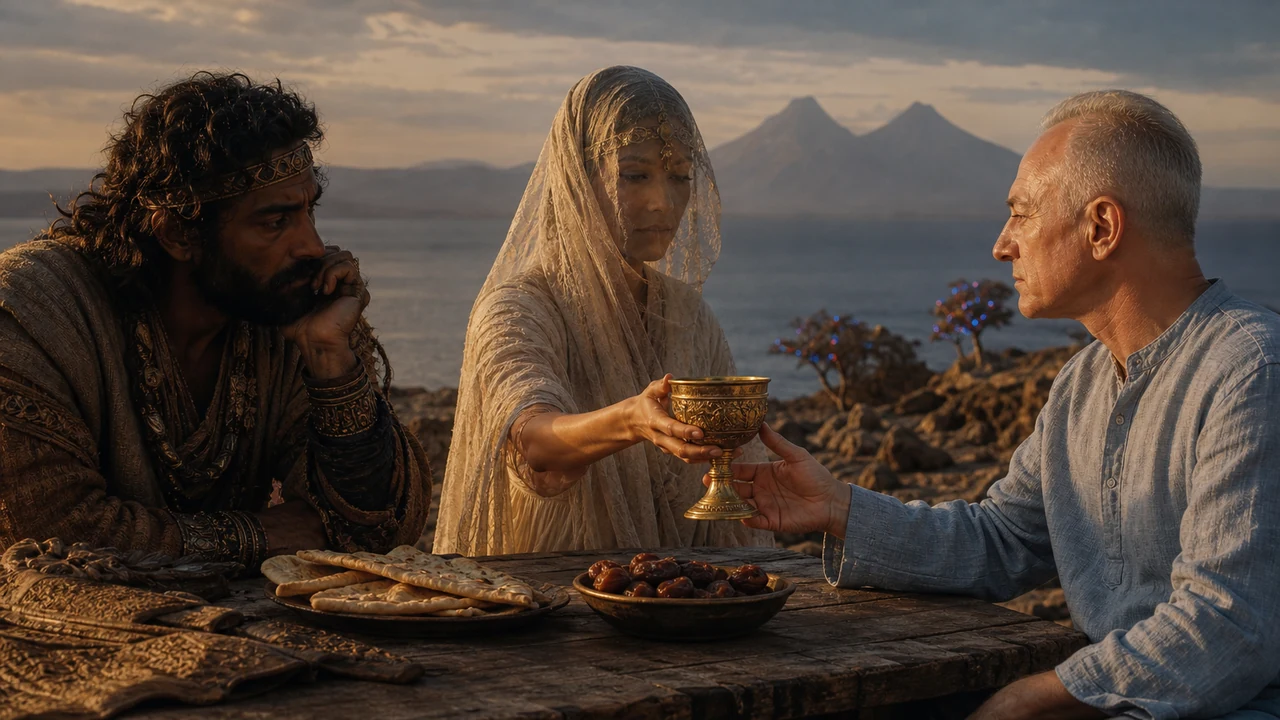
Searching for immortality, Gilgamesh passes through the darkness of Mount Mashu and the Garden of the Gods, with its trees of carnelian and lapis lazuli, and comes to the shore where the Waters of Death begin. Here he meets not a roadside tavern-keeper—as nineteenth- and twentieth-century translations often portrayed her—but Siduri, the veiled goddess of wisdom and the sacred cup, whose name in cuneiform bears the divine determinative DINGIR (ᵈSiduri).
She tries to bring Gilgamesh back to his senses: the gods kept eternal life in their own hands, while a human being holds a child's hand in his own. That is where our human portion lies—in this, and in the simple joys of fresh bread, clean water, and the embrace of a beloved wife.
It is hard to accept such an answer when loving what you will lose, and rejoicing in a day that will not return, feels like too little. Siduri does not erase that pain. Yet in her words, the fullness of a mortal life reveals itself right beside the inevitability of the end. Can I say yes to such fullness myself?
Man’s True Task: The Counsel of Siduri to Gilgamesh (Epic of Gilgamesh, Old Babylonian Sippar Tablet)
Three audio versions of the goddess Siduri’s counsel to Gilgamesh (Track #3 of the album “While We Live”): an Old Babylonian Akkadian sound reconstruction (“Gilgamesh, My Child” · ORIG · 2:29 · 80 BPM · A Dorian) and two independent vocal versions of the original song in Russian and English (RU “Siduri’s Speech to Gilgamesh” · 2:42 · 98 BPM · D Minor and EN “Man’s True Task” · 2:20 · 98 BPM · D Minor). At the cosmological boundary beyond Mount Mashu and the Garden of the Gods, right before the Waters of Death, Siduri (ᵈSiduri)—the veiled goddess of wisdom and the sacred cup—halts the exhausted king of Uruk in his flight from mortality and turns his gaze back to the sacred fullness of the earthly day: fresh water, bright garments, shared bread, a child’s hand in his own, and the embrace of a beloved wife.
«The gods kept eternal life in their own hands—yet a living child holds your hand right now, the hearth fire burns warm, and your beloved wife rejoices in your embrace. Only this is the true task of a human being.»
Note on the Old Babylonian Akkadian sound reconstruction (ORIG): this is a contemporary acoustic reconstruction grounded in Assyriological transliteration of the Sippar Tablet (VAT 4105, col. iii, ll. 1–14, ed. A. R. George), giving voice to Siduri (ᵈSiduri), the veiled goddess of the threshold at the shore of the cosmic ocean, accompanied by a Babylonian lute and cedar harp.
Гильгамеш, куда идешь?
Жизни вечной не найдешь.
Человеку дан предел,
Вечность — лишь богов удел.
Омой свою голову, в чистые воды войди,
Светлые ткани надень для земного пути.
Ешь свой хлеб и пей вино,
Радуйся, пока дано!
День как божий дар встречай
И забудь свою печаль.
Омой свою голову, в чистые воды войди,
Светлые ткани надень для земного пути.
Держит сын твою ладонь,
В очаге горит огонь,
Обними жену любя —
В этом доля для тебя!
Gilgamesh, where are you bound?
Endless life cannot be found.
Death is set by their commands,
Gods keep life within their hands.
Wash your head clean now and bathe in the cool water's flow,
Put on bright garments to walk on the earth's road below.
Eat your bread and drink your wine,
Dance and let your spirit shine!
Greet each day, though life is brief,
Cast away your heavy grief.
Wash your head clean now and bathe in the cool water's flow,
Put on bright garments to walk on the earth's road below.
Hold your child's hand at your side,
Where the warm hearth flames abide;
Clasp your gentle, loving wife—
This is man's true task in life!
Siduri's Counsel to Gilgamesh
The counsel of Siduri (ᵈSiduri sābītum), veiled goddess of wisdom and the sacred cup at the threshold of the Waters of Death, in the Old Babylonian Epic of Gilgamesh (Sippar Tablet VAT 4105, col. III, lines 1–14, c. 1800–1700 BCE) answers the terror of mortality with the measure of human purpose. Presented here are a modern translation, an Old Babylonian Akkadian sound reconstruction (ORIG), a 3D epigraphic model of tablet K.3375, and an original song (RU & EN).
The cosmological frontier at the very edge of the universe. For six days and seven nights Gilgamesh, king of Uruk, sat beside the body of his sworn brother Enkidu, refusing to bury him until he saw the flesh decay. Struck by terror of his own mortality, he cast off his royal robes, put on a raw lion skin, and fled beyond the inhabited world. He passed the Scorpion-guardians at the twin mountains of Mashu—whose peaks hold up the vault of heaven and whose roots reach down to the underworld—and walked for twelve double-hours in total darkness along the path of the Sun-god Shamash.
Emerging into the dazzling Garden of the Gods, where trees bear fruit of red carnelian and foliage of blue lapis lazuli, he halts on the rocky shore of the cosmic ocean directly before the lethal Waters of Death (mê mūti). Here stands the threshold sanctuary of the goddess Siduri (ᵈSiduri sābītum)—the veiled guardian of the cosmic border, divine wisdom, and the golden vessels of life-giving drink. No mortal traveler could ever wander here by chance: only a goddess standing between the Garden of the Immortals and the Waters of Death has the authority to pronounce the law of the cosmos in these fourteen lines.
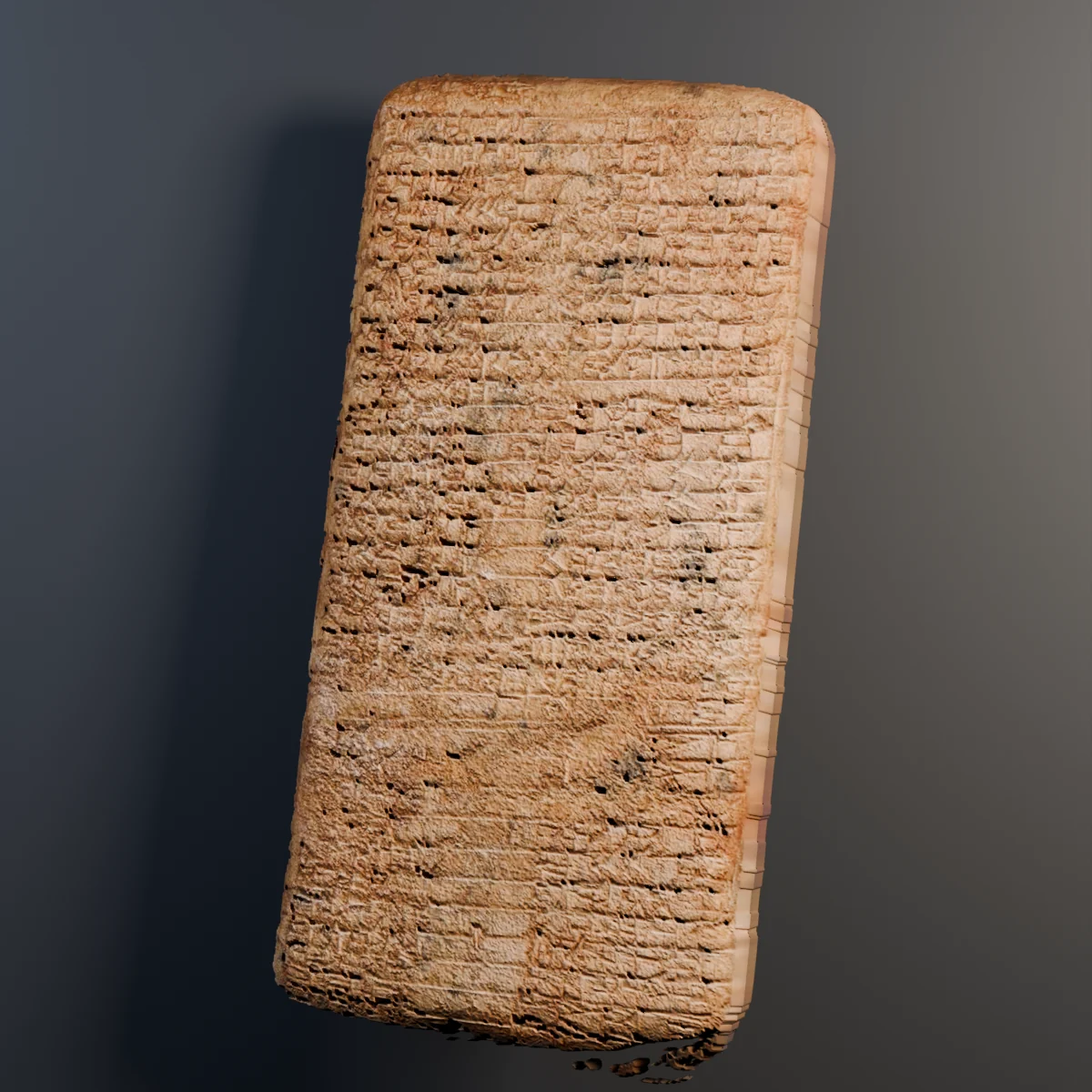
Cuneiform Tablet of the Epic of Gilgamesh from the Library of Ashurbanipal (K.3375)
Gilgamesh’s Old Babylonian dialogue with Siduri (ᵈSiduri), the veiled goddess of wisdom and the sacred cup on the shore of the cosmic ocean beyond Mount Mashu and the jewelled Garden of the Gods (Sippar tablet, 18th c. BCE), stands at the threshold before crossing the Waters of Death to Utnapishtim. Above is the 3D epigraphic reconstruction of the Nineveh tablet K.3375 from the Royal Library of Ashurbanipal: sweep the raking museum light across its surface to inspect the reed-stylus wedges and the fire scars of 612 BCE.
Gilgamesh, where are you wandering in circles?
The eternal life that you are searching for you will not find.
When the gods created humankind,
they assigned death to people,
and kept eternal life in their own hands.
As for you, Gilgamesh, let your stomach be full,
day and night be joyful,
every single day hold a celebration,
day and night dance and make music!
Let your clothes be clean,
wash your head and wash the dirt from your body in water!
Look with love upon the child who holds your hand,
bring joy to your beloved wife in your embrace!
Only this is the true task of a human being.
dGIŠ-gím-maš e-le-eš tad-dal
ba-la-ṭam ša ta-sa-aḫ-ḫu-ru la tu-ut-ta
i-nu-ma i-lu ib-nu-ú a-wi-lu-tam
mu-tam iš-ku-nu a-na a-wi-lu-tim
ba-la-ṭam i-na qá-ti-šu-nu iṣ-ṣa-ab-tu
at-ta dGIŠ-gím-maš lu-ú ma-li ka-ra-aš-ka
ur-ri u mu-ši lu-ú ḫa-da-a-ta at-ta
u4-mi-ša-am šu-kun ḫi-du-tam
ur-ri u mu-ši su-ur u me-li-il
lu-ú zak-ku-ú ṣú-ba-tu-ka
qá-qá-ad-ka lu-ú me-si me-e lu-ú ra-am-ka-a-ta
ṣú-ub-bi ṣe-eḫ-ra-am ṣa-bi-tu qá-ti-ka
mar-ḫi-tum li-iḫ-ta-ad-da-am i-na su-ni-ka
an-na-ma ši-pi-ir a-wi-lu-tim
Uruk the Sheepfold: Explore the Ancient Sumerian Polis in 3D
Fly across the 9.5-kilometer ramparts of Gilgamesh, the sacred Eanna ziggurat of Inanna, the royal Egal palace, the cenotaph of Enkidu, and the Euphrates canals. Includes a 3D-synced timeline of Gilgamesh’s reign, Shamash sunset lighting, a cuneiform glossary, and live archaeological grounding.
Ready to Enter 3D Uruk?
The 3D scene launches on click so it never traps page scrolling while you read the poem. Inside you can orbit and zoom the camera, run the Gilgamesh reign auto-tour, play the Lyre of Ur, and explore the cuneiform glossary.
✦ Archaeological Dossier of this 3D Scene: Walls of Gilgamesh, Royal Egal Palace & Cenotaph of Enkidu (Read)▼
Uruk the Sheepfold at Sunset
By 2750 BCE, Uruk in southern Mesopotamia had become humanity’s first metropolis with over 40,000 inhabitants. According to the Epic, King Gilgamesh raised impregnable ramparts enclosing the sacred Eanna precinct, the royal palace, mudbrick residential quarters, bustling markets, and irrigated date-palm gardens.
- During the Uruk IV–III periods (c. 3300–2900 BCE), the city expanded to 400–550 hectares, making it the largest urban center of the ancient world.
- The world’s earliest proto-cuneiform clay tablets (nearly 5,000 texts from the Eanna strata) were excavated in Uruk, marking the birth of human writing.
Royal Palace of Gilgamesh — 5th Ruler of Uruk’s 1st Dynasty
According to the Sumerian King List, Gilgamesh (Sumerian Bilgames) was the fifth ruler of the First Dynasty of Uruk, following Meskiaggasher, Enmerkar, Lugalbanda, and Dumuzi. His royal complex É-gal ("Great House") in the Kullab district united the Lugal’s throne hall, the Court of the Assembly of Elders (Ukkin), and the upper Egalmah sanctuary where his mother, the wise goddess Ninsun, offered prayers to Shamash.
- On the Weld-Blundell Prism of the Sumerian King List, Gilgamesh is recorded as the fifth king of the First Dynasty of Uruk and son of Lugalbanda, reigning after Enmerkar and Dumuzi.
- In the Sumerian poem "Gilgamesh and Aga", the palace of Uruk hosts history’s earliest attested bicameral assembly (Ukkin): a council of city elders (abba-uru) and an assembly of young arms-bearing men (gurush).
Great Ramparts of Gilgamesh & Gate of Shamash
Archaeological excavations led by J. Jordan and H. Lenzen confirmed the monumental 9.5-kilometer circuit of Uruk’s city walls, reinforced with semicircular and rectangular bastions every 9 meters. In the Epic, its upper cornice gleams like burnished copper in the sunset.
- Magnetometry surveys and German excavations at Warka revealed a 9.5-km double defensive wall reinforced with over 900 semicircular and rectangular bastion towers.
- Constructed at the dawn of the Early Dynastic period (c. 2800–2700 BCE) from plano-convex mudbricks, the inner rampart reached up to 5 meters in thickness at its base.
Tomb & Royal Cenotaph of Enkidu
In Tablet VIII of the Epic, grief-stricken Gilgamesh mourns his sworn brother Enkidu for six days and seven nights, summons Uruk’s coppersmiths, lapidaries, and goldsmiths to fashion a funerary statue of gold and lapis lazuli, and raises a secluded riverside mausoleum displaying offerings to the sun god Shamash.
- Tablet VIII of the Epic of Gilgamesh preserves the most detailed inventory of funerary offerings (kispū) in Mesopotamian literature, displayed before the sun god Shamash for the underworld deities Ereshkigal and Namtar.
- The Sumerian custom of crafting funerary effigies from gold, silver, lapis lazuli, and shell is archaeologically attested in Sir Leonard Woolley’s excavations of the Royal Tombs of Ur (c. 2600 BCE).
Staying Beside the Question
In this image, the contemporary author stands beside his interlocutor (The Goddess Siduri (ᵈSiduri) · Epic of Gilgamesh). This encounter is created for a conversation through the poem; the contemporary participant's likeness is grounded in photographs of Oleksandr Bochkala.
The image does not claim a literal historical meeting—it opens a shared space where the poet’s question is addressed to us today and asks for a personal answer.
Historical Context & Keys to the Text
The Goddess Siduri (ᵈSiduri sābītum) & the Threshold Before the Waters of Death
In cuneiform her name is written with the divine determinative DINGIR (ᵈSiduri), and in Babylonian theological lists (An = Anum, Šurpu) she is explicitly identified with Ishtar of Wisdom (Ištar nēmeqi). Her epithet sābītum ('mistress of sacred fermentation and the cup') and the golden ritual vats (karpātum ša ḫurāṣi) given to her by the gods belong not to a secular drinking house, but to a liminal sanctuary at the edge of the cosmos—between the jewelled Garden of the Gods and the lethal Waters of Death (mê mūti). Veiled with a sacred cloth (kutummu), she guards the boundary between the immortals and mortal humanity.
Wandering in circles (taddal)
The Akkadian verb dâlum does not mean a casual stroll, but the restless circling of someone caught in a trap. Gilgamesh has a goal—to find immortality—yet no solution exists, turning every step into a closed loop.
Eternal life in the gods' hands (ina qātīšunu iṣṣabtū) & the child's hand (ṣābitu qātīka)
In the Akkadian original, lines 5 and 12 are bound by the same verb root, ṣabātum ('to hold, to grasp'). In line 5, the gods keep eternal life in their own hands. In line 12, a living child holds on to your hand. What is locked away in heaven is already warm inside your palm.
Clean clothes and washing off dirt (zakû / ramākum)
Fasting, a body crusted with steppe dirt, and an unworked animal skin were signs of the underworld in Mesopotamia. Siduri's command to eat your fill, wash the dirt off in water, and put on clean clothes is not advice about comfort—it is a physical return from the realm of death to the world of the living.
Beloved wife in your embrace (marḫītum)
The rare Old Babylonian poetic word marḫītum comes from the root reḫûm ('to unite in love'). It speaks not of formal marital duty, but of living sensual tenderness and joy shared with a beloved woman.
The true task of a human being (šipir awīlūtim)
In Babylonia, šiprum meant an assigned work, craft, or royal commission. Siduri overturns heroic ethics: the true work a human being was made for is not storming the borders of death, but living this day beside those you love.
Critical edition and cuneiform collation: Prof. Andrew R. George (SOAS University of London, Oxford University Press 2003, Vol. I, pp. 278–279), Prof. Enrique Jiménez (LMU Munich, Electronic Babylonian Literature), and Prof. Stephanie Dalley (University of Oxford).