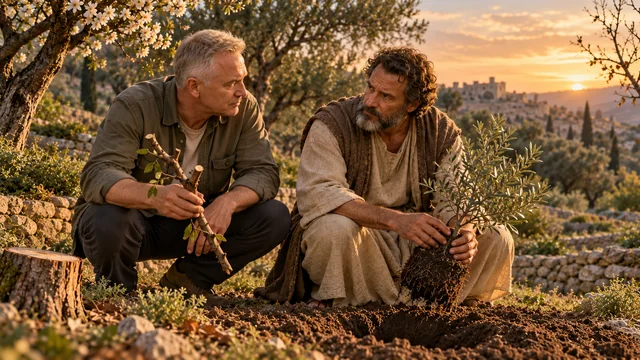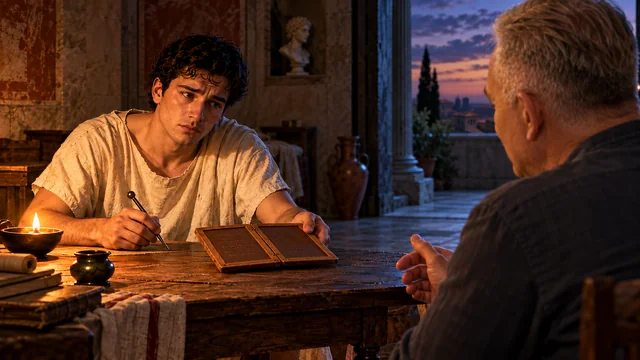
Sappho · Fragment 16Love changes the measure of beauty
What defines the worth of the world for me: its grandeur or my love?
Sappho places horsemen, infantry, and warships beside the walk of absent Anactoria. What everyone can admire together yields to the one a single person loves. Yet love in this poem is not harmless: before remembering Anactoria, Sappho speaks of Helen, who left behind her husband, her child, and her parents.
The beloved becomes the measure of beauty and can collide with everything once held dutiful and dear. What makes my life worthwhile, and what is the price of fidelity to that choice? My encounter with Sappho begins where acknowledging the power of love is no longer enough: one has to see what it can alter and what it can shatter.
Fragment 16 (Some say a host of cavalry...)
In Papyrus Fragment 16 (P.Oxy. 1231, c. 600 BCE), Sappho of Lesbos challenges the Greek martial epic tradition: against cavalry, infantry, and warships, she declares the most beautiful thing on the dark earth to be “whatever one loves.” The modern translation restores all twenty surviving papyrus lines and the formal argument connecting Helen’s choice to Anaktoria’s radiant step.
The island of Lesbos, the city of Mytilene, around 600 BCE. Across a narrow strait lies the mighty Lydian kingdom with its capital at Sardis—the military superpower of the age, whose war-chariots and closed ranks of infantry flashing with bronze shields and spears stood as the supreme standard of male power and beauty.
Sappho's companion Anactoria has left Lesbos for distant Lydia. Against the talk of armies and warships, Sappho speaks lines in which a new measure of worth is born: a single memory of the graceful walk and sparkling eyes of the one you love outweighs the entire military might of an empire.
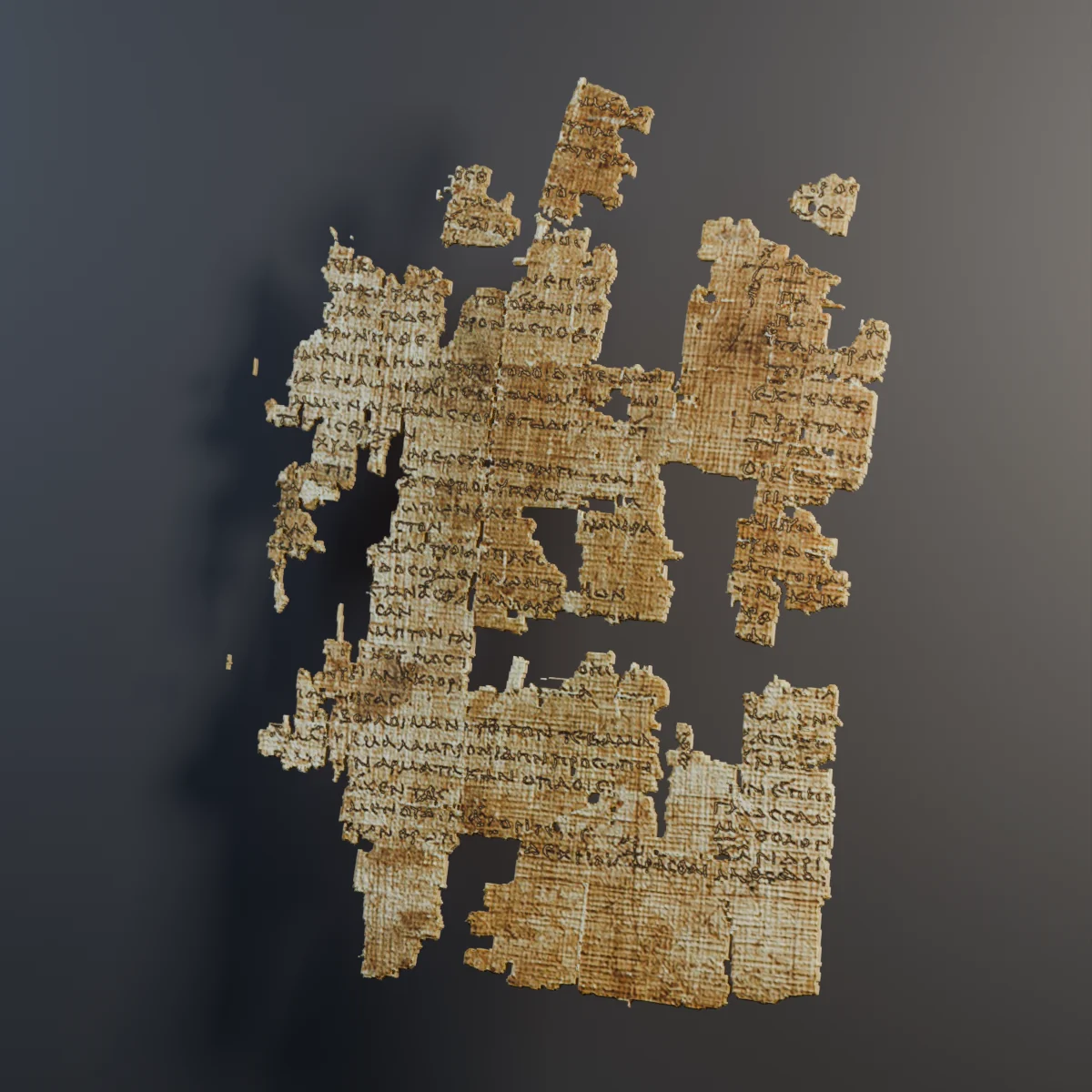
The Oxyrhynchus Papyrus of Sappho, P.Oxy. 1231 (Fragment 16 Voigt)
For over two millennia these lines were thought lost forever, until Bernard Grenfell and Arthur Hunt recovered a torn roll of Book I of Sappho (P.Oxy. 1231) from the dry desert sands of Oxyrhynchus in 1914. This 3D reconstruction preserves the papyrus’s jagged silhouette, open interior lacunae, and woven Nile reed fibers.
Some say a host of cavalry, others of infantry,
and others a fleet of ships — upon the black earth
is the most beautiful thing, but I say it is whatever
a person loves.
And it is completely easy to make this clear
to everyone: for Helen, who far surpassed
all human beings in beauty, left her husband,
the noblest of all men,
and went sailing across the sea to Troy,
and neither of her child nor of her dear parents
did she remember at all, for she was led away
[by the power of love ...]
[for a passionate] heart
easily directs thought [toward what is desired].
[This] has reminded me now of Anactoria,
who is not here:
her graceful, alluring walk
and the bright radiance of her face and sparkling eyes I would rather see
than the war-chariots of the Lydians and the closed ranks of infantry
charging into battle, flashing with bronze shields and spears.
Οἰ μὲν ἰππήων στρότον, οἰ δὲ πέσδων,
οἰ δὲ νάων φαῖσ’ ἐπὶ γᾶν μέλαιναν
ἔμμεναι κάλλιστον, ἔγω δὲ κῆν’ ὄτ-
τω τις ἔραται·
πάγχυ δ’ εὔμαρες σύνετον πόησαι
πάντι τοῦτ’, ἀ γὰρ πόλυ περσκέθοισα
κάλλος ἀνθρώπων Ἐλένα τὸν ἄνδρα
τὸν πανάριστον
καλλίποισ’ ἔβα ’ς Τροΐαν πλέοισα
κωὐδὲ παῖδος οὐδὲ φίλων τοκήων
πάμπαν ἐμνάσθη, ἀλλὰ παράγαγ’ αὔταν
[...]σαν
[...]αμπτον γὰρ [...] νόημμα
[...] κούφως τ[...] νοήσῃ·
[..]με νῦν Ἀνακτορίας ὀνέμναι-
[σ’ οὐ] παρεοίσας,
τᾶς κε βολλοίμαν ἔρατόν τε βᾶμα
κἀμάρυχμα λάμπρον ἴδην προσώπω
ἢ τὰ Λύδων ἄρματα κἀν ὅπλοισι
πεσδομάχεντας.
Staying Beside the Question
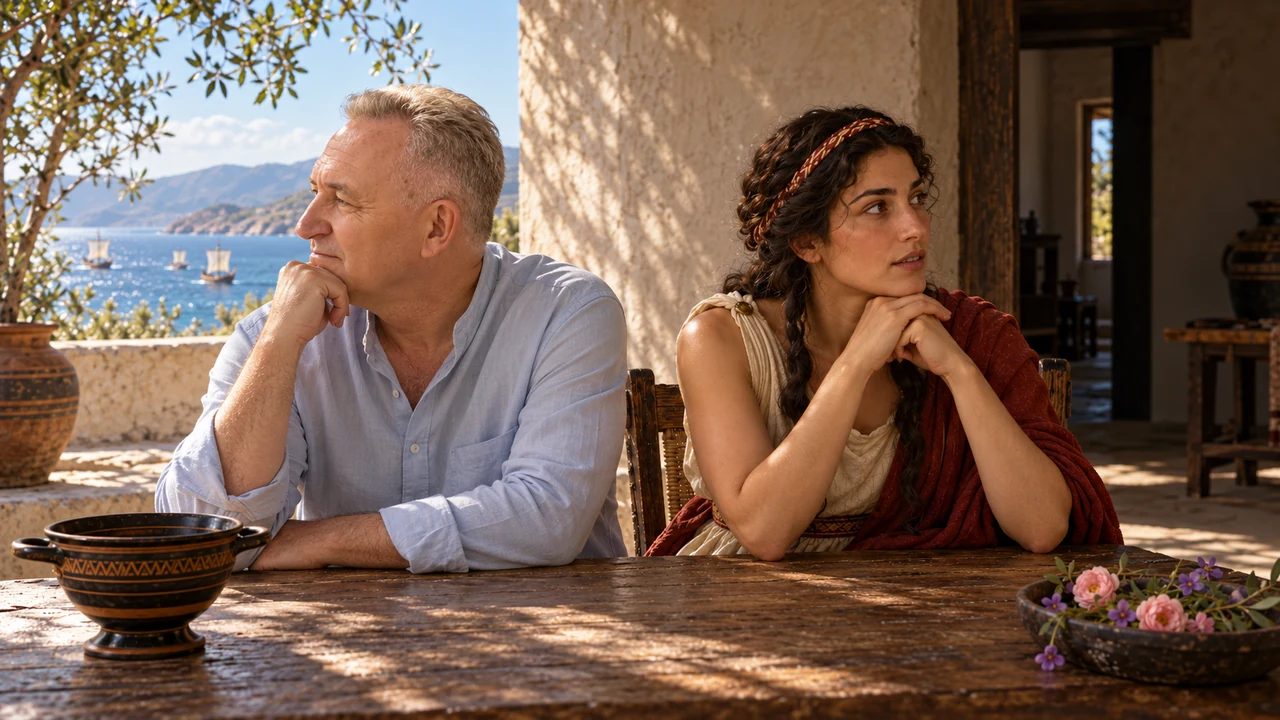
In this image, the contemporary author stands beside his interlocutor (Sappho · Fragment 16). This encounter is created for a conversation through the poem; the contemporary participant's likeness is grounded in photographs of Oleksandr Bochkala.
The image does not claim a literal historical meeting—it opens a shared space where the poet’s question is addressed to us today and asks for a personal answer.
Historical Context & Keys to the Text
Cavalry, infantry, fleet — 'but I say' (egō de)
The poem opens with an archaic Greek priamel: Sappho names the three supreme standards of beauty and power in society's eyes—cavalry, infantry, and warships upon the black earth—only to overturn them with a single 'but I say' (egō de): the most beautiful thing is whatever a person loves.
Helen's choice and the husband 'noblest of all' (panariston)
In the Homeric world, Helen was an object contested by men. Sappho reverses the lens: Helen, who surpassed all mortals in beauty, is the one who chooses and acts. Her husband Menelaus is explicitly called 'the noblest of all' (panariston)—yet even the pinnacle of social standing and family duty gives way before the power of love.
Graceful walk (eraton bama) & radiance of face and sparkling eyes (amarychma)
Sappho remembers Anactoria not as a static statue, but in living motion: eraton bama is a graceful, alluring walk that awakens love; amarychma (from amaryssō, 'to sparkle, to flash with the eyes') is the living play of light across a smiling face and sparkling eyes.
Lydian war-chariots and infantry flashing with bronze (ta Lydōn armata kan hoploisi pesdomachentas)
The finale sets two kinds of motion and two kinds of radiance against each other: the terrifying military charge of Lydian war-chariots and closed ranks of infantry flashing with bronze shields and spears (hopla)—and the quiet radiance of the face and eyes of one absent woman.
Papyrology and critical reconstruction: Prof. Eva-Maria Voigt (Universität Hamburg, 1971), Prof. Edgar Lobel & Prof. Denys Page (University of Oxford / University of Cambridge, PLF 1955), and Prof. David A. Campbell (University of Victoria, Loeb Classical Library / Harvard University Press).