Su Shi, First Ode on the Red CliffThe water has flowed past. The river is still before us.
Which world is real: the one where everything passes, or the one where everything continues?
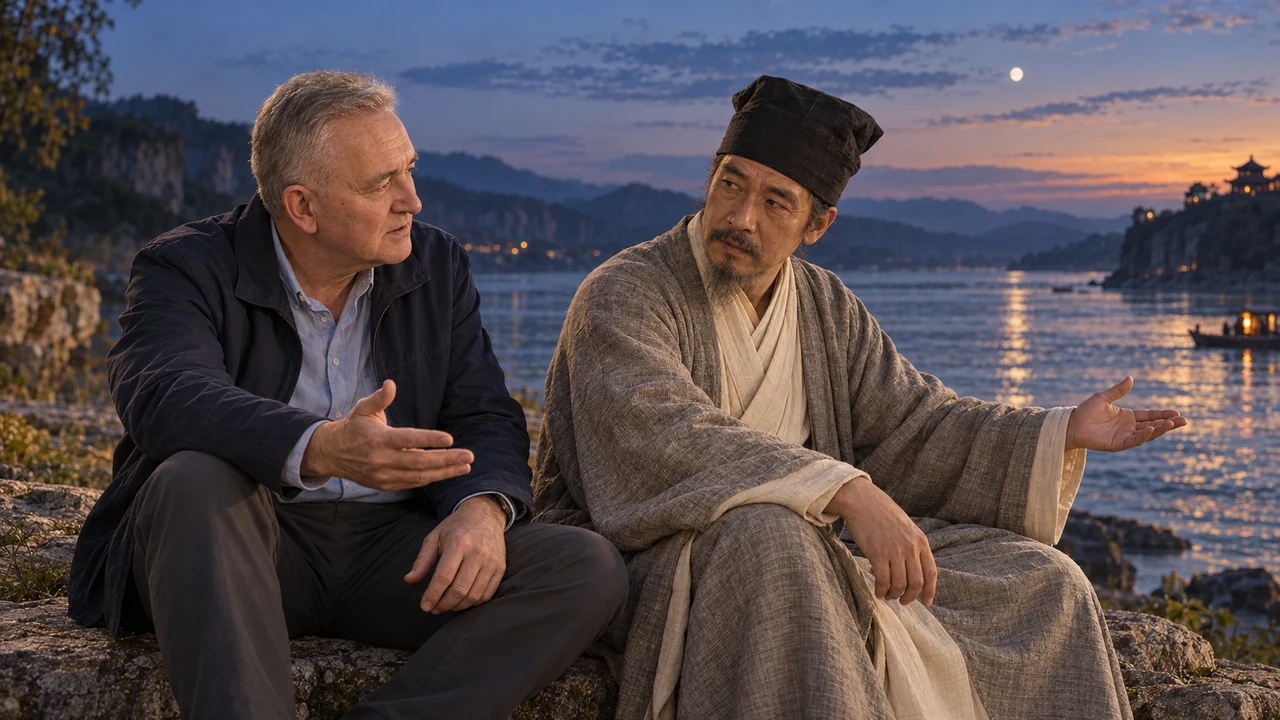
Su Shi's guest looks at the river and feels the brevity of human life before its endless current. Su Shi answers with the very same river and the very same moon: the water passes away yet is never gone; the moon wanes only to grow full again. Seen from the side of change, nothing stands still for an instant. Seen from the side of permanence, we too participate in the continuity of the world.
These two ways of seeing lead to different experiences of one's own life. The conversation ends with the possibility of enjoying the breeze and the moon together without needing to own them. I remain beside that river with a question: what do I call the truth about the world, and how much of it depends on how I look?
Former Ode on the Red Cliff (Qian Chibi fu)
In the “First Ode on the Red Cliff” (Qian Chibi fu, Huangzhou, 1082 CE), exiled Northern Song poet Su Shi (Su Dongpo) answers his guest’s lament over mortal brevity with a dual-perspective paradox: seen through change, the cosmos never stands still for an instant; seen through continuity, neither the river, the moon, nor we ourselves ever pass away.
“Westwards to Hsia-k‘ou, eastwards to Wu-ch‘ang, where hill and stream in wild luxuriance blend,—was it not there that Ts‘ao Ts‘ao was routed by Chou Yü? Ching-chou was at his feet: he was pushing down stream towards the east. His war-vessels stretched stem to stern for a thousand li: his banners darkened the sky. He poured out a libation as he neared Chiangling; and sitting in the saddle, armed cap-à-pie, he uttered those words did that hero of his age. Yet where is he to-day?”
“Now you and I have fished and gathered fuel together on the river eyots. We have fraternized with the crayfish: we have made friends with the deer. We have embarked together in our frail canoe; we have drawn inspiration together from the wine-flask—a couple of ephemerides, launched on the ocean in a rice-husk! Alas, life is but an instant of Time. I long to be like the Great River which rolls on its way without end.
“Ah, that I might cling to some angel’s wing and roam with him for ever! Ah, that I might clasp the bright moon in my arms and dwell with her for aye! Alas, it only remains to me to enwrap these regrets in the tender melody of sound.”
“But do you forsooth comprehend,” I enquired, “the mystery of this river and of this moon? The water passes by but is never gone: the moon wanes only to wax once more. Relatively speaking, Time itself is but an instant of time; absolutely speaking, you and I, in common with all matter, shall exist to all eternity. Wherefore then the longing of which you speak?
“The objects we see around us are one and all the property of individuals. If a thing does not belong to me, not a particle of it may be enjoyed by me. But the clear breeze blowing across this stream, the bright moon streaming over yon hills,—these are sounds and sights to be enjoyed without let or hindrance by all. They are the eternal gifts of God to all mankind, and their enjoyment is inexhaustible. Hence it is that you and I are enjoying them now.”
Staying Beside the Question
In this image, the contemporary author stands beside his interlocutor (Su Shi, First Ode on the Red Cliff). This encounter is created for a conversation through the poem; the contemporary participant's likeness is grounded in photographs of Oleksandr Bochkala.
The image does not claim a literal historical meeting—it opens a shared space where the poet’s question is addressed to us today and asks for a personal answer.
Historical Context & Keys to the Text
Sinological textual scholarship and Song Dynasty studies: Prof. Ronald C. Egan (Stanford University / UC Santa Barbara, Harvard University Asia Center), Prof. Stephen Owen (Harvard University), and Prof. Herbert A. Giles (University of Cambridge).