Ferdowsi · 'Shahnameh', Concluding CodaA mortal human being builds out of words
Why give one's finite life to creating something meant to live without you?
Ferdowsi speaks of thirty years of toil, and then of a lofty palace of verse that neither wind nor rain can harm. Beside the building appears another image: the word has been sown as seed, and life continues through it. A human being pours a finite span of years into what can outlast his own mortality.
Today our reading participates in that continuation. The question of the meaning of labor becomes deeply personal for me: what am I building, who might need it, and why do I feel the urgency to finish what I will never see to its end? Ferdowsi answers with confidence in his word. My own answer still has to find its form.
Shahnameh · Thirty-Year Coda
In the concluding coda of the Persian epic Shahnameh (Tus, Khorasan, completed c. 1010 CE), Abu’l-Qasim Ferdowsi sums up thirty years of relentless labor. He unites two contrasting images of human creation: a lofty palace of verse impervious to wind and rain, and living seeds of speech (toxm-e soxan) that germinate in readers’ minds long after the poet’s death.
Tus in Khorasan, around 1010 CE. Hakim Abu’l-Qasim Ferdowsi (c. 935–1020), an Iranian landowner-scholar (dehqān), brings the Shahnameh ('Book of Kings') to completion—roughly fifty thousand rhymed couplets (bayts) shaped across more than thirty years of labor. During those decades dynasties shifted from the Samanid court of Bukhara to the realm of Mahmud of Ghazni, while the poet himself grew old in poverty and buried his son.
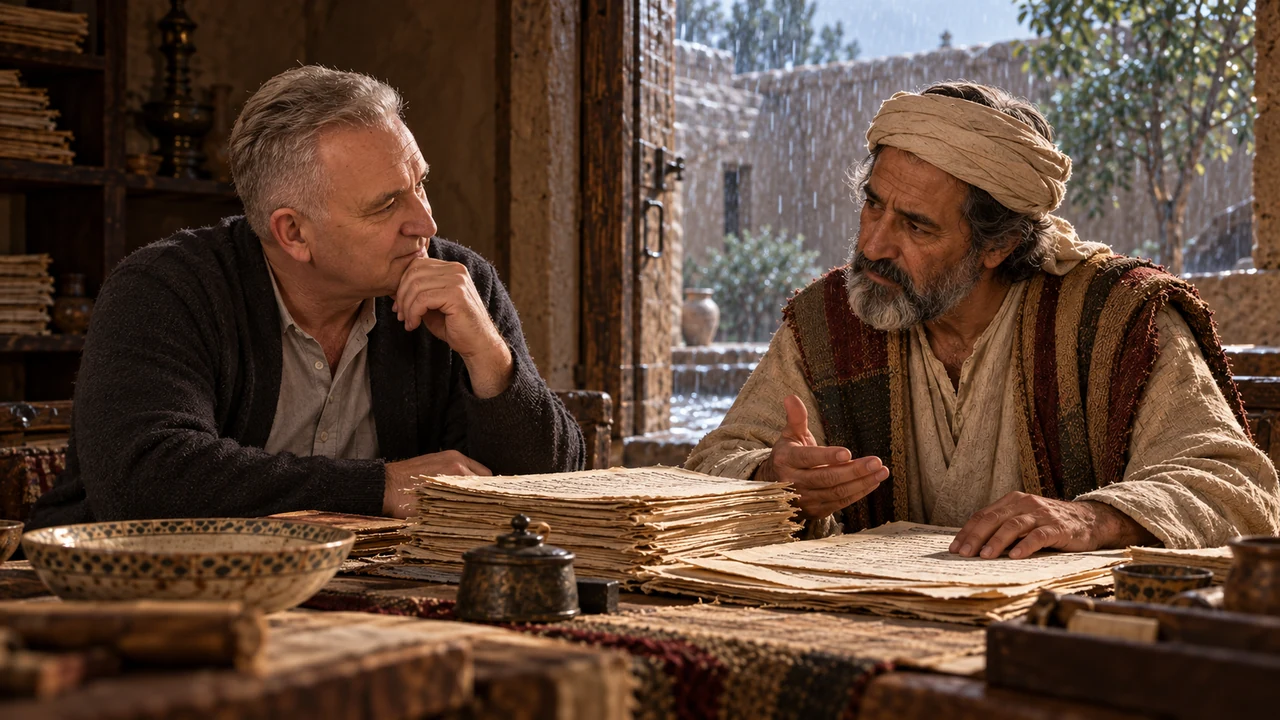
In the closing lines of the epic, kings, battles, and the hero Rostam step aside. A seventy-year-old craftsman sits alone with a stack of finished folios while rain falls beyond the stone arch. Summing up his life, he names two reasons why what he made will not vanish with his body: the structural masonry of verse and the living germination of sown speech.
Much sorrow and toil have I borne through these thirty long years,
Yet have I revived the soul of Persia through this sweet tongue!
I have founded a lofty palace of timeless verse,
Which neither gale of wind nor rushing rain can ever impair!
Henceforth I shall not die, for I live on in these songs,
Having scattered broadcast the seeds of the eternal Word!
Whoever possesses wisdom, judgment, and righteous faith,
Shall bless my name and memory long after I am laid in the tomb!
بسی رنج بردم در این سال سی
عجم زنده کردم بدین پارسی
پی افکندم از نظم کاخی بلند
که از باد و باران نیابد گزند
نمیرم از این پس که من زندهام
که تخم سخن را پراکندهام
هر آن کس که دارد هش و رای و دین
پس از مرگ بر من کند آفرین
Staying Beside the Question
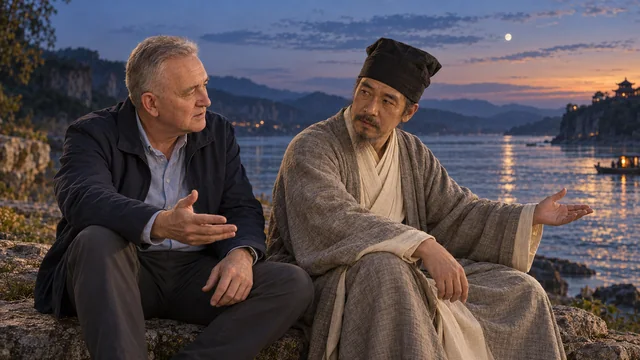
In this image, the contemporary author stands beside his interlocutor (Ferdowsi · 'Shahnameh', Concluding Coda). This encounter is created for a conversation through the poem; the contemporary participant's likeness is grounded in photographs of Oleksandr Bochkala.
The image does not claim a literal historical meeting—it opens a shared space where the poet’s question is addressed to us today and asks for a personal answer.
Historical Context & Keys to the Text
Thirty years of toil (sāl-e sī)
Ferdowsi began shaping pre-Islamic Iranian chronicles (Khwaday-namag) and dehqān oral traditions around 977 CE after the death of the poet Daqiqi, finishing the final recension around 1010 CE. The noun ranj in line 1 denotes physical exhaustion, hardship, and decades of exacting craft rather than effortless inspiration.
Reviving Iran through the living tongue (ʿajam and pārsī)
In the Abbasid era, ʿajam designated Iranians as speakers outside Arabic. By composing a vast historical and mythic cycle in New Persian (pārsī) with minimal Arabic loanwords, Ferdowsi anchored cultural memory in a living language that modern Persian readers can still read directly a millennium later.
A lofty palace of verse (kāx-e boland)
In Khorasan, royal palaces and citadels built of sun-dried mudbrick were steadily eroded by wind and autumn downpours (bād o bārān). Against crumbling dynastic masonry, Ferdowsi sets the rhythmic architecture of the mutaqārib meter—a structure no storm can wash away.
Seeds of speech (toxm-e soxan)
Right after the immobile stone palace, Ferdowsi introduces an opposite, biological metaphor: speech (soxan—word, thought, and coherent meaning) is scattered like grain. A monument stands alone, whereas seed germinates inside future listeners endowed with discernment, judgment, and integrity (huš o rāy o dīn).
Critical text edition of the Shahnameh: Prof. Djalal Khaleghi-Motlagh (Universität Hamburg, Bibliotheca Persica / Columbia University Center for Iranian Studies, 8 vols.), Prof. Dick Davis (Ohio State University), and Prof. Yevgeny Bertels (Institute of Oriental Studies).