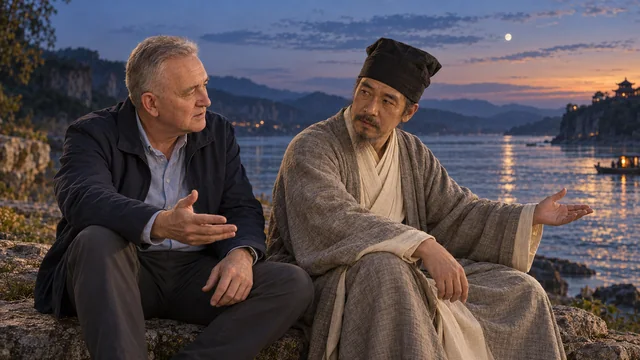
Kalidasa · 'The Cloud Messenger' (Meghaduta), OpeningAddressing the one who cannot hear you
What preserves closeness when the other person is out of reach?

At the opening of 'The Cloud Messenger,' an exiled yaksha begs a monsoon cloud to carry news to his beloved. We notice what the lover himself overlooks: how can smoke, fire, water, and wind serve as a messenger? Yet for one who longs, the entire world is already drawn into his address to her.
Closeness exists in separation as the desire to be heard, as care for someone you cannot reach right now. The poem gives speech to that impossible bond. What matters to me is holding both its hope and the distance that hope does not abolish: the message is not yet delivered, the reunion has not happened, yet the other person already shapes everything the lover sees.
Meghaduta (The Cloud Messenger, Stanzas I–VII)
The opening of Kalidasa’s Sanskrit poem “The Cloud Messenger” (Meghadūta, stanzas 1–7, c. 4th–5th century CE) answers the question: what preserves closeness in separation when the person you love is out of reach? Exiled on Mount Ramagiri, a yaksha greets a rain cloud with fresh flowers and asks it to carry word to his wife in Alaka. We see only smoke, fire, water, and wind in the cloud, yet for him everything around is already turned toward her.
I
On Rama's shady peak where hermits roam,
Mid streams by Sita's bathing sanctified,
An erring Yaksha made his hapless home,
Doomed by his master humbly to abide,
And spend a long, long year of absence from his bride.
II
Some months were gone; the lonely lover's pain
Had loosed his golden bracelet day by day
Ere he beheld the harbinger of rain,
A cloud that charged the peak in mimic fray,
As an elephant attacks a bank of earth in play.
III
Before this cause of lovers' hopes and fears
Long time Kubera's bondman sadly bowed
In meditation, choking down his tears--
Even happy hearts thrill strangely to the cloud;
To him, poor wretch, the loved embrace was disallowed.
IV
Longing to save his darling's life, unblest
With joyous tidings, through the rainy days,
He plucked fresh blossoms for his cloudy guest,
Such homage as a welcoming comrade pays,
And bravely spoke brave words of greeting and of praise.
V
Nor did it pass the lovelorn Yaksha's mind
How all unfitly might his message mate
With a cloud, mere fire and water, smoke and wind--
Ne'er yet was lover could discriminate
'Twixt life and lifeless things, in his love-blinded state.
VI
I know, he said, thy far-famed princely line,
Thy state, in heaven's imperial council chief,
Thy changing forms; to thee, such fate is mine,
I come a suppliant in my widowed grief--
Better thy lordly "no" than meaner souls' relief.
VII
O cloud, the parching spirit stirs thy pity;
My bride is far, through royal wrath and might;
Bring her my message to the Yaksha city,
Rich-gardened Alaka, where radiance bright
From Shiva's crescent bathes the palaces in light.
Staying Beside the Question
In this image, the contemporary author stands beside his interlocutor (Kalidasa · 'The Cloud Messenger' (Meghaduta), Opening). This encounter is created for a conversation through the poem; the contemporary participant's likeness is grounded in photographs of Oleksandr Bochkala.
The image does not claim a literal historical meeting—it opens a shared space where the poet’s question is addressed to us today and asks for a personal answer.
Historical Context & Keys to the Text
Critical Sanskrit text and Vallabhadeva’s commentary: Prof. E. Hultzsch (Martin-Luther-Universität Halle-Wittenberg, Royal Asiatic Society 1911), Prof. Somadeva Vasudeva (Université Sorbonne Nouvelle, Clay Sanskrit Library / NYU Press), and Prof. Arthur W. Ryder (UC Berkeley).