Ono no Komachi · 'The Color of the Flowers...'In the blossoms, my own youth is fading
What does time do to us while we think we are merely watching it?
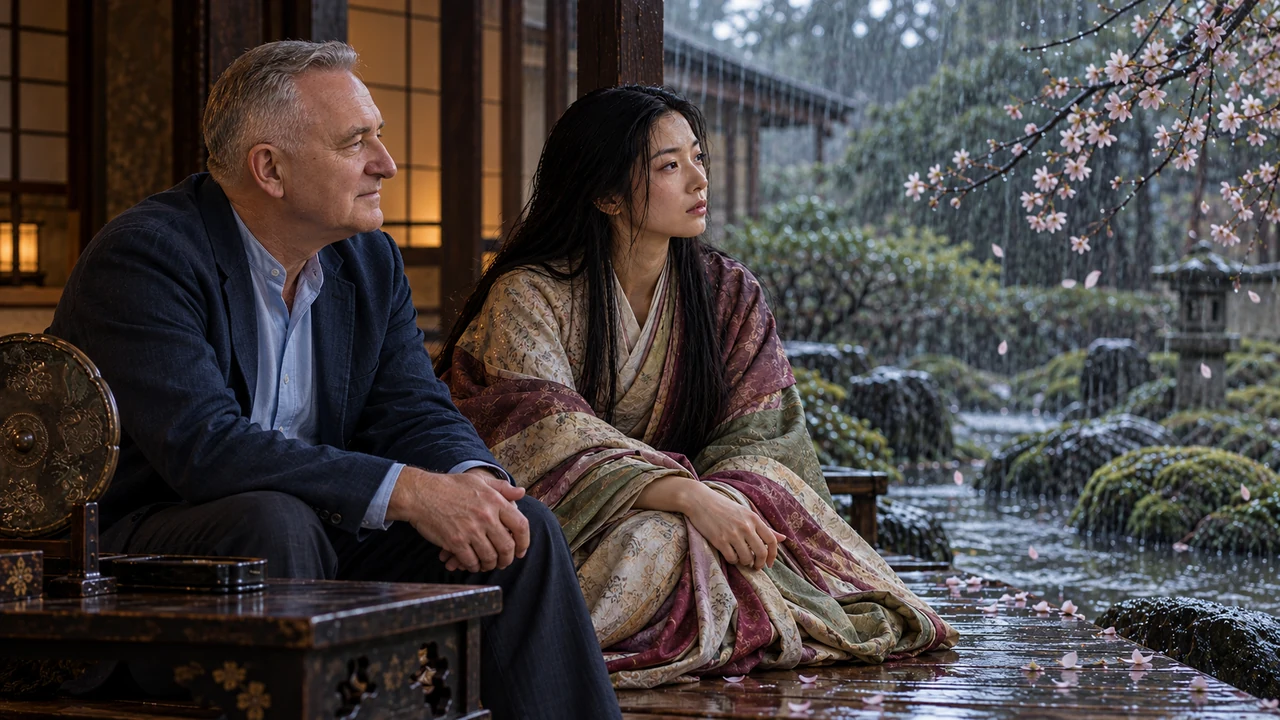
In Ono no Komachi's poem the cherry blossoms fade, and in their washed-out color she recognizes her own fading. Long rains, quiet gazing, and passing days converge inside a few short lines. Between what she looks at and what has happened to her, no calm boundary can be drawn anymore.
We notice the world changing and can arrive late to recognizing the change within ourselves. Komachi gives that lateness a voice. The poem preserves the instant in which a person realizes that time has already passed through her; it cannot give that time back. Reading it, I find myself inside the same movement.
Hana no iro wa (Kokin Wakashū 113)
The five-line waka by Heian poet Ono no Komachi (Kokin Wakashū, Book II, no. 113, c. 905 CE) answers the question: what does time do to us while we think we are merely watching it? Looking at faded cherry blossoms under long rain, she recognizes her own passing youth. The Japanese text binds outer weather and inner aging through double-meaning words (kakekotoba): nagame (“long rains” and “lost in thought”) and furu (“rain falls” and “growing old”).
The blossom's tint is washed away
By heavy showers of rain;
My charms, which once I prized so much,
Are also on the wane;
Both lost, alas, in vain!
花の色は
うつりにけりな
いたづらに
わが身世にふる
ながめせしまに
Staying Beside the Question
In this image, the contemporary author stands beside his interlocutor (Ono no Komachi · 'The Color of the Flowers...'). This encounter is created for a conversation through the poem; the contemporary participant's likeness is grounded in photographs of Oleksandr Bochkala.
The image does not claim a literal historical meeting—it opens a shared space where the poet’s question is addressed to us today and asks for a personal answer.
Historical Context & Keys to the Text
Philological edition and annotated commentary on Kokin Wakashū: Prof. Helen Craig McCullough (Stanford University / UC Berkeley, Stanford University Press 1985), Prof. Laurel Rasplica Rodd (University of Colorado Boulder), and the National Institute of Japanese Literature (NIJL, Tokyo).