Nahua Song Tradition · Cantares Mexicanos, Song XXIVI will depart. To whom will the song remain?
What can a mortal voice leave behind in a world where even flowers wither?
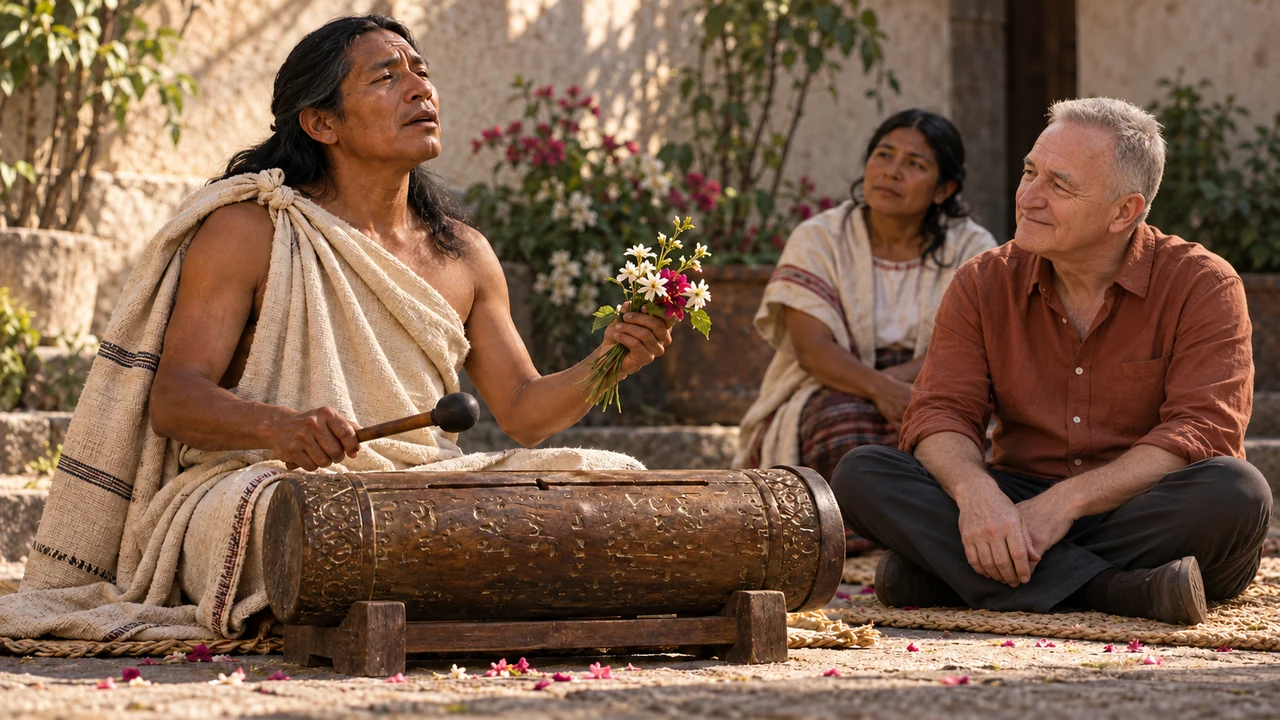
To the two-toned beat of the wooden teponaztli slit-drum and the thunder of the deerskin huehuetl, the dance circle turns in the courtyard of the Cuicacalli amid falling poyoma blossoms. Deep within the singer’s heart the flower of song blooms open, yet at the height of the feast comes a sudden turn: he will wrap himself in song like a parting shroud as he departs.
Out of that awareness rises a tearful vow to leave behind his renown in flowers and his name in songs, so that one day his heart may intertwine as flowers among the children and rulers. Listening to this voice brings me back to a core question of making: what flower or song can still meet the living after our own time has run out?
In Xochitl In Cuicatl (Flowers and Songs, Song XXIV)
Song XXIV from the Nahuatl manuscript Cantares Mexicanos (Biblioteca Nacional de México, MS 1628bis, fols. 28v–29r, §§ 531–536; ed. D. G. Brinton, 1890; UNAM, 2011) voices a core paradox of Nahua poetics: to the beat of teponaztli and huehuetl drums, the flower of song blooms open deep within the singer’s heart (ontlapani on cuicaxochitl), and wrapping himself in song as a parting shroud, he leaves his song-name behind so his heart may intertwine as flowers among children and rulers.
Quititi, quititi, quiti tocoto, tocoti tocoto tocoti: right on this drumbeat, the dance circle turns back again.
Let flower-songs rise, and let my companions take them up:
the intoxicating flower has already arrived here
and comes in full strength into the land adorned with poyoma blossoms.
Let the flowers appear right here:
across this grove of joyful flowers, they pour out and shower down all around;
surely these are the many-hued, varied blooms.
Now the huehuetl drum thunders: let the dance begin!
My heart is painted with the precious poyoma blossom as I sing;
the flowers themselves shower down,
and I gather them at once: rejoice!
Only deep within my heart does the flower of song bloom open, and I scatter it across the flower garden.
I will wrap myself in song as I depart, so that one day
my heart may intertwine as flowers among the children and rulers.
This is why I weep at times and say only this:
I will leave behind my renown in flowers, my name in songs before I go, and one day
my heart will intertwine as flowers among the children and rulers.
Quititi, quititi, quiti tocoto, tocoti tocoto tocoti zan ic mocueptiuh.
Ma xochicuicoya ma ihtoa nichuana ayyahue
teyhuinti xochitl aoyano yehcoc ye nica
poyoma xahuallan timaliuhtihuitz ay yo.
Ma xochitl oyecoc ye nican ayyahue
zan tlaahuixochitla moyahuaya motzetzeloa
ancazo yehuatl in nepapaxochitl ayyo.
Zan comoni huehuetl ma ya netotilo.
Yn quetzal poyomatl a yc ihcuilihuic noyol nicuicanitl
in xochitl ayan tzetzelihui ya
ancuel nicuiya ma xonahuacan ayio
zan noyolitic ontlapani on cuicaxochitl nicyamoyahuaya yxoochitla.
Cuicatl ya ninoquimilotehuaz in quemmanian
xochineneliuhtiaz noyollo yehuan tepilhuan oon teteuctin in ca yio.
Zan ye ic nichoca in quemanian zan nicaya ihtoa
noxochiteyo nocuicatoca nictlalitehuaz in quemanian
xochineneliuhtiaz noyollo yehuan tepilhuan oon teteuctin in ca yio.
Tenochtitlan (1500 CE): Sacred Precinct, Cuicacalli ("House of Song") & Lake Texcoco in 3D
Fly over the island metropolis of Tenochtitlan in the middle of Lake Texcoco: enter the red-and-white colonnaded courtyard of the Cuicacalli ("House of Song") where poets and tlamatinime sages gather around glowing copal braziers and carved teponaztli drums to sing Song XXIV ("At least flowers, at least songs!"), inspect the twin pyramid of Templo Mayor, and glide through the floating chinampa flower gardens.
Ready to Enter 3D Tenochtitlan (1500 CE)?
The 3D scene launches on click so it never traps page scrolling while you read Song XXIV. Inside you can orbit and zoom the camera, trigger a festive blossom & quetzal salute over the Cuicacalli, switch weather to Tlaloc’s tropical rain or golden sunset, and hear the teponaztli drum and clay flute.
✦ Archaeological Dossier of this 3D Scene: Cuicacalli ("House of Song"), Poets’ Garden, Templo Mayor & Chinampas (Read)▼
Cuicacalli House of Song & Courtyard of Drums
An open red-and-white stuccoed courtyard with colonnaded porticoes flanking the Sacred Precinct. Here at sunset gather singer-poets (cuicanime [masters of lyric meter and chant]) and philosophers (tlamatinime [sages who inquire into the nature of existence]). At the center sound the horizontal teponaztli [a hollowed hardwood slit-drum with two H-cut tongues of distinct pitch] and the upright huehuetl [a tall carved wooden cylinder topped with stretched jaguar or deer skin].
Aromatic blue-white smoke of copal resin [incense harvested from tropical Bursera trees] rises from stone braziers while columns are draped in golden cempasuchil [ritual Aztec marigold garlands].
Templo Mayor: Twin Shrines of Tlaloc & Huitzilopochtli
The monumental four-tiered stepped pyramid at the axis mundi of the Nahua cosmos, embodying the sacred mountain Coatepec ("Serpent Hill"). Twin steep balustraded stairways ascend from the west to two summit temples: the northern blue shrine of Tlaloc [deity of lifegiving rain, thunder, and agriculture] and the southern red shrine of Huitzilopochtli [solar patron deity of Tenochtitlan].
Carved stone serpent heads anchor the bases of the balustrades. Before Tlaloc’s shrine rests a polychrome chacmool [reclining stone figure holding a receptacle for rain offerings], while Huitzilopochtli’s side is aligned with the monumental Coyolxauhqui [lunar sister of the sun] monolith.
Botanical Garden of Flowers & Quetzal Aviary
A serene palace garden of terraced reflecting pools cultivating rare flora brought from across Mesoamerica: cacao trees, fragrant yolloxochitl [heart-flower magnolia], crimson poinsettias, and golden marigolds. Lattice pavilions house iridescent birds—emerald quetzals [sacred cloud-forest birds prized for long green tail plumes] and roseate spoonbills.
Here philosopher-poets (tlamatinime [Nahua sages]) held dialogues on human transience, contrasting the fragility of stone, jade, and gold against the enduring beauty of living poetry.
Chinampa Floating Gardens & Canals
A belt of engineered agricultural islands (chinampa [from Nahuatl chinamitl, "reed enclosure": rectangular beds of lakebed silt and aquatic vegetation]) anchored by the living roots of slender ahuejote [water willow] trees. Sub-surface capillary irrigation and nutrient-rich canal muck yielded up to four harvests a year of maize, crimson amaranth, beans, and ceremonial flowers.
Straight water canals between the chinampas are plied by flat-bottomed wooden dugout canoes (acalli [literally "water-house", carved from a single pine or cedar trunk]).
Staying Beside the Question
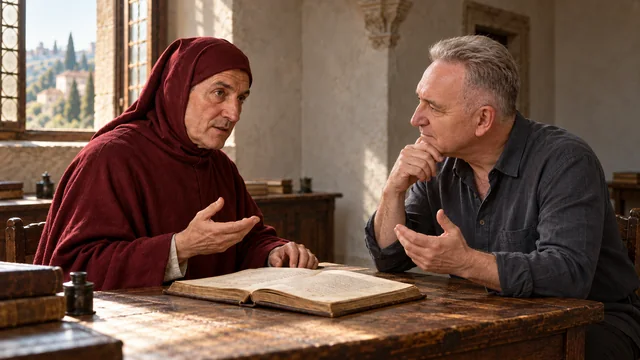
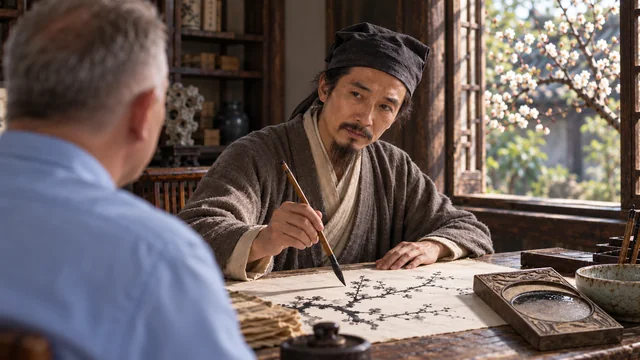
In this image, the contemporary author stands beside his interlocutor (Nahua Song Tradition · Cantares Mexicanos, Song XXIV). This encounter is created for a conversation through the poem; the contemporary participant's likeness is grounded in photographs of Oleksandr Bochkala.
The image does not claim a literal historical meeting—it opens a shared space where the poet’s question is addressed to us today and asks for a personal answer.
Historical Context & Keys to the Text
Nahuatl philology and critical editions of Cantares Mexicanos (BNM MS 1628bis): Prof. Miguel León-Portilla (Universidad Nacional Autónoma de México — UNAM, 2011), Prof. Ángel María Garibay Kintana (UNAM), Prof. John Bierhorst (Stanford University Press, 1985), and Prof. Daniel G. Brinton (University of Pennsylvania, 1890).