Rumi · Opening of the 'Masnavi', Song of the ReedA voice that remembers separation from the whole
How can one be a separate self and still feel belonging to what one was torn from?
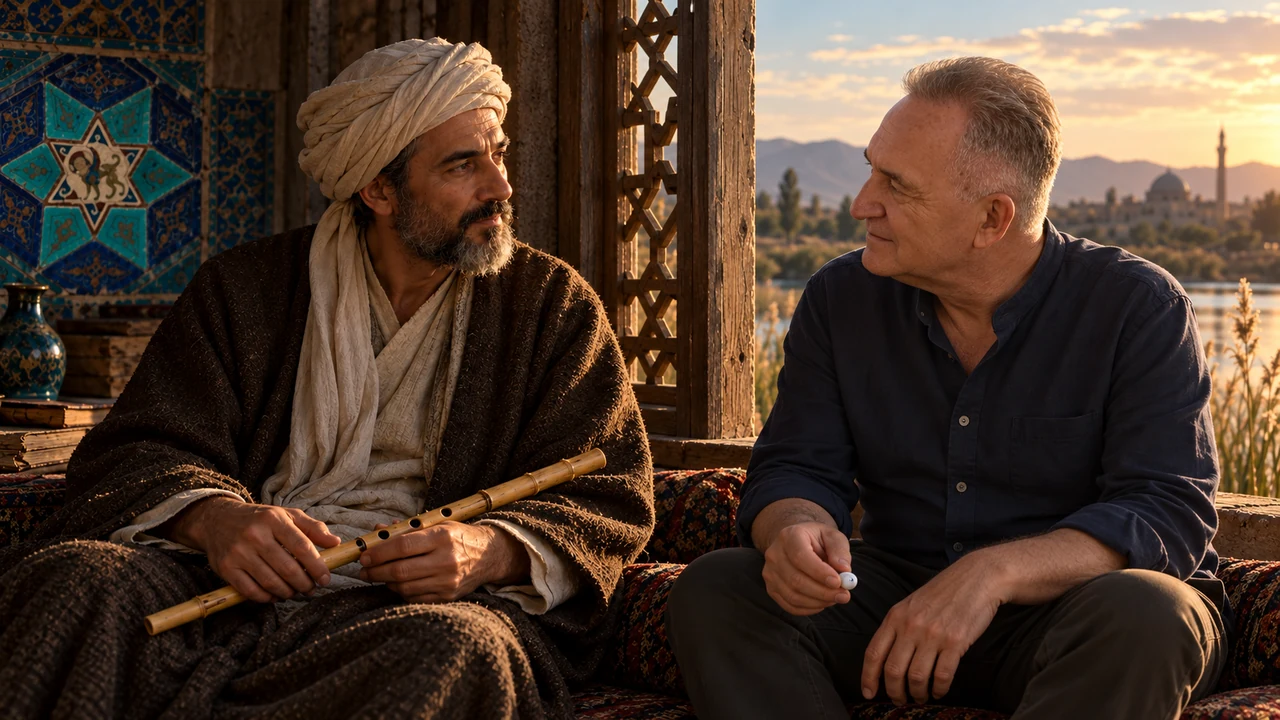
Rumi's reed flute sings because it has become an instrument, and laments because it was torn from its reed bed. Its voice carries separation from its source. To hear that speech requires a heart that knows rupture of its own.
In Sufi reading, behind the longing of the flute opens human separateness and the desire to return to a larger whole. The bond with that whole is experienced even through absence. What matters to me is hearing how an acquired voice and a lost unity meet inside a single sound. How do we express that longing without turning it into an easy promise that every separation will be healed?
Song of the Reed (Masnavi-ye Ma'navi, Book I Prologue)
The eighteen opening couplets of Jalal al-Din Rumi’s Masnavi-ye Ma’navi (“Song of the Reed,” Konya, c. 1258–1273 CE, collated from the 1278 Mevlana Museum manuscript) reveal the paradox of the human voice: the reed flute (ney) can sing only because it was severed from its reed bed and hollowed out. Separation from the whole becomes the very medium of song.
Hearken to the reed-flute, how it complains,
Lamenting its banishment from its home:
"Ever since they tore me from my osier bed,
My plaintive notes have moved men and women to tears.
I burst my breast, striving to give vent to sighs,
And to express the pangs of my yearning for my home.
He who abides far away from his home
Is ever longing for the day he shall return."
Staying Beside the Question
In this image, the contemporary author stands beside his interlocutor (Rumi · Opening of the 'Masnavi', Song of the Reed). This encounter is created for a conversation through the poem; the contemporary participant's likeness is grounded in photographs of Oleksandr Bochkala.
The image does not claim a literal historical meeting—it opens a shared space where the poet’s question is addressed to us today and asks for a personal answer.
Historical Context & Keys to the Text
Critical edition based on the 1278 Konya manuscript: Prof. Reynold A. Nicholson (University of Cambridge, E. J. W. Gibb Memorial Series, 1925–1940), Prof. Mohammad Estelami (McGill University), and Prof. Jawid Mojaddedi (Rutgers University, Oxford University Press).