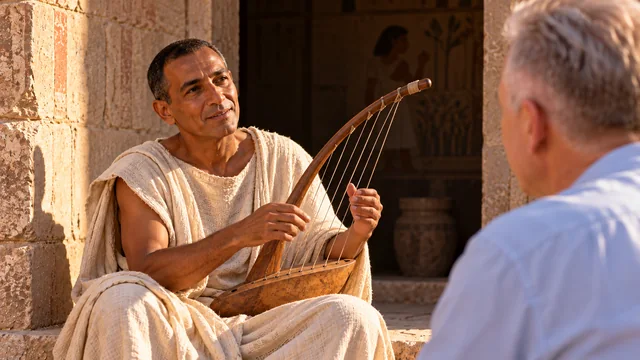
Enheduanna · Exile in 'The Exaltation of Inanna'A prayer from the place where faith is wounded
Whom do you address when the sacred order you served failed to protect you?
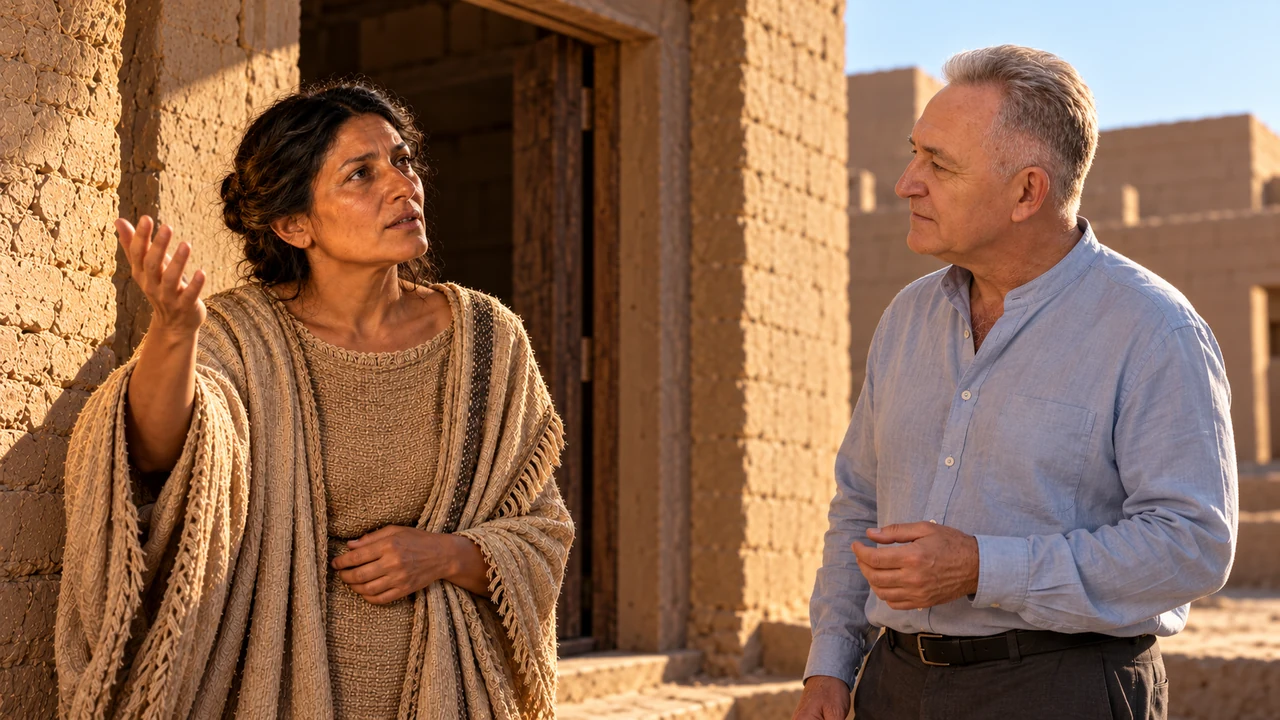
Enheduanna speaks to the goddess from a world where her devotion did not save her from exile. Her place in the temple was stripped away; her plea received no judgment from Nanna. Yet she continues to seek justice from the gods: her tears become an offering to Inanna, and a humiliated voice demands an answer.
In this prayer we hear both shattered trust and the impossibility of severing the bond with what gave life its meaning. Can one keep believing without hiding one's anger and pain? I come to Enheduanna with that question. Her world was built differently, yet the need to address what is larger than ourselves outlived both her temple and her exile.
The Exaltation of Inanna (Nin-me-šara, excerpt)
The Sumerian temple hymn “The Exaltation of Inanna” (Nin-me-šara, lines 66–111, c. 2285–2250 BCE) by Enheduanna, high priestess of Ur, is a foundational written monument signed with a personal authorial “I.” Driven into exile by usurper Lugal-ane while the Moon god Nanna remains silent, she appeals to Inanna. The modern translation restores ritual realia obscured by older editions.
The 23rd century BCE. Southern Mesopotamia. Daughter of Sargon of Akkad, the high priestess Enheduanna serves the Moon god Nanna at the great temple of Ur—Ekishnugal. During an uprising, the rebel ruler Lugal-ane seizes the sanctuary, demands that the priestess sanction his usurpation, and after her refusal tears off her tiara and drives her into the desert steppe.
Behind her rises the captured white ziggurat, above which the disk of the Moon god shines cold and indifferent. Around her lies a scorched waste of thorny brush tearing her feet to blood. And here something happens that world literature had never seen before: for the first time in history, a human being speaks her own name inside a poem. “I am Enheduanna.” When the god of the temple to whom she gave her life remains silent, she carries her case directly to Inanna.
I am Enheduanna; I will speak this prayer to you,
I will pour my tears into your hands like sweet barley beer,
To the noble daughter Inanna I will speak words of greeting and peace,
This grave crime does not even trouble Ashimbabbar:
In the Ekishnugal temple he wiped away the purification rites of your sacred house,
And I, together with my sacred tiara, have been crushed right before your eyes.
The god Nanna renders no verdict in my case,
"You are destroyed!" the usurper declared to me.
Lugal-ane broke into the temple and defiled its hand-washing rites,
He drove me by force out of the inner sanctuary,
Like a bird from its nest, he made me fly away.
Though I am the high en-priestess, he cut me off from your temple,
He forced me to walk through thickets of thorny brush.
He tore off my sacred tiara and shattered my diadem,
He put a dagger and a sword into my hands so that I would kill myself.
My mouth, once sweet as honey, is now covered with bitter foam,
Everything with which I gladdened and calmed hearts has been trampled into the dust,
And my hair is tangled by the wind in the desolate steppe.
The god Suen has not stood up in judgment against Lugal-ane—
Give the command yourself, Inanna, to overturn this cruel fate with your hand:
Nanna gave no verdict—now the decision is yours to make!
me-e {d}en-he2-du7-an-na-me-en šud3-bi ga-mu-ra-ab-dug4
er2-gu10 kaš dug3-ga-gin7 šu-za ga-mu-ra-ab-dug4
dumu-gir15 {d}inana-ra silim-ma ga-na-ab-be2
{d}aš-im2-babbar-ra nir-da-an-bi la-ba-an-kuš2-u3
e2-kiš-nu-gal2-la ki-tuš kug-za šu bi2-in-luh
me-e men kug-ga-gu10-še3 igi-zu-še3 ba-e-gul
{d}nanna-a di-gu10 la-ba-ab-sum-mu
"ba-e-gul!" bi2-in-dug4-ga
lugal-an-ne2 e2-a ba-an-ku4 šu-luh-bi ba-an-hul
itima-a-ni-ta mu-un-da-an-kur2-re-en
mušen-e gud3-bi-ta šu ba-ni-ib-dal-en
me-e en-me-en e2-za-ta mu-un-da-an-tar-re-en
giš-dih3-a mu-un-ši-in-jen-ne2-en
men kug aga zir-ra šu ba-ab-dug4
giri2-giri2-a ba-an-sum-mu
ka lal3-gu10 uhl-e ba-ab-dug4
nig2 ur5 sa6-ge-gu10 sahar-ta ba-da-ab-gi4
siki-gu10 edin-na mu-un-da-ab-bir-re
{d}suen-e lugal-an-ne2-ra nam-mu-un-de3-gub-bu
{d}inana-ra šu-a bal-e-bi dug4-ga-ab
{d}nanna li-bi2-in-dug4-ga za-a-kam!
Sacred Eanna Precinct & Uruk in the Age of Inanna and Gilgamesh (3D)
Step inside a 3D reconstruction of ancient Uruk at sunset: inspect the stepped terrace of the Eanna temple ("House of Heaven") with Inanna’s ringed standards and clay-cone mosaics, trigger a Shamal dust storm, listen to the Lyre of Ur, and browse the cuneiform glossary.
Ready to Enter 3D Uruk?
The 3D scene launches on click so it never traps page scrolling while you read the poem. Inside you can orbit and zoom the camera, run the Gilgamesh reign auto-tour, play the Lyre of Ur, and explore the cuneiform glossary.
✦ Archaeological Dossier of this 3D Scene: Sacred Eanna Precinct & Cuneiform Heritage (Read / Index)▼
Temple of Inanna — Sacred Eanna Precinct
At the heart of Uruk rises the stepped terrace and ziggurat of Eanna, dedicated to the goddess Inanna (Akkadian Ishtar) and the sky god Anu. Its facades are articulated with stepped buttresses and tens of thousands of baked clay cones dipped in red ochre, white gypsum, and black bitumen.
- The walls and half-columns of the Eanna complex were sheathed in tens of thousands of 10-cm baked clay cones painted in red ochre, white gypsum, and black bitumen to weatherproof the mudbrick.
- In the Eanna treasury, archaeologists discovered the famous carved alabaster Warka Vase (c. 3000 BCE), depicting a ritual procession bringing offerings before Inanna’s ringed reed standards.
Market Square (Kārum) & Processional Way
Ancient Uruk was the nexus of long-distance exchange: lacking local stone, timber, or ore in the alluvial plain, merchants imported copper from Dilmun (Bahrain) and Magan (Oman), lapis lazuli from Badakhshan, and cedar from Lebanon in exchange for barley, woolen textiles, and dates.
- The Sumerian term kar (Akkadian kārum) originally denoted a canal quay or harbor around which the central marketplace, merchant warehouses, and commercial courts developed.
- Badakhshan lapis lazuli traveled over 2,500 kilometers from the Pamir Mountains to Uruk, a trade celebrated in the Sumerian epic "Enmerkar and the Lord of Aratta".
Staying Beside the Question
In this image, the contemporary author stands beside his interlocutor (Enheduanna · Exile in 'The Exaltation of Inanna'). This encounter is created for a conversation through the poem; the contemporary participant's likeness is grounded in photographs of Oleksandr Bochkala.
The image does not claim a literal historical meeting—it opens a shared space where the poet’s question is addressed to us today and asks for a personal answer.
Historical Context & Keys to the Text
“I am Enheduanna” (me-e En-hedu-ana-me-en)
The first signed authorial “I” in human history. Before her, texts were anonymous. Naming herself here is not vanity—it is the direct act of a person stepping forward in her own name before a higher court.
Tears like sweet barley beer (kaš dug3-ga)
In the temples of Ur, the finest sweet barley beer brewed with date syrup was poured daily for the gods. Stripped of her ritual vessels in exile, Enheduanna has only her own tears left—and pours them into the goddess’s hands.
The silence of Ashimbabbar / Nanna
Ashimbabbar ('the Rising White Light') and Suen are names of the Moon god Nanna, patron of Ur. The tragedy’s sharpest edge is that the temple is defiled right beneath the Moon god’s gaze—yet he refuses to defend his own high priestess.
Torn tiara (men kug) and shattered diadem (aga)
The round golden tiara and diadem of the high en-priestess were the physical insignia of her inviolable status as earthly consort of the Moon god. Tearing them off meant publicly erasing her office and identity.
A dagger and sword put into her hands (giri2-giri2-a)
The usurper Lugal-ane fears shedding the sacred blood of the high priestess with his own hands, so he hands her a blade: kill yourself. Her refusal to comply is the very point from which this hymn is born.
Mouth covered in foam & hair tangled in the steppe (edin)
A 'honeyed mouth' was the Sumerian term for a priestess’s clear liturgical voice. Driven into the scorched steppe (edin—the lawless wasteland beyond the city walls), her lips crust with bitter foam from thirst and crying.
Critical text and collation: Prof. Annette Zgoll (Georg-August-Universität Göttingen, 1997), Prof. William W. Hallo & Prof. J. J. A. van Dijk (Yale University, 1968), Prof. Jeremy Black (University of Oxford, ETCSL t.4.07.2), and Prof. Enrique Jiménez (LMU Munich, Electronic Babylonian Literature).