CATHARSIS GROOVE — Solar Vinyl Mandala emblem
CATHARSIS GROOVEWorld Poetry · Translations · Songs · 3D
RU
CATHARSIS GROOVE — Timeless Emotional Beats: visual project banner and sound portal across 6 historical epochs
POETRY · HUMAN BEING · TIME · ENCOUNTERS ACROSS EPOCHS
CATHARSIS GROOVE — Solar Vinyl Mandala
POETRY · HUMAN BEING · TIME · META-RENAISSANCE
CATHARSIS GROOVE
OLEKSANDR BOCHKALA · POETRY, ART, AND TECHNOLOGY
Tap disc for sound
♫ In player: Manoratha (Rigveda X.135) (ORIG · RU · EN · Ṛgveda X.135)
Open Poem, Translation & Song ↗

There are questions and feelings that make us human across all ages.

What it means to be alive and mortal — in love and parting, in the birth of children, in creation, in every passing moment of our journey through time.

They left behind the possibility of an encounter — poetry that preserves a personal “I” beyond past and future, right here in our present.

CATHARSIS GROOVE is a series of encounters with people of other eras and cultures in search of answers. A conversation through a hymn to a goddess — with Enheduanna, poet and exiled priestess of ancient Ur. Through Odi et amo — with Catullus, crucified by his own love upon the cross of simultaneous hatred and passion. An encounter through Sappho’s lines with a woman whose body burns with fire and whose voice is paralyzed by love.
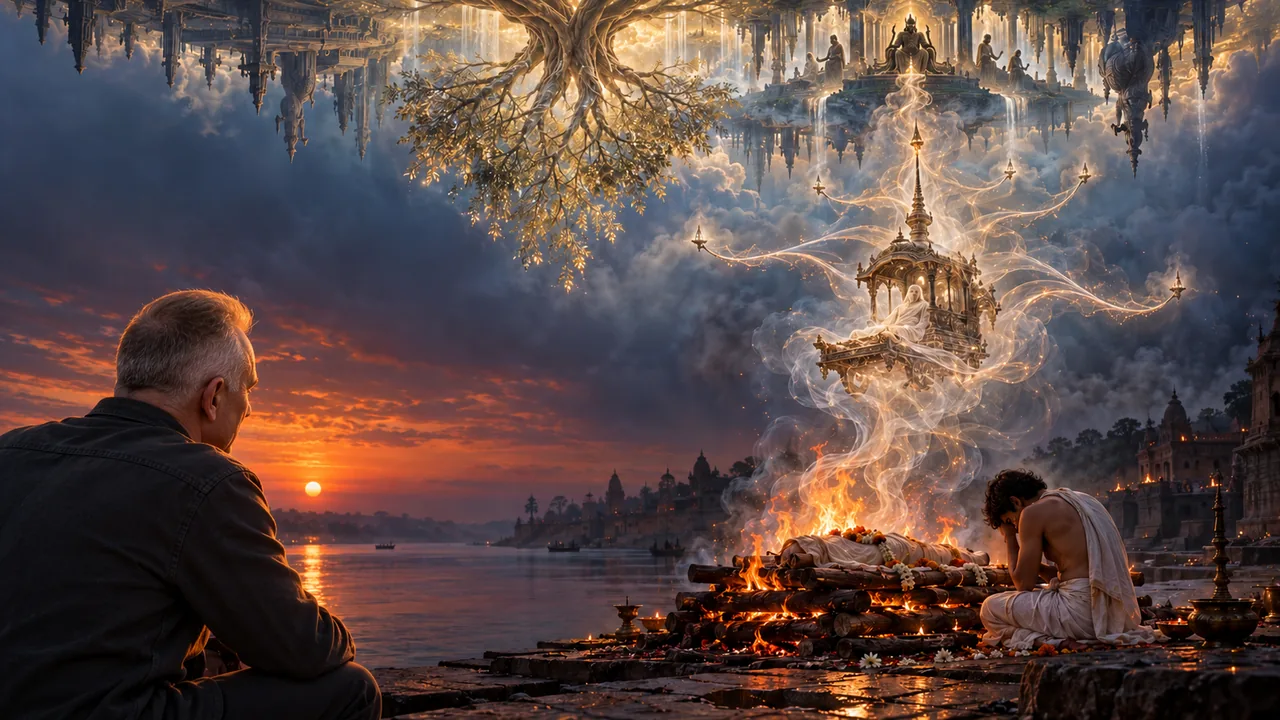
Oleksandr Bochkala on stone river ghats watches a bereaved boy and the wheelless chariot Manoratha (Rigveda 10.135, 1200–900 BCE).
♫ Premiere · Text + Translation + 3 AudioQuestion 11 · Mortality & What Remains
Vedic India · Manoratha (RV X.135)
Chariot of mind and heart in the boat of the Sāman
Open ↗

«What happens to us after death—and how do we live knowing that we and everyone we love will die?»

THREE AUDIO FORMATS (LISTEN IN PLAYER):ORIG · RU · EN
Open Poem, Translation & Song Page →
SCALE OF MEANING & TIME · 12 ETERNAL QUESTIONS ACROSS ALL 6 EPOCHSChoose Your Question ↓

Twelve Eternal Human Questions sound across all six epochs: for every question, the project’s poetic library already holds voices from diverse cultures awaiting personal encounters.

SCALE OF MEANING · 12 ETERNAL HUMAN QUESTIONS ACROSS ALL SIX EPOCHS

What would you ask the people who lived before us?

The Twelve Eternal Human Questions form a supra-epochal scale of meaning connecting a contemporary person’s real struggles, pain, love, and search for purpose with the poetic answers of ancestors, music, and visual art. All Eternal Questions sound across all six historical epochs (3000 BCE – 1930 CE): in the project’s poetic library, works from diverse cultures are already selected for every question, while personal encounters with the authors open invitations to living contact.

QUESTION 01
E1E2E3E4E5E6

How did the world begin—and is there an order in what happens?

Where does the sense of order or chaos come from when we face the universe?

In the question’s poetic library (all 6 epochs · cultures):

Vedic India · Sumer & Babylon · Hellas & Rome · Ancient China · Norse & Celtic North · English Romanticism · Modernity

Invitations to contact (open encounters):
Show on 6 epoch layers ↓All Works for Question →
QUESTION 02
E1E2E3E4E5E6

What is real—and what can we trust?

When inherited dogmas crumble, what remains trustworthy?

In the question’s poetic library (all 6 epochs · cultures):

Thebes & Vedic India · Hellas & Upanishads · Tang China · Bhakti India (Kabir) · Mexican Baroque · Amherst

Invitations to contact (open encounters):
Show on 6 epoch layers ↓All Works for Question →
QUESTION 03
E1E2E3E4E5E6

Who am I—and what remains me when everything changes?

How do we recognize our own voice amid shifting roles and passing years?

In the question’s poetic library (all 6 epochs · cultures):

Ancient Egypt & Babylon · Lesbos & Rome · Heian Japan · Sufi East & Tuscany · Romanticism · American Modernism

Invitations to contact (open encounters):
Show on 6 epoch layers ↓All Works for Question →
QUESTION 04
E1E2E3E4E5E6

What makes life worth living?

What remains truly precious in an ordinary human day in the face of mortality?

In the question’s poetic library (all 6 epochs · cultures):

Thebes & Babylon · Daoist China & Classical Antiquity · Celtic & Tang Lyric · Tenochtitlan (Nahua Songs) · Modernity

Show on 6 epoch layers ↓All Works for Question →
QUESTION 05
E1E2E3E4E5E6

What can I truly choose—and what am I responsible for?

Where is the boundary between fate, circumstance, and personal choice?

In the question’s poetic library (all 6 epochs · cultures):

Ugarit, Hittite Anatolia & India · Athenian Tragedy & Lesbos · Latin Europe · Renaissance · Baroque · Bengal & 20th-c. Europe

Invitations to contact (open encounters):
Show on 6 epoch layers ↓All Works for Question →
QUESTION 06
E1E2E3E4E5E6

How do we live with suffering?

How does inner fracture transform into form and clarity rather than numbness?

In the question’s poetic library (all 6 epochs · cultures):

Hittite Anatolia & Babylon · Biblical Job & Hellas · Old English Elegies · Italy & Persia · Romanticism · Latin America & Europe

Invitations to contact (open encounters):
Show on 6 epoch layers ↓All Works for Question →
QUESTION 07
E1E2E3E4E5E6

What makes love, intimacy, and trust real?

Why does closeness to another person bring both fullness and vulnerability?

In the question’s poetic library (all 6 epochs · cultures):

Egyptian Papyri & Babylon · Lesbos & Rome · Classical India & Heian Japan · Sufi East & Renaissance · Punjab · Latin America

Invitations to contact (open encounters):
Show on 6 epoch layers ↓All Works for Question →
QUESTION 08
E1E2E3E4E5E6

What do we owe one another?

What holds human beings together across exile, conflict, and distance?

In the question’s poetic library (all 6 epochs · cultures):

Mesopotamia & Egypt · Ancient China & Greek Polis · Tang & Song Poetry · Bhakti India & Renaissance Europe · Modernity

Invitations to contact (open encounters):
Show on 6 epoch layers ↓All Works for Question →
QUESTION 09
E1E2E3E4E5E6

Why create and act if the result may vanish?

Why build, sing, or craft if time erodes even stone?

In the question’s poetic library (all 6 epochs · cultures):

Ur & Karnak · Classical Rome · Persia (Ferdowsi) · Yuan China & Florentine Renaissance · Blake’s Workshop · 20th Century

Invitations to contact (open encounters):
Show on 6 epoch layers ↓All Works for Question →
QUESTION 10
E1E2E3E4E5E6

What does time do to us?

Why do years slip away while a single moment stays forever?

In the question’s poetic library (all 6 epochs · cultures):

Babylon & Egypt · Jerusalem of Qoheleth · Song China (Su Shi) & Heian Japan · Shakespearean Sonnets · Qing China · Symbolism

Invitations to contact (open encounters):
Show on 6 epoch layers ↓All Works for Question →
QUESTION 11
E1E2E3E4E5E6

How do we live knowing we will die—and what remains after us?

Can a word or melody outlive its creator by millennia and speak again?

In the question’s poetic library (all 6 epochs · cultures):

Vedic India (Rigveda X.135) & Uruk · Katha Upanishad & Antiquity · Norse North & East · France & Italy · Metaphysicals · Amherst & Paris

Invitations to contact (open encounters):
Show on 6 epoch layers ↓All Works for Question →
QUESTION 12
E1E2E3E4E5E6

What is larger than a single human being—and how are we connected to it?

How can a single human voice hold the sky, the ocean, and infinity?

In the question’s poetic library (all 6 epochs · cultures):

Sumerian Ur (Enheduanna) · Psalms, Avesta & Upanishads · Andalusia & Byzantium · Dante, Kabir & Nanak · Romanticism · Dickinson & Rilke

Invitations to contact (open encounters):
Show on 6 epoch layers ↓All Works for Question →
HORIZONTAL LAYERS OF TIME · SIX EPOCHS & INVITATIONS TO CONTACT

With what question will you come?

The six historical epochs are horizontal layers of time where diverse cultures create their own unique answers to the 12 Eternal Questions. Voices from each epoch are already selected in the project’s poetic library, and here the author’s personal encounters with the poets are open—invitations to contact where you can read the poem, hear the song, inspect the 1:1 museum artifact, and switch interlocutors within the epoch.

Source geography & cultures within this epoch (Eternal Questions):Mesopotamia (Sumer, Akkad, Babylon) · Ancient Egypt (Thebes, Memphis) · Vedic India · Hittite Anatolia · Ugarit & Canaan
All E1 Works →
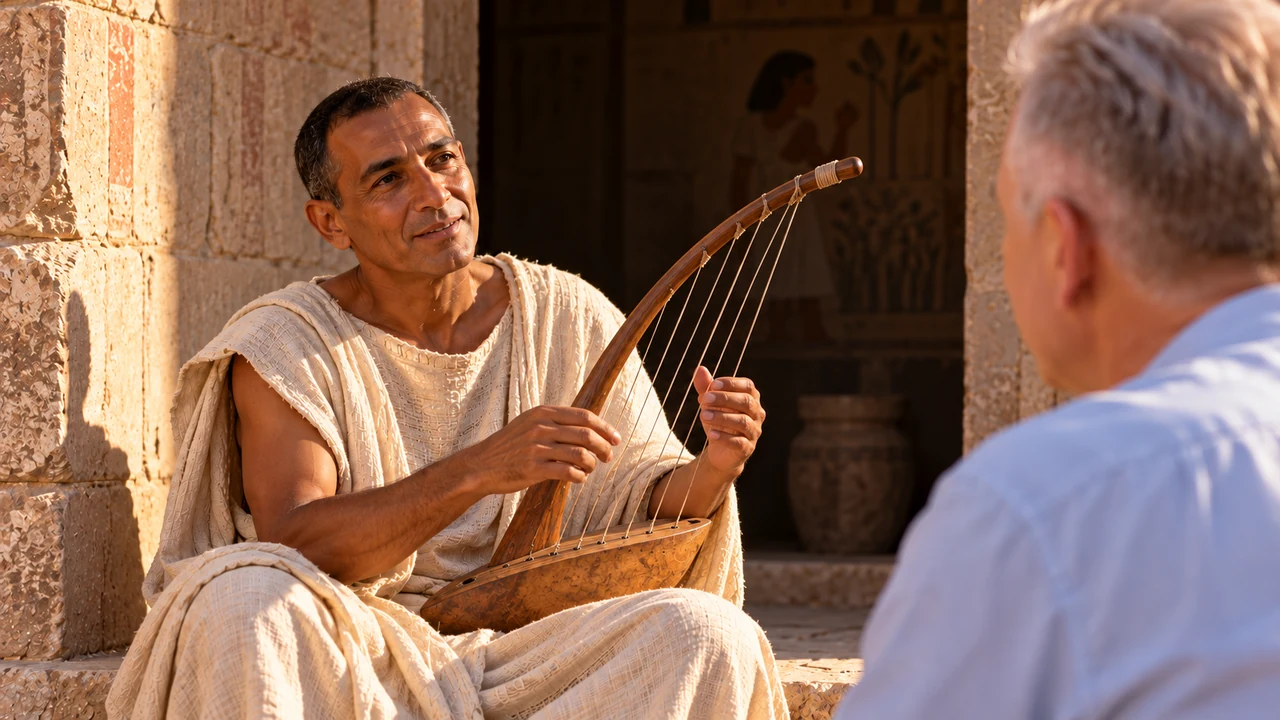
Blind Egyptian harper with arched harp at King Intef’s tomb beside Oleksandr Bochkala (Papyrus Harris 500, EA 10060, 2050 BCE).
♫ Song Premiere (ORIG · RU · EN)◈ 3DQuestion 04
Ancient EgyptRead Poem ↗
Theban necropolis of King Intef: blind harper with arched benet harp and hieratic “Song of the Harper” (Papyrus Harris 500, British Museum EA 10060).© Catharsis Groove
Song of the Harper · Tradition of King Intef

Rejoicing while knowing you will leave

What makes life worthwhile if everything we possess must be left behind?

The Harper's Song does not promise that death will explain everything. Dwellings have crumbled, generations have vanished; no one has returned to calm the living with an account of what awaits them. And in the very same song sounds an invitation to put on festive linen, anoint oneself with myrrh, and follow the desire of the heart.

Generations of people pass away and disappear,
while others take their place since the time of the ancestors.
The god-kings who lived before lie in their pyramids,
and the great and the honored dead are likewise buried in their tombs.
Those who built houses — their places no longer exist;
see what has become of them!
♫ Listen to song & reconstruction:
800 BCE–300 CEBirth of Self✦ 3D Jerusalem of Qoheleth ↗✦ 3D Rome of Catullus (55 BCE) ↗
Source geography & cultures within this epoch (Eternal Questions):Hellas & Aegean Islands · Rome · Ancient Israel (Jerusalem) · Zhou & Han China · India of the Upanishads & Early Buddhism · Ancient Iran
All E2 Works →
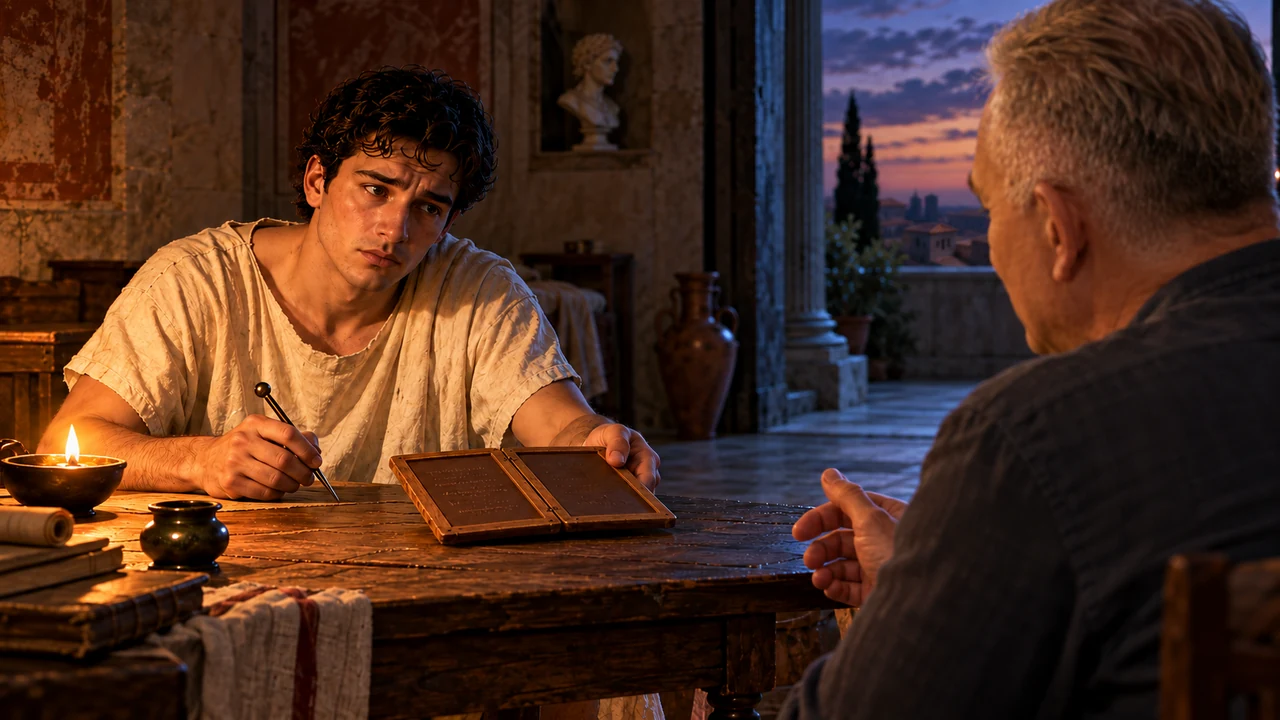
Roman poet Catullus turns a wax tablet inscribed with Latin Carmen 85 (Odi et amo, 55 BCE) toward Oleksandr Bochkala.
◈ 3DQuestion 03
Ancient RomeRead Poem ↗
Nocturnal Rome (c. 55 BCE): Gaius Valerius Catullus with iron stylus and hinged wax tablet (pugillares) inscribed with Carmen 85 (“Ōdī et amō”).© Catharsis Groove
Catullus, Carmen 85

I do not know why. Yet it is happening to me.

Who am I when opposite feelings within me are equally real?

Catullus loves and hates at the same time. When asked why, he answers with non-knowing, and then testifies to what he feels: it is happening, and it tears him apart. A human being cannot explain himself and yet knows his own pain.

I hate and I love. Why do I do this, perhaps you ask?
I do not know, but it is happening, and I feel crucified.
300–1100 CESynthesis and Isolation
Source geography & cultures within this epoch (Eternal Questions):Tang & Song China · Nara & Heian Japan · Classical India · Persia & the Arab East · Andalusia · Latin Europe, Celtic Ireland, Britain & Scandinavia
All E3 Works →
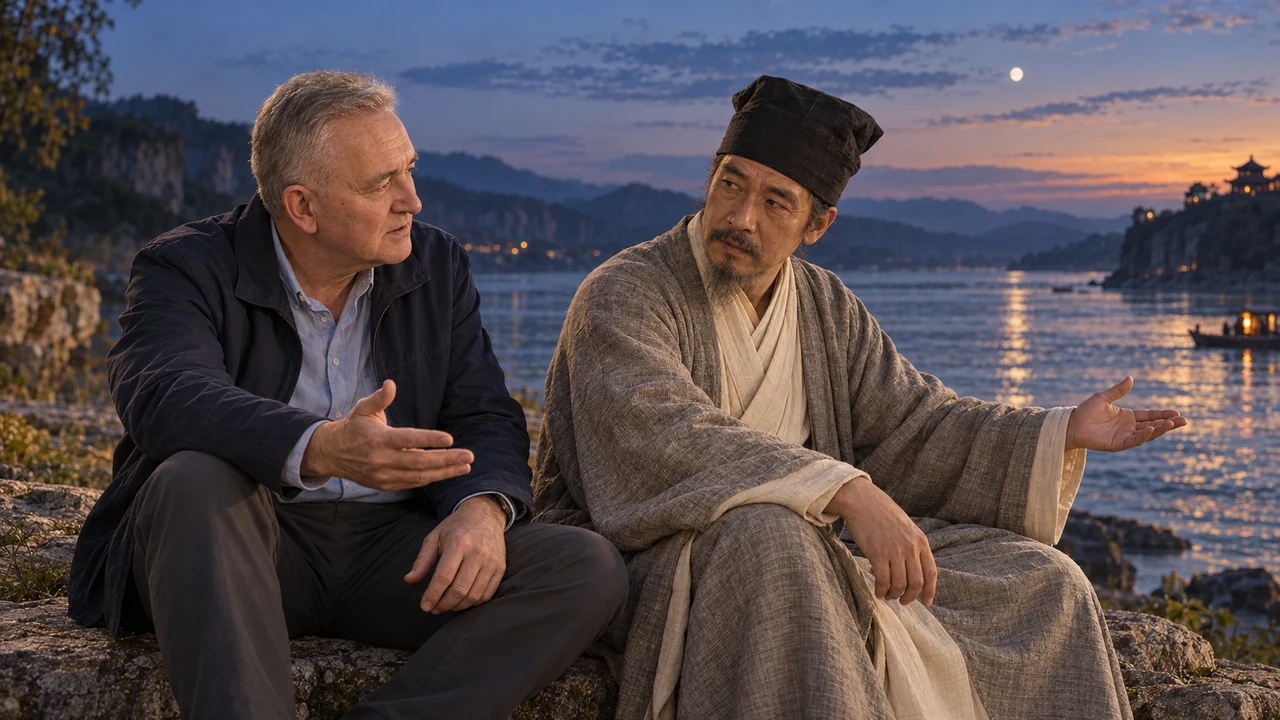
Northern Song poet Su Shi and Oleksandr Bochkala converse beside the moonlit Yangtze (“First Ode on the Red Cliff,” Huangzhou, 1082).
Question 02
Song Dynasty ChinaRead Poem ↗
Yangtze riverbank at Huangzhou (autumn 1082 CE): Su Shi (Su Dongpo) on ever-flowing water and unchanging moon in “Qian Chibi fu” (“First Ode on the Red Cliff”).© Catharsis Groove
Su Shi, First Ode on the Red Cliff

The water has flowed past. The river is still before us.

Which world is real: the one where everything passes, or the one where everything continues?

Su Shi's guest looks at the river and feels the brevity of human life before its endless current. Su Shi answers with the very same river and the very same moon: the water passes away yet is never gone; the moon wanes only to grow full again. Seen from the side of change, nothing stands still for an instant. Seen from the side of permanence, we too participate in the continuity of the world.

“Westwards to Hsia-k‘ou, eastwards to Wu-ch‘ang, where hill and stream in wild luxuriance blend,—was it not there that Ts‘ao Ts‘ao was routed by Chou Yü? Ching-chou was at his feet: he was pushing down stream towards the east. His war-vessels stretched stem to stern for a thousand li: his banners darkened the sky. He poured out a libation as he neared Chiangling; and sitting in the saddle, armed cap-à-pie, he uttered those words did that hero of his age. Yet where is he to-day?”
1100–1600 CERising Voice✦ 3D Tenochtitlan (1500 CE) ↗
Source geography & cultures within this epoch (Eternal Questions):Italy, France, England, Spain & Portugal · Bhakti India (Kabir, Nanak, Mirabai) · Sufi East (Rumi, Hafez, Fuzuli) · Mesoamerica (Tenochtitlan) · China & Korea
All E4 Works →
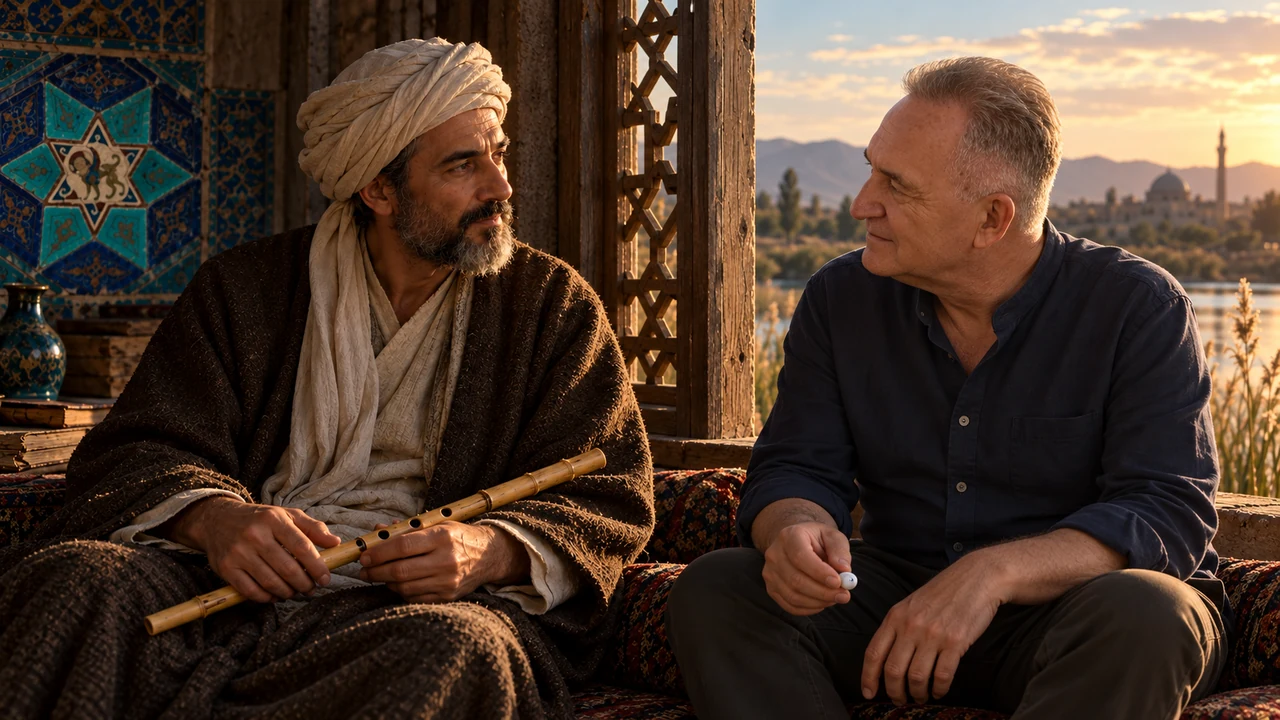
Jalal al-Din Rumi holding a reed flute ney in Konya beside listening Oleksandr Bochkala (Masnavi Book I prologue, 1278 manuscript).
Question 12
Persian PoetryRead Poem ↗
Konya (13th-century Anatolia): Jalal al-Din Rumi holding the severed reed flute (ney) — Masnavi Book I prologue collated from the 1278 Mevlana Museum manuscript.© Catharsis Groove
Rumi · Opening of the 'Masnavi', Song of the Reed

A voice that remembers separation from the whole

How can one be a separate self and still feel belonging to what one was torn from?

Rumi's reed flute sings because it has become an instrument, and laments because it was torn from its reed bed. Its voice carries separation from its source. To hear that speech requires a heart that knows rupture of its own.

Hearken to the reed-flute, how it complains,
Lamenting its banishment from its home:
"Ever since they tore me from my osier bed,
My plaintive notes have moved men and women to tears.
I burst my breast, striving to give vent to sighs,
And to express the pangs of my yearning for my home.
He who abides far away from his home
Is ever longing for the day he shall return."
1600–1850 CECollapse and Romanticism
Source geography & cultures within this epoch (Eternal Questions):England (Metaphysicals & Romanticism) · Spanish & Mexican Baroque · German Classicism & Romanticism · Italy & Poland · Russia · Punjab & Qing China · North America
All E5 Works →
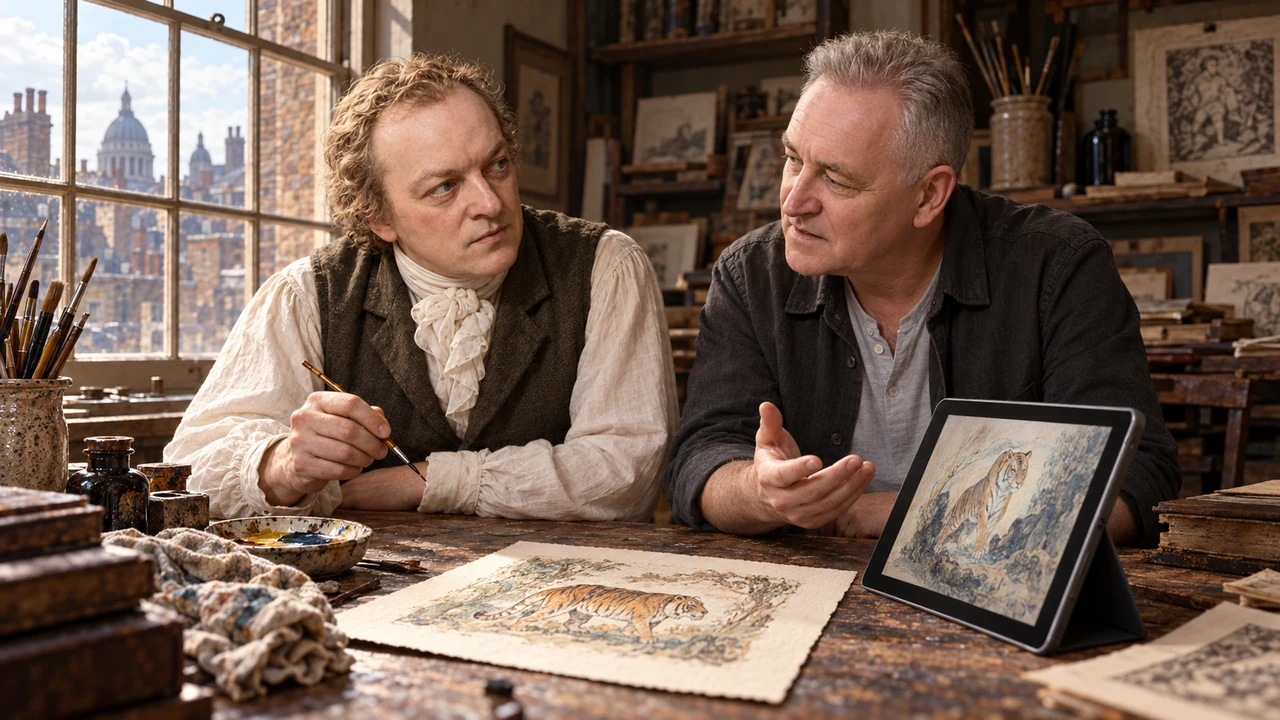
William Blake and Oleksandr Bochkala at a London engraving bench compare illuminated plate 42 of “The Tyger” (1794) and tablet.
Question 01
William Blake’s London workshop (1794): relief-etched hand-colored copperplate print of “The Tyger” (Songs of Experience, plate 42, The William Blake Archive).© Catharsis Groove
William Blake, The Tyger

Standing in awe of what you fear

What kind of world is this, in which beauty and terror may share a single creator?

Blake looks at the tiger and cannot separate its beauty from terror. Images of fire and the forge compel us to picture the labor of shaping a creature whose heart is about to beat. Did the same creator make the gentle Lamb? Could he smile upon seeing the tiger?

Tiger, tiger, burning bright
In the forests of the night,
What immortal hand or eye
Could frame thy fearful symmetry?
1850–1930 CEModern Fracture
TagoreDickinsonAgustiniDunbar
Source geography & cultures within this epoch (Eternal Questions):North America (Amherst, New York) · Symbolist & Modernist France · Germany & Austria · Britain & Ireland · Russian Silver Age · India (Bengal) · Latin America
All E6 Works →
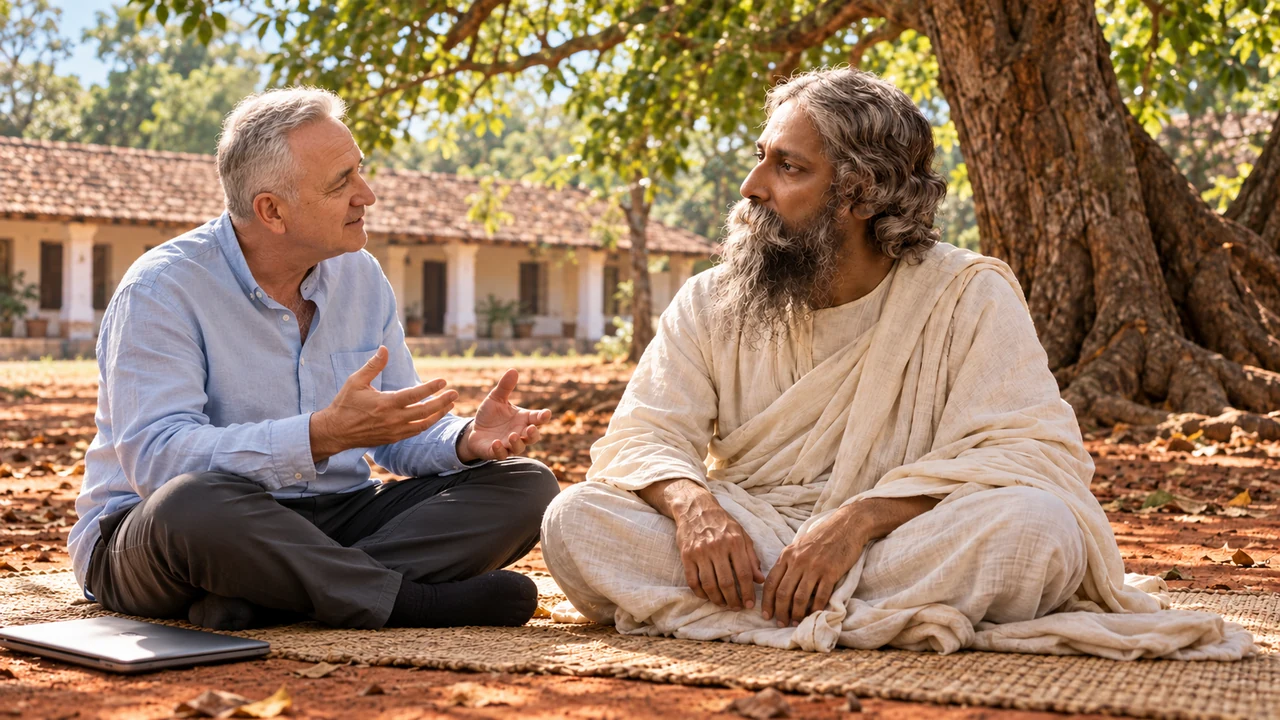
Oleksandr Bochkala converses with Rabindranath Tagore beneath a tree in Santiniketan (Bengali Naivedya 72 and English Gitanjali 35, 1901–1912).
Question 05
Santiniketan (Bengal): Rabindranath Tagore and the dual autographs of “Chitto Jetha Bhoyshunyo” — Bengali Naivedya 72 (1901) and English Gitanjali 35 (1912, Bichitra Variorum).© Catharsis Groove
Rabindranath Tagore · Naivedya 72

A freedom to which we still have to awaken

What makes freedom real within a human being and within shared life?

Tagore prays for an awakening for India—where thought does not live in fear, knowledge is free, and courtyard walls do not shatter the world into fragments. That freedom is threatened by inner barriers as well: dead habit and petty custom can swallow the clear stream of reason and deprive a person of the courage to think and act.

Where the mind is without fear and the head is held high;
Where knowledge is free;
Where the world has not been broken up into fragments by narrow domestic walls;
Where words come out from the depth of truth;
Where tireless striving stretches its arms towards perfection;
Where the clear stream of reason has not lost its way into the dreary desert sand of dead habit;
Where the mind is led forward by thee into ever-widening thought and action—
Into that heaven of freedom, my Father, let my country awake.
Poetry Translations: All Open Invitations to Contact

Explore the complete directory of dialogue scenes with filtering by the 12 Eternal Questions, 6 Epochs, songs, and 3D worlds.

Poetry Translations →
E1 · c. 3000–800 BCE

Mesopotamian Scribe · Old Babylonian Period — A voice held in baked clay

Mesopotamian scribe presenting authentic cuneiform tablet Walters 48.1802 with a temple hymn (c. 1800–1600 BCE) — Catharsis Groove Epoch I
E1 · Mesopotamian Scribe · Old Babylonian Period (c. 3000–800 BCE) — Tablet with Temple Hymn · Walters 48.1802© Catharsis Groove
Tablet with Temple Hymn · Walters 48.1802 — 1:1 authentic museum artifact detail (E1)
AUTHENTIC MUSEUM ARTIFACT (1:1 DETAIL ZOOM)

Tablet with Temple Hymn · Walters 48.1802

Artifact Mystery: In the scribe’s hands is the authentic cuneiform surface of tablet Walters 48.1802 (c. 1800–1600 BCE), where every wedge preserves the hand movement of a person from 3,700 years ago.

Open Museum / Archive Record↗
Mythopoetic Era

How do you speak to a world larger than yourself?

“None comes from there to tell their state… Follow your heart for as long as you live!”

— Epoch I Resonance: Temple Hymn · Harper’s Song · Gilgamesh

The earliest recorded voices of humanity. Love, fear of death, and doubt are pressed into wet clay and papyrus for the first time—contending with gods, the abyss, and time.

Archival Provenance & Attribution Passport

Meeting of times: an artistically reconstructed Mesopotamian scribe holds the authentic photographic face of an Old Babylonian cuneiform tablet bearing a temple hymn (Walters Art Museum, 48.1802, c. 1800–1600 BCE).

Credit: The Walters Art Museum · 48.1802 · CC0 Public Domain

BEHIND THE POEM — A HUMAN BEING

What happens when a poem speaks of two things at once—and neither can be removed?

They were not the same as us. They lived in other cultures, believed in other gods. Understood love, selfhood, freedom, and the order of the world differently. They are gone, yet the words born of their love, fear, desire, or loss are still alive.

A poem already holds its author’s answer. And the most vital meaning often ignites between two Themes—Primary and Secondary—that exist simultaneously and transform each other.

PARADOX 01THEME I × THEME II
Desire to Live×Knowledge of Death

When pyramids crumble into dust and no one returns from beyond the Waters of Death, the ordinary human hour—breath, clean linen, a child’s hand, and shared music—ceases to be trivial and becomes the only sacred reality.

Harper’s Song of King Intef (1950 BCE) · Siduri’s Counsel in Gilgamesh (1800 BCE)
PARADOX 02THEME I × THEME II
Intimacy & Love×Impossibility of Possessing

Sappho remembers departed Anactoria while Su Shi writes from exile under the Huangzhou moon: the very impossibility of possessing another person makes their step and the light of their face outshine all the chariots and empires of the world.

Sappho (Fragment 16) · Su Shi “Former Ode on the Red Cliff”
PARADOX 03THEME I × THEME II
Search for Cosmic Order×Radical Doubt

The Rigvedic hymn asks how the universe began and in its final line admits that perhaps not even the Overseer in highest heaven knows. Doubt does not destroy the sacred—it purifies it of false dogma.

Nasadiya Sukta (Rigveda X.129) · William Blake “The Tyger”
PARADOX 04THEME I × THEME II
Inner Contradiction×Strict Poetic Form

Petrarch’s soul “burns and freezes,” yet the 14 lines of the sonnet or Dickinson’s dash-syntax forge a crystalline lattice capable of holding incompatible truths inside a single utterance.

Francesco Petrarca (Sonnet 134) · Emily Dickinson (J632)
INTERACTIVE TIME BRIDGE · 5 LIVING DIALOGUES

Dialogue Across Millennia: Switch the Voice of the Era

EPOCH I · THEBES, EGYPT (C. 1950 BCE)Singer of King Intef’s Tomb
“I have heard the words of Imhotep and Hardedef, whose sayings are recited whole—yet where are their tombs today? Their walls have crumbled, their places are no more, as though they had never been. None comes from there to tell their state… Follow your heart for as long as you live!”
Artifact:Papyrus Harris 500 · British Museum EA 10060
Δt = 3,976 years
TODAY · DIGITAL PYRAMIDS & THE LIVING HOUR

Nearly four millennia later we build our own pyramids out of career monuments, cloud archives, and social feeds—postponing life for later. Suddenly, out of the crumbled stone of the Middle Kingdom, a human voice dares to say inside a tomb: no monument can replace the warmth of the present day while you still breathe.

MY ANSWER TO THE POET · ONE POEM · TWO ARTISTIC PATHS

How an Ancient Poem Becomes a Song and a Contemporary Visual Story

01 · THE SONG

How does a poem begin to sing?

A poetic text is not yet song lyrics. For it to sing, one must hear the physical breath of the words anew:

✦ Breath
✦ Stress
✦ Pause
✦ Phrase Length
✦ Repetition
✦ Emotional Arc

Sometimes the text barely changes; sometimes it requires a completely new song architecture. Music here never serves as mere background for reciting verse—it becomes part of my personal answer to the person who wrote it.

♫ Song Premiere · Ṛgveda 10.135 (“Manoratha”)Epoch E1 · Question 11

“Manoratha: Chariot of Sorrow and Love” — Vedic Sanskrit sound reconstruction (ORIG · 3:08), original song inspired by the hymn in Russian (4:10) & English (4:00) vocal versions, modern translation, and meaning explained

From Philology to Song Prosody
02 · THE VISUAL PLOT

What if we refuse to illustrate the poem literally?

Literal illustration is only one way of working with poetry. For Catharsis Groove, I chose a different path:

  1. Extract the Primary and Secondary Themes of the original poem.
  2. Find two contemporary human situations where those Themes are immediately recognizable without needing ancient footnotes.
  3. Collide them inside a single visual narrative so the poet’s original paradox ignites anew.

“That is why the sea in an ancient poem does not have to become a sea in the film. What matters is understanding why the poet needed it.”

Collision of Two Contemporary PlotsStages of the Project ↓
03 · STAGES OF PROJECT REALIZATIONETERNAL QUESTIONS × HISTORICAL EPOCHS · INVITATIONS TO CONTACT

From the Project’s Poetic Library to Personal Encounters and Songs

For all Eternal Human Questions across all six historical epochs, texts are already selected in the project’s poetic library, linked to source geography and the diverse cultures within each epoch. Ongoing work unfolds through the author’s personal encounters with these works—invitations to living contact.

Open Poetry Translations Directory →
STAGE I · POETIC LIBRARYHistorical Epochs · Eternal Questions

Selected Voices Across Historical Epochs

Works across all six historical epochs are already gathered and linked to the Eternal Human Questions—from Sumerian cuneiform, Egyptian papyri, and Vedic Sanskrit to Classical lyrics, the East, the Renaissance, Baroque, and Modernism. This living library evolves as new academic source studies emerge.

Source Geography & CulturesTo Eternal Questions ↑
STAGE II · POETRY TRANSLATIONS25 Works · 5 3D Worlds

Modern Translations, Meanings & 3D Worlds

Each work from the library undergoes a deep reading: original text verification, zero-familiarity realia notes, contemporary poetic translations (RU / EN), reflection on the human paradox, and 3D reconstruction of the historical space.

Open Dialogues on the SitePoetry Translations →
♫ STAGE III · SONGS & VISUALSORIG · RU · EN

Musical and Visual Birth

From an open encounter emerge three vocal audio versions (original-language sound reconstruction ORIG, Russian song RU, and independent English song EN) alongside a contemporary visual story. The first full premiere is already live—“Ṛgveda X.135 · Manoratha”—with new songs and thematic releases following as they are completed.

RV 10.135 Premiere ↗
THE AUTHOR’S WORKSHOP · META-RENAISSANCE

Man Is the Measure of All Things

Today, artificial intelligence has entered this conversation — not as an author. It is an instrument and digital medium, an apprentice and partner, a student and teacher. It can be obedient clay or unyielding marble, resisting the design and suggesting unexpected forms.

In my journey, the 21st century is the era of the Meta-Renaissance. Every author today, like a Renaissance master, can assemble a crew of digital apprentices. Not to imitate someone else’s voice, but, as ever, to express and preserve a personal “I.”

DIGITAL WORKSHOP CREW

7 Roles of AI in the Project

Meta-Renaissance
01 · Material
Raw sonic, textual, and visual plasticity awaiting human shaping.
02 · Instrument
Precision actuator for technical operations in sound, code, and image.
03 · Performer
Voice, ensemble, or camera crew performing the author’s score.
04 · Partner
Interlocutor proposing unexpected bridges across epochs and plots.
05 · Source of Knowledge
Navigator through ancient tongues, literal glosses, meter, and museum archives.
06 · Apprentice
A network of specialized agents trained on the project’s canons and boundaries.
07 · Teacher
A medium from which the author learns new ways to work with sound, vision, or code.
THE AUTHORSHIP QUESTION · FROM FOUNTAIN (1917) TO AI

Who asked the question? Who chose? Who answers for the statement?

In 1917, Marcel Duchamp presented Fountain—a factory-made porcelain urinal signed R. Mutt. Duchamp did not fashion the object with his own hands. His artistic act lay elsewhere: in choosing, moving the object into a new context, naming it, and posing a question.

Artificial intelligence can make any “urinal” in any style. Generation can replace craft, but it is not equal to creation.

Posing the QuestionShifting ContextChoiceRejecting AlternativesDesigning CollisionsAttending to ChanceResponsibility
THE EXISTENTIAL MEASURE OF A HUMAN BEING

AI does not grow old. Does not bear children. Does not lose those it loves.

It does not wake with a memory that alters the entire day. Does not carry lived years within a body. It cannot love what it is bound to lose. Create what it may never live to see completed. Search for meaning while knowing there is no answer.

A human being enters creation with an entire life—with body and memory, love and fear, and the awareness of one’s own finitude, when time is running out. And all of this is the human measure.

POETRY ANALYSIS, ANCIENT POEM TRANSLATIONS & SONGS ON POEMS · BLOG & STORIES

Poetry Analysis, Ancient Poem Translations & AI Music Creation

Two connected article series: philological analysis and modern translations of ancient works (Rigveda 10.135, The Harper’s Song, Gilgamesh & Siduri) and hands-on AI music production in dead languages using Suno, local YuE2 Studio, and REAPER.

What the Vedas Say About Death: Rigveda 10.135 (Modern Translation, Realia & Meaning)VEDIC INDIA · RIGVEDA 10.135 · TRANSLATION & MEANING
«What do the Vedas say about death—and how do you survive a father’s death upon a chariot built solely by thought and love?»

What the Vedas Say About Death: Rigveda 10.135 (Modern Translation, Realia & Meaning)

From a child’s resentment at a father’s departure to the wheelless chariot of the mind (manoratha) carried aloft by the Sāman melody-boat: academic text verification, modern translation, and song premiere.

2026-10-31Read Story →
Catharsis Groove Audio Player Disc
Epoch I · RV 10.135
Manoratha: Chariot of Sorrow and Love (Rigveda X.135 — Yama and the Boy)
0:004:00